
History of the Canadian space program — 1962 to 1999

This neat timeline showcases every crucial milestone and flagship event in Canada's space endeavour since its beginnings. You can find more information about Canadian space milestones on our milestones webpage.
Explore the crucial role Canada has played and is still playing in global space exploration.
Alouette-I
The launch of Alouette I made Canada one of the first countries to put a satellite into orbit. Only the USSR and the USA reached space before Canada. Alouette-I launched in after three and a half years of design and building. At a time when satellites were expected to last only a few months, Alouette-I transmitted data for over 10 years, outlasting any other satellite of its era!
A first for Canada

This 35-mm roll of film contains the first-ever Canadian scientific data measured in space. The Alouette-I satellite used radio signals to take measurements of the ionosphere, and these ionograms were converted into photographic images recorded on film. Curious about this data? Learn more about it, and even how to access it, on the page Alouette-I: saving its data… 60 years later!
John H. Chapman
John Herbert Chapman's life and work are integral to Canada's place in space.
From helming the development of the historic Alouette-I satellite to his seminal "Chapman report," in which he proposed guidelines for the future of Canada's space program, Chapman's legacy is profound and concrete. The Canadian space program and the Canadian Space Agency (CSA) are the realization of his life's work, and for those reasons, this building now bears his name.
Black Brant 9 rocket

The rocket that proudly stands outside the CSA headquarters is a Black Brant 9. The Canadian-designed Black Brant line of sounding rockets, first launched in , was key in the development of Canada's space program.
The Black Brant 9 rocket takes its name from a species of goose that nests along the Arctic coast.
Aurora borealis
In , as part of the International Satellites for Ionospheric Studies (ISIS) program, the ISIS I satellite provides the world with the first-ever images of aurora borealis, or northern lights, recorded from outer space.
The first "prints" on the Moon are Canadian

That's right: the first human footprints belong to the American astronaut Neil Armstrong and date back to Apollo 11 in , but the landing gear of the Apollo lunar module was made right here in Longueuil, Quebec.
Telesat
sees the creation of Telesat, a company tasked by Parliament with building and operating Canadian communications satellites.

Spacecraft craft
In , Canada launches a world-class laboratory for the integration and testing of spacecraft. The David Florida Laboratory was so named in honour of the manager of the ISIS satellite program.
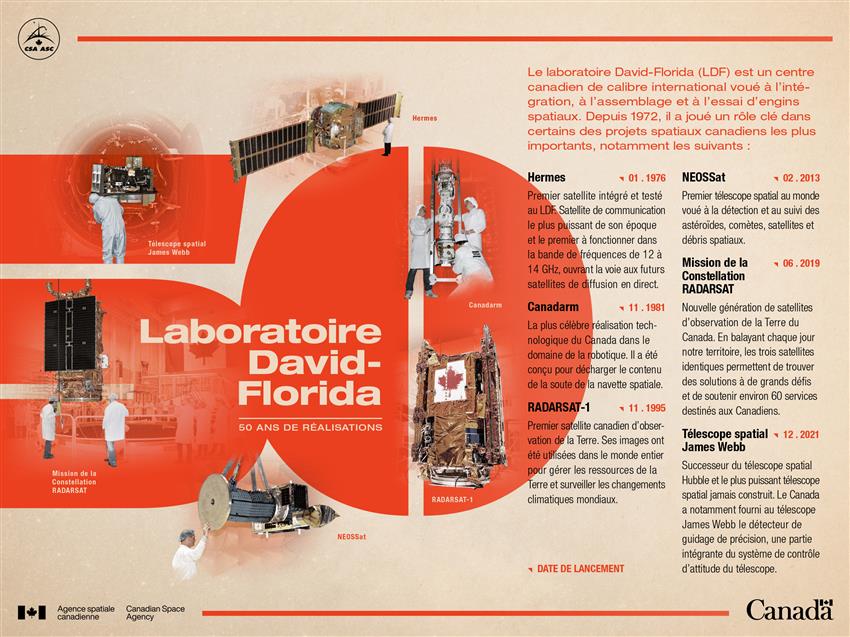
The David Florida Laboratory opened its doors in , the 10th anniversary of the launch of Alouette. It is named in honour of one of Canada's pioneers in space research, C. David Florida. This infographic showcases five important space endeavours. (Credit: CSA)
Canada is #1
. When Anik A1 goes into orbit, Canada becomes the first nation to put a domestic communications satellite in space. It brought live television broadcasts and reliable long-distance telephone services to remote Canadian communities for the first time.
An international affair
In , Canada joins efforts with the European Space Agency (ESA). To this day, Canada is still the only non-European cooperating member state.
Two thumbs up for Canadarm
The year is . Canada's most iconic contribution to space exploration is about to launch into space aboard Space Shuttle Columbia. Over the ensuing years, a total of five Canadarms are built, and these robotic arms go on to support space shuttle missions for 30 years!
First Canadian astronaut corps
Six exceptional people formed the first-ever Canadian astronaut corps: Ken Money, Marc Garneau, Steve MacLean, Bjarni Tryggvason, Robert Thirsk, and Roberta Bondar. Read more about their recruitment in at History of the Canadian astronaut corps.

The Canadian astronauts selected in . Back row, from left to right: Ken Money, Marc Garneau, Steve MacLean and Bjarni Tryggvason. Front row: Robert Thirsk and Roberta Bondar. (Credit: CSA)
Marc Garneau
Selected from the six original members of Canada's astronaut corps, military engineer Marc Garneau is the first Canadian to fly to space in .

Launch of Space Shuttle Challenger for mission STS-41G. (Credit: NASA)
Canada's seat at the ISS
Canada joins the International Space Station (ISS) program in . This international partnership would mark the start, in , of over two decades of groundbreaking scientific research in space.
The ISS's first module was sent into orbit in , and the Station takes 90 minutes to complete one full orbit around Earth.
The CSA is born
After over 25 years of activity in space, Canada finally gets its own space agency in .
Headquarters Model
This model of CSA headquarters shows its modular design. Far from being a fanciful choice, this design has the ability to add sections (or modules) to it, much like the ISS.
A fine "throw"
In , Canadarm deploys the famous Hubble Telescope from Space Shuttle Discovery.

The Canadarm grapples the Hubble Space Telescope from the payload bay of Space Shuttle Discovery to place it into orbit. (Credit: NASA)
Roberta Bondar
In , Roberta Bondar takes part in NASA's Discovery Mission STS-42, studying the effects of weightlessness on the human body. She is the first Canadian woman to go to space.
Four Canadian astronauts join the corps
In , four new Canadian astronauts are recruited: Mike McKay, Chris Hadfield, Julie Payette, and Dave Williams.

The four Canadian recruits in . Back row, from left to right: Chris Hadfield, Dave Williams. Front row: Michael McKay, Julie Payette. (Credit: NASA.)
Steve MacLean
The year is a busy one. After Roberta Bondar goes on Mission STS-42, astronaut Steve MacLean conducts seven experiments aboard Mission STS-52.
New home
. Three years after its inception, the CSA gets its headquarters. When employees began to work here that year, parts of the building were still under construction!
Headquarters model

This model of CSA headquarters shows its modular design. Far from being a fanciful choice, this design has the ability to add sections (or modules) to it, much like the ISS.

RADARSAT-1
In , Canada launches its first Earth observation satellite. It's equipped with a powerful radar instrument that captures image data of Earth, day and night, and in all weather conditions.
Chris Hadfield's 1st mission
In , Chris Hadfield becomes the first Canadian to board the Russian Mir station during Mission STS-74. He is also the first Canadian to operate Canadarm in space.
Marc Garneau's 2nd flight
In , Marc Garneau goes into space once more during Mission STS-77. On the ground, fellow Canadian Chris Hadfield provides communications in Mission Control.
Bob Thirsk's 1st mission
In , Robert Thirsk achieves the longest mission by a Canadian astronaut yet. During Mission STS-78, he works intensively on the Life and Microgravity Spacelab Mission.
Bjarni Tryggvason's 1st mission
In , meteorologist, researcher, and astronaut Bjarni Tryggvason, who also studied engineering, goes into orbit aboard Mission STS-85, where he tests the Microgravity Isolation Mount, a Canadian technology he helped develop.

An ice image
In , Canada's RADARSAT-1 satellite provides the first complete, high-resolution satellite image map of Antarctica.
Making crystals grow
The Canadian Protein Crystallization Experiment (CAPE), the most important set of space protein crystal growth experiments that Canada has ever performed, are transferred aboard the Space Shuttle Atlantis flight, and onto the Mir space station.
Canada's very own space doctor
During the STS-90 Neurolab mission, Dave Williams becomes the first non-American astronaut to serve as official crew physician on a space shuttle mission.
The John Glenn—Canada connection
In , 77-year-old veteran astronaut John Glenn returns to space, performing two Canadian experiments on bone cells (OSTEO) and cancerous cells.
Pioneering like it's
It's indeed , and Julie Payette is part of Mission STS-96. Its crew made history as the first to ever board the International Space Station.
Tracking pollution
Canada's environmental commitment is on full display via an instrument, MOPITT, which is integrated into NASA's Terra satellite, launched in , and which measures carbon monoxide concentrations in Earth's atmosphere.