
History of the Canadian space program — 2000 to 2009

Strength in numbers
In , the Canadian Space Agency (CSA) joins forces with the European Space Agency (ESA) and France's space agency, the Centre national d'études spatiales (CNES) to form the International Charter "Space and Major Disasters." This charter has since evolved into a worldwide collaboration for disaster response.
3rd time's a record
. Marc Garneau goes to space for a third time as a crewmember of Mission STS-97. At the time, this trio of space flights marks a record for a Canadian astronaut.
OSIRIS on Odin
In , Canadian environmental instrument OSIRIS is launched aboard Swedish satellite Odin. OSIRIS monitors the ozone layer from space. Epic!
Another first for Canada
In , Canada leads its first experiment on the ISS, known as H-Reflex, which studies the effects of microgravity on the spinal cord's ability to transmit signals to the brain.
Special delivery
Canadarm2 is delivered to the International Space Station (ISS) in . This robotic arm quickly becomes a critical component in the construction, maintenance, and operation of the Space Station.
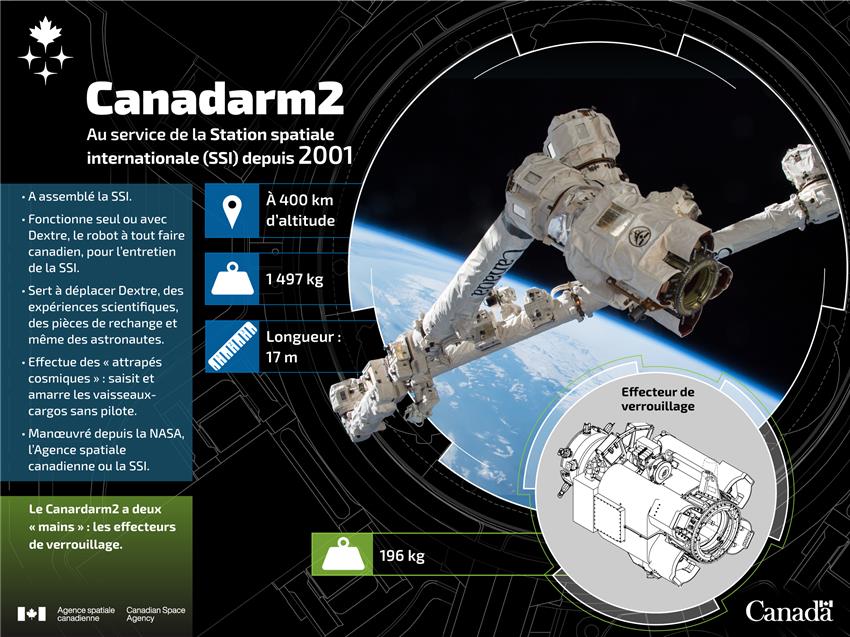
Infographic showing an illustration of Canadarm2's Latching End Effector. (Credit: CSA)
Out and about
. On his second mission, Chris Hadfield goes out into the wide-open space of… well, space, to attach Canadarm2 to the ISS, becoming the first Canadian to go on a spacewalk.
NEEMO 1
Dave Williams joins the crew of NEEMO 1 in for a one-week stay inside Aquarius, the world's only undersea laboratory. Far beneath the waves off the coast of Florida, this laboratory simulates a space exploration environment, as NEEMO crewmembers contend with some of the same tasks and challenges underwater as they would in space. Canada collaborates in a number of future NEEMO missions.
Beware of rays
In , the EVARM experiment is deployed to measure how much radiation astronauts are exposed to during spacewalks.
Mobile Base System
In , Canada launches the Mobile Base System, a platform that helps move equipment outside the ISS.

Small is best
In , Canada launches MOST, a tiny space telescope capable of measuring the age of stars in our galaxy, as well as the satellite SCISAT, intended to help scientists understand changes in the ozone layer, particularly over Canada and the Arctic. It is capable of measuring over 70 different atmospheric trace gases.
Honouring our astronauts
In , Canada Post honoured the eight Canadian astronauts who had been to space so far by issuing this set of stamps.

In , Canada Post honoured the eight Canadian astronauts who had been to space so far by issuing this set of stamps. The astronauts are Marc Garneau, Roberta Bondar, Steve MacLean, Chris Hadfield, Robert Thirsk, Bjarni Tryggvason, Dave Williams, and Julie Payette. (Credit: Canada Post)
Tomatosphere
Since , tomato seeds that were exposed to space or space-like conditions have been provided to millions of students across Canada and the United States. This offers students an excellent opportunity to think and act like scientists as they make observations about these seeds vs. control seeds!
Steve MacLean: first and second
On his second cosmic outing in , Steve MacLean becomes the first Canadian to control Canadarm2, and the second one to go on a spacewalk.

On Flight Day 5, Steve MacLean performs his very first spacewalk and takes a break to wave to the camera. (Credit: NASA)
Out and about in space
In , Dave Williams spends nearly 18 hours in total outside the ISS during Mission STS-118, setting an impressive Canadian record.

RADARSAT-2
Launched in , this Canadian satellite marks another step for Earth observation satellites, supporting environmental monitoring and disaster management efforts, among other applications.
Two arms are better than one
marks the debut of the two-armed Dextre, the most sophisticated space robot ever built. This versatile robot can tackle a variety of jobs outside the Space Station with minute precision, freeing up astronauts' time to focus on science.
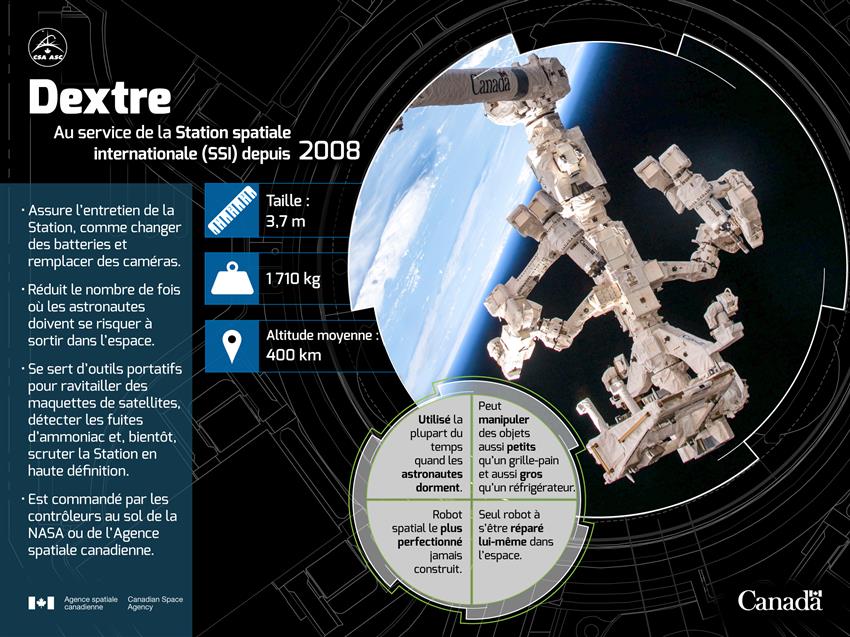
Quick facts on Dextre, the ISS's versatile robot. (Credit: CSA)
Canada, snow and Mars
In , the Phoenix Mars Lander carries Canada's meteorological station and lidar instrument to Mars, where they detect snow crystals in the Martian atmosphere. This marks the first time Canadian technology has landed on the surface of another planet.
A new (maple) leaf
In , the CSA selects its two new astronaut recruits, Jeremy Hansen and David Saint-Jacques.

A fab collab
The CSA continues its collaboration with ESA with the launch of the Herschel Space Observatory and the Planck Space Telescope in .
Extended expedition
As part of Expedition 20/21, launched in , Robert Thirsk spends six months aboard the ISS, on his second mission.
A neat meet and greet
In , Julie Payette revisits space. Mission STS-127 is a "handful" for her, as she is tasked with controlling three robotic arms — our Canadarm and Canadarm2, as well as the Japanese Experiment Module Remote Manipulator System (JEMRMS).
While in space, Julie Payette meets up with fellow Canadian Robert Thirsk, who boarded the ISS only two months earlier.

Julie Payette, STS-127 mission specialist, and Robert Thirsk, Expedition 20 flight engineer, pose for a photo in the Destiny laboratory of the ISS. (Credit: NASA)
The funny thing about space
In , Cirque du Soleil cofounder Guy Laliberté visits the ISS, becoming Canada's first private space explorer.

Guy Laliberté (left) poses for a photo with Robert Thirsk. (Credit: NASA)
Trees and gravity
Among his many roles aboard the ISS, Robert Thirsk conducts the APEX-Cambium study, on the role of gravity in the formation of wood.