The crew of Artemis II (left to right): NASA astronauts Victor Glover and Reid Wiseman, Canadian Space Agency (CSA) astronaut Jeremy Hansen, and NASA astronaut Christina Koch. (Credit: NASA)
In preparation for their nearly 10 days in space, the Artemis II crew officially started training in . All astronauts receive basic training and, once assigned to a flight, they go through mission-specific training. Until recently, the destination for those missions was the International Space Station (ISS). We now have a new destination: the Moon!
But how do you train for a mission around the Moon? The training covers everything for the crew to be successful on their journey to the Moon and back. Since it will be the very first time a crew trains for an Artemis mission, Jeremy and his crewmates, including the backup astronauts, will be essential in helping shape the training requirements for future flights.
Destination Moon, with Jeremy Hansen: An Artemis II vlog series
Watch the Destination Moon vlog series to learn more about Jeremy Hansen's training and preparation for the Artemis II mission.
The training in a nutshell
When it started:
Where it happens:
Primary location – NASA's Johnson Space Center, Houston, Texas: Orion simulator, mock-up of the crew module, rocket and spacecraft hardware
Secondary location – NASA's Kennedy Space Center, Cape Canaveral, Florida: rocket and spacecraft hardware integration, and launch pad and countdown operations
Other locations based on the type of training
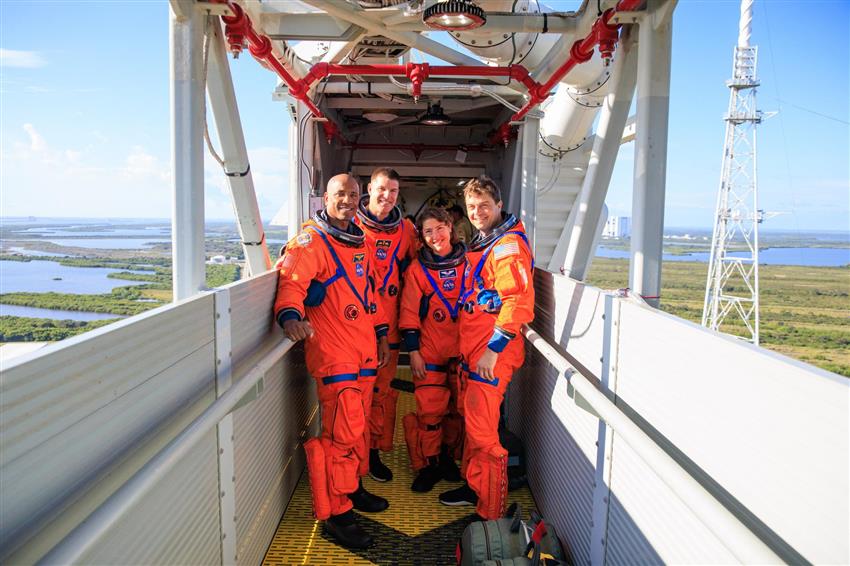
CSA Jeremy Hansen, second left, and his Artemis II crewmates, NASA astronauts Victor Glover, Christina Koch and Reid Wiseman, successfully completed the first in a series of integrated ground system tests in preparation for the mission around the Moon. They stand on the crew access arm of the mobile launcher at Launch Pad 39B, where they will be launching from. (Credit: NASA)
Learning to fly Orion and SLS (Space Launch System)
Artemis II was the first time that humans rode the new rocket system composed of the Orion spacecraft and the SLS, one of the most powerful rockets in the world. The crew received detailed lessons on Orion's crew displays, vehicle controls and audio system. They learned to operate and monitor systems of the spacecraft and rocket for every phase of the mission: from launch and flying to the Moon, to re-entering Earth's atmosphere and splashdown. Here's a summary of what the crew trained for:
familiarization with the mobile launcher and emergency pad egress operations
major milestones leading up to and during launch, as well as the first few hours in orbit
abort scenarios during the ride to space
rendezvous and proximity operations
Ok
CSA astronaut Jeremy Hansen explains how Orion id piloted, at times through automation and at other times manually by the crew. They use Earth tracking, star-based navigation, and hand controllers to ensure precise manoeuvres, safe docking, and mission success. (Credits: CSA, NASA, Fulwell 73 UK Limited)
CSA astronaut Jenni Gibbons participates in an emergency simulation in Florida. Jenni assisted as Astronaut Support Personnel, conducting final preparations, and reviewing launch day procedures. She also tested the emergency egress system that utilizes gondola-sized baskets to transport the crew safely away from the launch pad in the event of an evacuation. (Credit: NASA/Kim Shiflett)
Flying to the Moon
high Earth orbit vehicle testing to better understand Orion's manual piloting qualities and reduce risks for future Artemis missions
execution of translunar injection and other burns to manoeuvre the spacecraft
flying on a lunar trajectory
solar array operations to provide power to the vehicle
troubleshooting communications issues
CSA astronaut Jenni Gibbons takes part in an ascent (or launch) run in the Orion simulator. (Credit: NASA/Bill Stafford)
familiarization with different post-splashdown scenarios they could face as they await recovery on the ocean surface
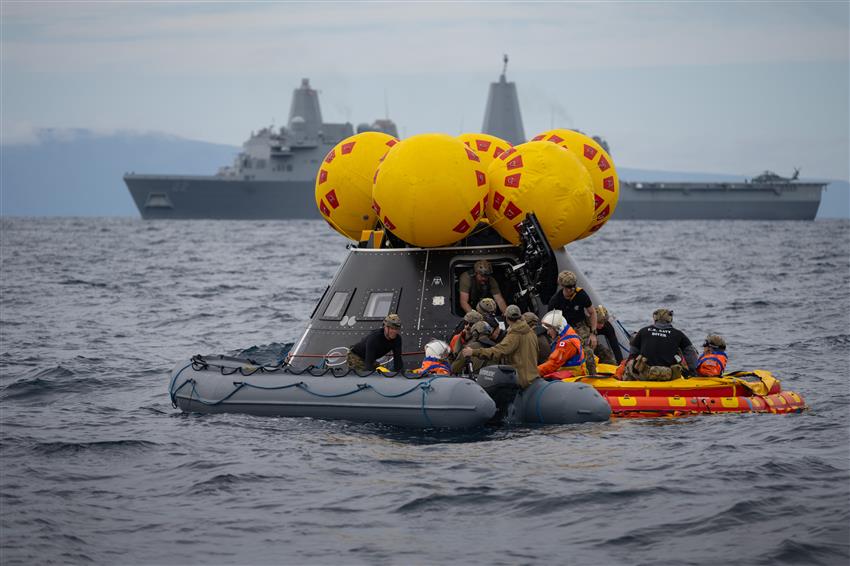
The Artemis II crew, including CSA astronaut Jeremy Hansen and his backup Jenni Gibbons, takes part in a recovery test off the coast of San Diego. This test, conducted by the U.S. Navy and NASA, was to rehearse the safe recovery of the crew and the Orion capsule after their splashdown in the Pacific Ocean. (Credit: NASA/Ken Allen)
CSA astronaut Jeremy Hansen and his Artemis II crewmates took part in the Post Insertion and Deorbit Operations training inside the Orion mockup at NASA's Johnson Space Center in Houston. The crew practiced getting the Orion spacecraft configured once in orbit, how to make it habitable, and suited up in their entry pressure suits to prepare for their return from the Moon. (Credit: NASA/Mark Sowa)
operate the various life support systems and habitation equipment
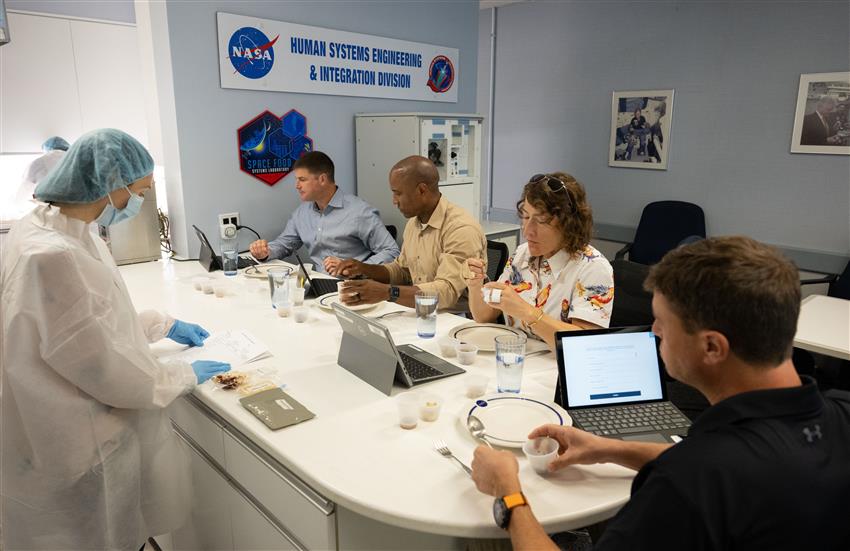
The Artemis II crew took part in a food tasting session at NASA's food lab at the Johnson Space Center. They tasted and rated a selection of meals and snacks ahead of their trip to the Moon. (Credit: NASA)
Dealing with emergencies
All space missions are risky. Lessons learned are collected after every flight to make the next ones safer and more efficient. The risks are mitigated as much as possible thanks to extensive testing of equipment and procedures on Earth and in space (think Artemis I) as well as training and preparation of both the crew and ground teams. The crew needs to train for any eventuality, learn to troubleshoot various issues that may arise, and respond to different types of emergencies and off-nominal (or abnormal, in non-space terms) scenarios such as:
medical emergencies and wound care
water survival
emergency egress
communications issues
Ok
Have you ever wondered what happens if an astronaut gets sick in space? If they badly cut themselves? If they get a tooth ache? CSA astronaut Jeremy Hansen talks about the training astronauts receive to deal with medical emergencies, bumps and bruises in space. (Credits: CSA, NASA, Fulwell 73 UK Limited)
While Orion will not be a fancy lab like the ISS, there were still opportunities for the crew to conduct science experiments. The astronauts also used wearable devices to monitor their health and measure radiation levels on Orion.
Planet Earth's magnetic field protects us and astronauts aboard the ISS from a lot of space radiation. Radiation levels are a bit higher on the ISS than on Earth, but much higher outside of the magnetic field, where the crew of Artemis II flew. Extensive testing was required to keep them and future Moon travellers safe.
Geology training
Being the "test crew," Jeremy, Reid, Victor and Christina are helping test procedures and define the training flow not only for their mission, but also for future Artemis missions. When they flew past the Moon, they made some observation and took photos, so having good knowledge of lunar geology helped them identify specific features of scientific interest.
In , the Artemis II crewmembers participated in lunar science fundamentals training in the Lunar Sample Laboratory Facilities (aka the Lunar Lab) at NASA's Johnson Space Center. This is where geological samples returned from the Moon by the Apollo lunar surface exploration missions (–) are preserved and studied. The crew talked to the scientists about taking photos of parts of the lunar surface that the Apollo astronauts never saw.
Four months later, Jeremy, Jenni and Christina took part in field geology training with Dr. Gordon Osinski and a team from Western University's Institute for Earth and Space Exploration. The expedition took place at Mistastin Lake, which covers part of a crater in Labrador formed by a meteorite impact millions of years ago. This was not Jeremy's first time taking part in this kind of expedition, but it was his first time to a crater known to have rocks similar to those found on the Moon.
In , the entire prime and backup crew travelled to Iceland to practice geologic fieldwork in a unique Moon-like topography. They also refined spacewalking techniques, tested geological tools and navigated lunar-like landscapes in low-angle lighting similar to conditions that astronauts on the Moon will experience.
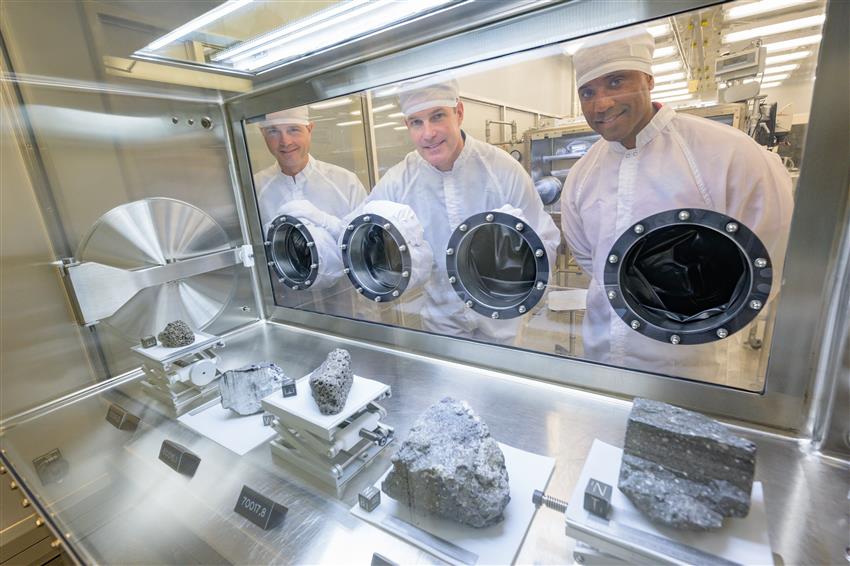
Three astronauts wearing clean room suits are seen through the glass of a vault containing lunar rock samples. Left to right: NASA astronaut Reid Wiseman, CSA astronaut Jeremy Hansen, and NASA astronaut Victor Glover, with lunar rock samples during a geology course at NASA's Johnson Space Center in Houston, Texas, on . (Credit: NASA/Robert Markowitz)
CSA astronauts Jeremy Hansen and Jenni Gibbons listen to Dr. Gordon Osinski from Western University's Institute for Earth and Space Exploration. A renowned geologist, Dr. Osinski led this geology field training. (Credit: CSA)
Ok
CSA astronauts Jeremy Hansen and Jenni Gibbons, along with NASA astronauts Christina Koch and Raja Chari, spent a week exploring Kamestastin (also called Mistastin), a remote meteorite impact crater in northern Labrador, for planetary science and lunar geology training. (Credits: CSA, NASA, European Union – Copernicus Program, contains modified Sentinel-2 data processed by Sentinel-Hub, Fulwell 73 UK Limited)
The adventure continues for CSA astronauts Jeremy Hansen and Jenni Gibbons, along with NASA astronauts Christina Koch and Raja Chari in this second vlog on their lunar geology training expedition in Kamestastin. (Credits: CSA, NASA, Fulwell 73 UK Limited)