
The Space Launch System rocket and the Orion spacecraft
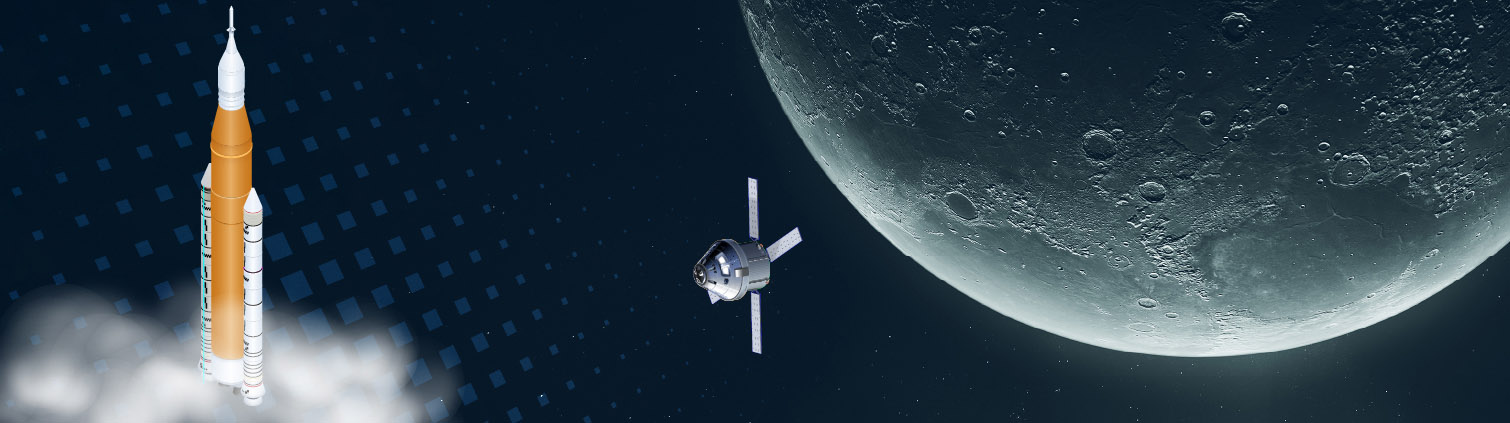
The Space Launch System (SLS) rocket and the Orion spacecraft are humanity's ticket back to the Moon. The powerful duo proved themselves during the uncrewed Artemis I test flight, and in April they teamed up to send a crew around the Moon during Artemis II.
The SLS
NASA's SLS is a rocket designed to help return humans to the Moon, establish a long-term presence there, and set the stage for human exploration of Mars. It is among the most powerful rockets in the world.
No other rocket can send astronauts and the Orion spacecraft directly to the Moon in a single mission. SLS uses a core stage and four RS-25 engines. The core stage holds over 2.7 million litres of liquid hydrogen and liquid oxygen. Two solid rocket boosters also provide more than 75 percent of the vehicle's thrust during the first two minutes of flight.

On , NASA's SLS rocket carrying the Orion spacecraft launched on the Artemis I flight test from NASA's Kennedy Space Center in Florida. (Credit: NASA/Joel Kowsky)
Jeremy Hansen shares his excitement live from the Vehicle Assembly Building at NASA's Kennedy Space Center in Florida. (Credits: Canadian Space Agency [CSA], NASA)
Transcript of the video entitled Jeremy Hansen excited to see the Artemis II rocket taking shape
During each lunar mission, the SLS will launch the crew in Orion to space and help set them on course to venture to the Moon. To do this, the SLS must have enough power to perform a manoeuvre known as a trans-lunar injection. This manoeuvre accelerates the spacecraft from its orbit around Earth onto a trajectory toward the Moon. During Artemis II, Orion's European Service Module provided this massive push! The ability to send more mass to the Moon on a single mission makes exploration simpler and safer.
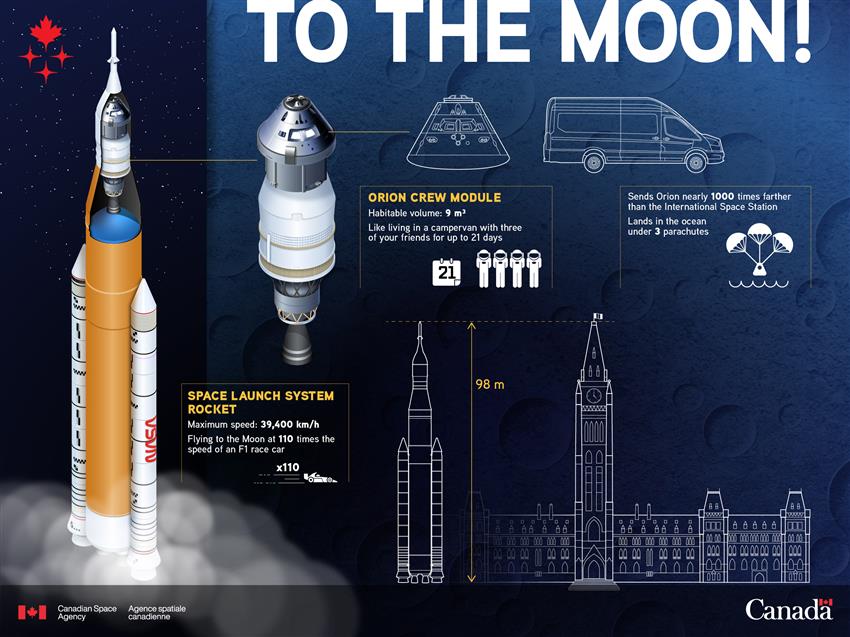
Orion is an exploration vehicle that will carry Artemis crews to space. It is designed to be launched by NASA's SLS rocket, one of the most powerful rockets in the world. (Credit: CSA)
From Florida to California via… the Moon! In their campervan-size Orion capsule atop the SLS rocket, CSA astronaut Jeremy Hansen and his Artemis II crewmates launched from Florida. Watch this vlog to hear Jeremy explain the Artemis II trajectory. (Credits: CSA, NASA, Fulwell 73 UK Limited)
Transcript of the video entitled Vlog 14: Over 1,000,000 kilometres in nearly 10 days
The Orion spacecraft
The Orion spacecraft is composed of three main elements:
- The Crew module, the habitable portion of the spacecraft where crews live and work on their journey to the Moon and back; it is able to withstand the intense physical forces and heat during re-entry into Earth's atmosphere
- The Service module, provided by the European Space Agency, which equips Orion with power, propulsion, thermal control, air, and water
- The Launch Abort System, which is designed to quickly activate and pull Orion to safety, away from the SLS rocket, in case of issues during launch
In this vlog, CSA astronaut Jeremy Hansen explains how Orion is piloted, at times through automation and at other times manually by the Artemis II crew. They used Earth tracking, star-based navigation, and hand controllers to ensure precise manoeuvres, safe docking, and mission success. (Credits: CSA, NASA, Fulwell 73 UK Limited)
Transcript of the video Vlog 26 - How the Artemis II crew will steer the Orion capsule
Guidance and navigation
On board Orion, an advanced guidance, navigation, and control system uses an array of sensors to calculate the spacecraft's position in space. Some of these sensors are:
- Star trackers, sensitive cameras which take images of the star field around Orion
- Optical navigation cameras, which take images of Earth and the Moon to keep Orion on course
- Sun sensors, located on the European Service Module, which ensure Orion keeps its solar panels pointed in the correct direction

Both Earth and the Moon are visible in this image that Orion captured as the spacecraft reached its maximum distance from Earth on day 13 of the Artemis I mission. (Credit: NASA)

CSA astronaut Jeremy Hansen and his Artemis II crewmates took part in the Post Insertion and Deorbit Operations training inside the Orion mockup at NASA's Johnson Space Center in Houston.
The crew practiced getting the Orion spacecraft configured once in orbit, how to make it habitable, and suited up in their entry pressure suits to prepare for their return from the Moon. (Credit: NASA/Mark Sowa)