
History of the Canadian space program — 2010 to 2020

AuroraMAX
In , the Canadian Space Agency (CSA) partners with the University of Calgary to launch AuroraMAX, a Canadian aurora observatory that offers, among other things, a live feed of aurora borealis in Yellowknife.
The Northern Lights in this high-definition video were captured on the night of -, by the AuroraMAX observatory near Yellowknife, Northwest Territories. (Credits: CSA, University of Calgary, Astronomy North)
A final flight
The final flight of Space Shuttle Atlantis takes place, marking the end of the Space Shuttle program as well as Canadarm's 90th and final mission.
Curiosity and Mars
In , the Curiosity rover launches to Mars, carrying the Mars Science Laboratory. It is equipped with the Canadian-made APXS instrument, which analyzes the chemical composition of rocks and soil.
Dextre's extreme dexterity
In , Dextre accomplishes the most intricate work ever performed by a robot in space during the Robotic Refueling Mission.
James Webb and Canada
In , the CSA delivered two important Canadian-made components for the James Webb Space Telescope: one that allows Webb to accurately point at and focus on astronomical objects, and another that gathers information about them.
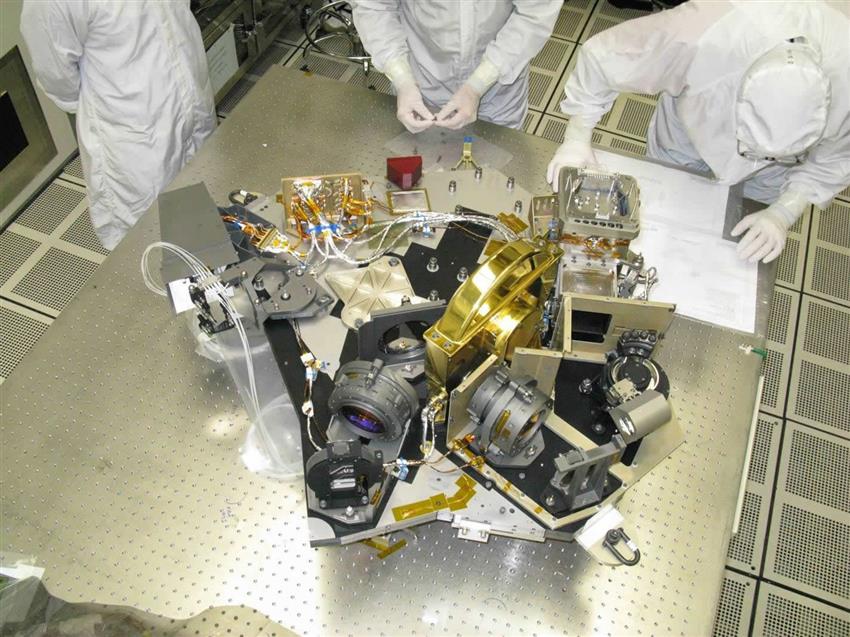
The NIRCam during testing at Lockheed Martin. (Credit: Lockheed Martin)
Chris Hadfield and BCAT-C1

. Aboard the ISS, Chris Hadfield conducts the Canadian BCAT-C1 experiment using this instrument. Watch this video to learn about what was studied.
Chris Hadfield describes BCAT-C1, a Canadian science mission that was conducted on the International Space Station (ISS). (Credits: CSA, NASA)
Hat trick for Hadfield
During his third mission in , Chris Hadfield becomes the first Canadian commander of the ISS. He also took photos of Earth from space, and filmed a lot of interesting videos, like this one where he chatted with fellow Canadian William Shatner!
The epic exchange between two Canadians, Chris Hadfield and actor William Shatner of Star Trek fame, unfolded on . The conversation was live-streamed from CSA headquarters in Longueuil, Quebec. (Credits: CSA, NASA)
Eye in the sky
Canada's NEOSSat, a small space telescope designed to search for near-Earth asteroids and space objects, is launched in .
Welcome home
In , Canadarm comes home for good. It is housed in the Canada Aviation and Space Museum in Ottawa, along with Marc Garneau and Julie Payette's flight suits, Chris Hadfield's Sokol suit, and a full-scale model of Alouette-I.

Big air
In , Canadian and French space agencies join forces to launch their first stratospheric research balloon, marking the beginning of the CSA's STRATOS program. Learn about it in this video.
This video explains the CSA's Stratospheric Balloon Program, Stratos, and its benefits to Canada. (Credit: CSA)
Solar storms and communication cascade
Launched in , the compact CASSIOPE satellite's mission is twofold: 1) study the effects of solar storms on Earth, and 2) test high-volume data transfers around the world.
Electric field instrument
In , Canada provides the European Space Agency's Swarm mission with the Electric Field Instrument, which helps us better understand Earth's electric field.
Robot-on-robot work
Dextre doesn't just take care of the ISS. In , it also performs a first act of robotic self-repair by replacing cameras on Canadarm2 and the Mobile Base System. Watch this simulation to see how it was done!
This animation shows how Dextre could swap two cameras on Canadarm2 and the mobile base, which together form the three main components of Canada's Mobile Servicing System. (Credit: CSA)
Shiny silver swag
marks the CSA's 25th anniversary, a milestone immortalized in a special collector coin issued by the Royal Canadian Mint.

On , the Royal Canadian Mint proudly celebrated the 25th anniversary of the CSA, with a unique silver collector coin featuring an achromatic hologram bringing the Agency's accomplishments to life.
Top soil
As part of NASA's SMAP mission, launched in to measure moisture levels across Earth, Canada funds five universities to participate in the scientific validation of its data.
Looking for hot, high-energy bodies
In , Canada takes part in India's AstroSat satellite mission, providing key components for studying hot, high-energy objects in the universe, like young stars and black holes.
Healthy hearts and bones
The Canadian MARROW and Vascular Echo experiments arrive on the ISS. Their purpose is to help determine how bone marrow changes in space and how weightlessness affects astronauts' cardiovascular health, respectively.
Directing traffic
The Maritime Monitoring and Messaging Microsatellite (M3MSat) launches in , helping improve Canada's capabilities to detect ships and manage marine traffic.
Encounter with an asteroid
In , NASA's OSIRIS-REx spacecraft is launched toward the asteroid Bennu. Once it arrives in , its Canadian-made Laser Altimeter (OLA) instrument begins creating the most detailed 3D map of any celestial body ever explored. On , the sample return capsule arrived on Earth.
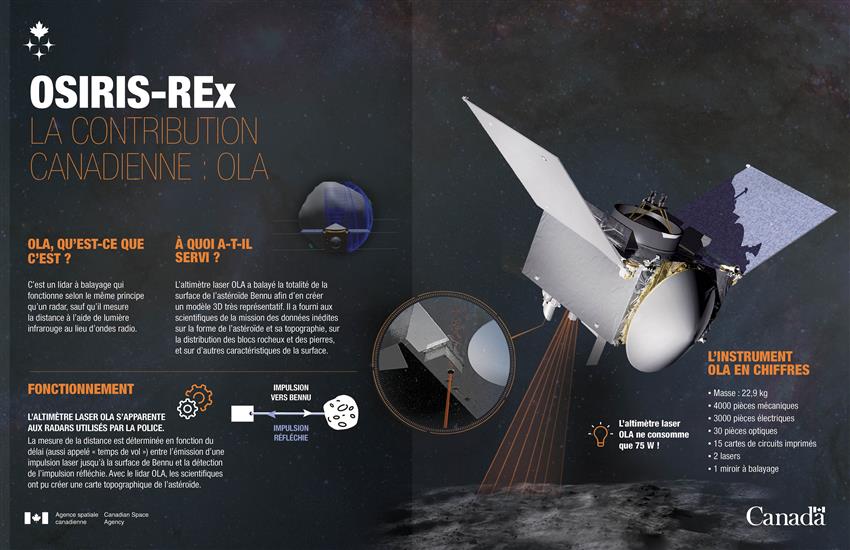
A Canadian laser made a 3D map of asteroid Bennu to help sleuth out the best sample site for NASA's OSIRIS-REx mission. (Credit: CSA)
You've got mail
In , as part of the Canada 150 celebrations, Canada Post issues a Canadarm postage stamp to commemorate Canada's achievements in space, science, technology, and innovation.

Canada 150 stamp celebrates Canadian achievements in robotics, science and technology.
Two new recruits
Jenni Gibbons and Joshua Kutryk become Canada's newest astronauts in .
In this video, Jenni Gibbons and Joshua Kutryk tell us about the first few days of events following their selection as Canadian astronauts, including the public announcement in Ottawa on Canada Day and their first appearance at the CSA. (Credit: CSA)
David Saint-Jacques' first mission
In , David Saint-Jacques embarks on his first mission, which at 204 days becomes the longest one by a Canadian astronaut to date. Read about some of his mission highlights:
Lunar Gateway
In , Canada partners with NASA on Gateway, the first space station to orbit the Moon. Canada will contribute an autonomous robotic system, Canadarm3, to Gateway.

Constellation of Canadian satellites
In , Canada launches the RADARSAT Constellation Mission (RCM), Canada's third generation of Earth observation satellites. This versatile multi-satellite mission aims to help with maritime surveillance, disaster management, and ecosystem monitoring. Learn more about the mission in this video:
The RCM uses a trio of satellites to take daily scans of our country and its waters collecting invaluable information. This important data helps captains safely navigate through Arctic waters, farmers maximize their crop yields, and first responders save lives, among other solutions. (Credit: CSA)
Canadians reach for the Moon
In , the Canadian government announces that two Canadians will take part in upcoming missions to the Moon — the first such missions since for humanity, but the first ever for a Canadian astronaut!