
Science satellites

Canada is renowned for the quality of its instruments on science satellites. Some of these satellites improve our understanding of the origin, formation, structure, and evolution of celestial bodies and the universe. Others make it possible to study the physics and effects of various phenomena on Earth, such as the impact of solar flares on Earth's magnetic field.
What's new?


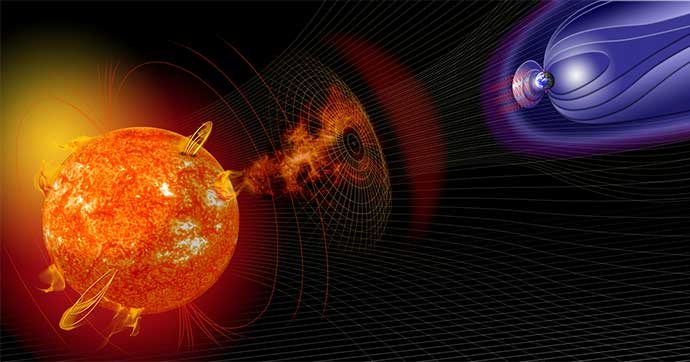
The various science satellites
Active Canadian satellites
CASSIOPE

Characteristics: Canadian satellite, active
Launched on , CASSIOPE carries two payloads:
- Enhanced Polar Outflow Probe (ePOP) observes space weather in Earth's ionosphere.
- Cascade (inactive) – its original purpose was to deliver very large digital data files to almost any destination in the world.
ePOP collects data on:
- solar storms in the upper polar atmosphere and associated plasma outflows
- the effects of solar storms on radio communications, satellite navigation, and other technologies
NEOSSat

Characteristics: Canadian satellite, active
Launched on , NEOSSat is a collaboration between Defence Research and Development Canada and the Canadian Space Agency. NEOSSat scans space in search of:
- satellites
- space debris
- near-Earth asteroids and comets
It also collects data on exoplanets — planets that orbit stars outside our solar system.
Canadian satellites in development
QEYSSat
Characteristics: Canadian satellite, planned no earlier than
QEYSSat will demonstrate quantum key distribution in space. This technology creates virtually unbreakable encryption codes.
It will be used for:
- online banking
- smartphones
- computers
- cloud computing
RADICALS
Characteristics: Canadian satellite, planned no earlier than
RADICALS will explore how radiation from space interacts with Earth's atmosphere and influences the climate.
By improving our understanding of these processes, the mission will help Canada prepare for major space weather events, such as solar storms, and better assess their impact on the technologies we depend on every day.
International satellites to which Canada has contributed
Proba-2

Characteristics: Canadian components, active
The European Space Agency's Proba-2 microsatellite was launched on . This satellite is used to observe the Sun and study space weather phenomena.
Three Canadian companies contributed to the mission by providing:
- a sensor measuring temperatures at different locations in the propulsion system and the spacecraft
- four micro-reaction wheels, to assure the accurate orientation of the satellite
- an on-board intelligent software to support the autonomous guidance, navigation, control and failure detection of the satellite
Proba-3
Characteristics: Canadian components, active
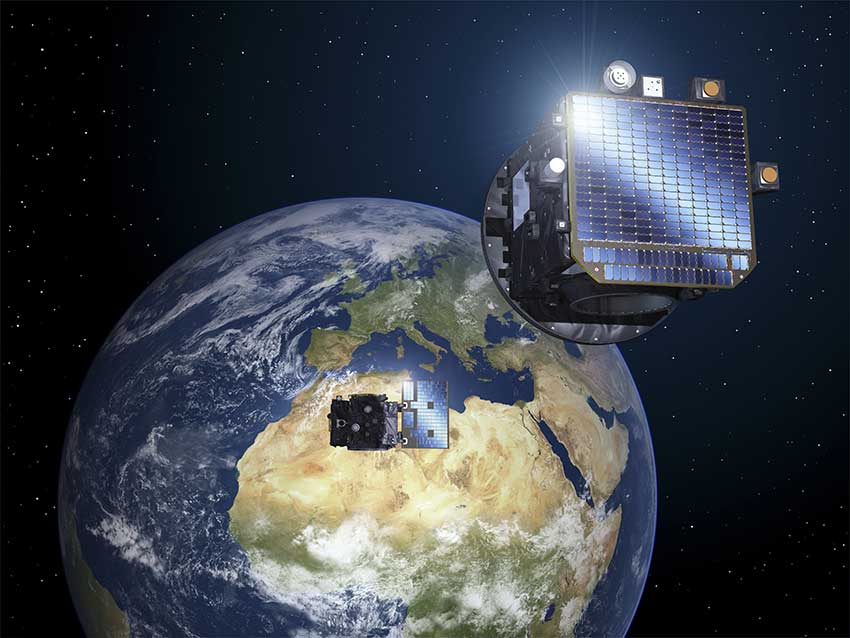
The European Space Agency's Proba-3 mission was launched on . Focused on demonstrating advanced technologies and techniques for extremely precise satellite formation flying, it comprises two small satellites.
Three Canadian companies provided components for the mission:
- an ultra-precision laser system for satellite positioning
- a software that controls precisely the position and orientation of the two satellites
- reaction wheels responsible for fine torquing of the spacecraft in three axes, operating with the software to maintain the pointing precision
Swarm

Characteristics: Canadian contribution, active
Launched on , the European Space Agency's Swarm mission is a constellation of Earth observation satellites. When it was launched, it comprised three identical satellites. In , Canada's CASSIOPE satellite was added to the mission.
The Swarm mission measures the magnetic fields generated by various elements of Earth:
- core
- mantle
- crust
- oceans
- ionosphere
- magnetosphere
THEMIS/ARTEMIS

Characteristics: Canadian instruments, active
Launched on , THEMIS is a constellation of five NASA satellites whose objective is to gain a better understanding of what causes auroras. In , two of the satellites were taken to create the ARTEMIS mission and moved elsewhere in space to study the same phenomena near the Moon. Specialists compare satellite data with data collected by ground stations in the Arctic Circle, where two sets of instruments – all-sky imagers and magnetometers – are Canadian contributions.
In order to study auroras, the satellites are equipped with:
- electric detectors
- magnetic detectors
- particle detectors
Inactive Canadian instruments and satellites
Alouette I and II
Characteristics: Canadian satellites, missions ended in and
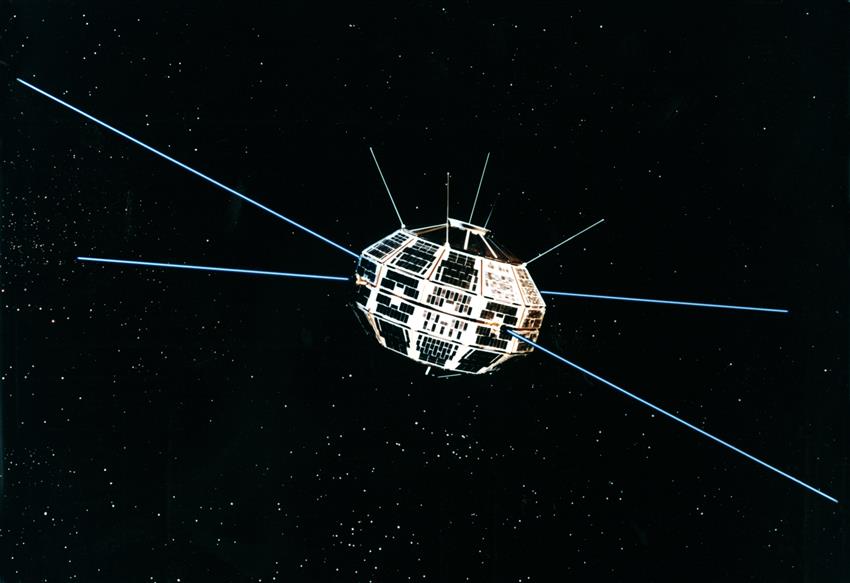
Launched in and , these science satellites were used to monitor the ionosphere. Canada became the first country, after the Soviet Union and the United States, to design, build, and put into orbit an artificial satellite.
These spacecraft were very reliable thanks to brand new technologies:
- the transistor
- the solar cell
Herschel

Characteristics: Canadian instruments, mission ended in
The European Space Agency's space observatory was launched on . It made over 35,000 observations and logged more than 25,000 hours of studying the universe. It had three instruments: the Heterodyne Instrument for the Far Infrared (HIFI), the Spectral and Photometric Imaging Receiver (SPIRE), and the Photometric Array Camera and Spectrometer (PACS).
Canada contributed by participating in the development of two out of the three instruments:
- HIFI, which enabled the analysis of interstellar gas composition by detecting far-infrared signals.
- SPIRE, which helped study distant galaxies and cosmic dust
ISIS I and II
Characteristics: Canadian satellites, missions ended in
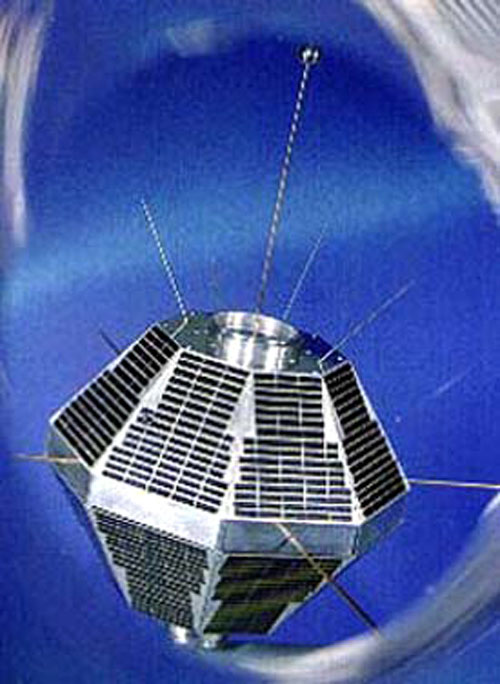
Launched in and , Canada's ISIS satellites were used to study the ionosphere and the aurora borealis. The satellites had:
- a set of direct measurement experiments
- a tape recorder to store data