
The Artemis II mission

Canada made history when Canadian Space Agency (CSA) astronaut Jeremy Hansen became the first Canadian – and first non-American – to ever participate in a lunar mission as part of Artemis II, the first crewed mission to the Moon since the Apollo missions over 50 years ago.
The four-person crew launched from Florida on the SLS rocket and flew aboard the Orion spacecraft, testing all of its life-support, navigation, and other systems in deep space to make sure everything works properly in preparation for future missions. They ventured beyond the far side of the Moon as part of a lunar flyby. After travelling for nearly 10 days and over 1 million kilometres, Orion splashed down in the Pacific Ocean off the coast of San Diego.
This mission was a unique opportunity to bring Canadians together and inspire them, to strengthen our leadership in the global space sector, and to highlight Canada's essential role in the future of space exploration.
- Launch:
- Mission duration:
- 9 days, 1 hour and 32 minutes
The Artemis II mission
The historic Artemis II mission was the first crewed test flight of the Artemis campaign, a multi-mission campaign set to create a durable lunar presence and pave the way for human exploration of Mars.
Following the success of the Artemis I uncrewed test flight in , the Artemis II mission travelled around the Moon to ensure that all of the Orion spacecraft's systems work as designed with a crew of four on board. Crewmembers lived and worked aboard Orion throughout their journey.
The historic Artemis II mission was the first crewed test flight of the Artemis campaign. In this vlog, CSA astronaut Jeremy Hansen explains the objectives of the mission and the kinds of tests that will be done on the spacecraft and its various systems. (Credits: CSA, NASA, Fulwell 73 UK Limited)
Transcript of the video entitled Vlog 15: Their mission? Test the Orion capsule
During their lunar flyby, the Artemis II astronauts witnessed "Earthset" and "Earthrise", a breathtaking view of our planet suspended in the blackness of space.
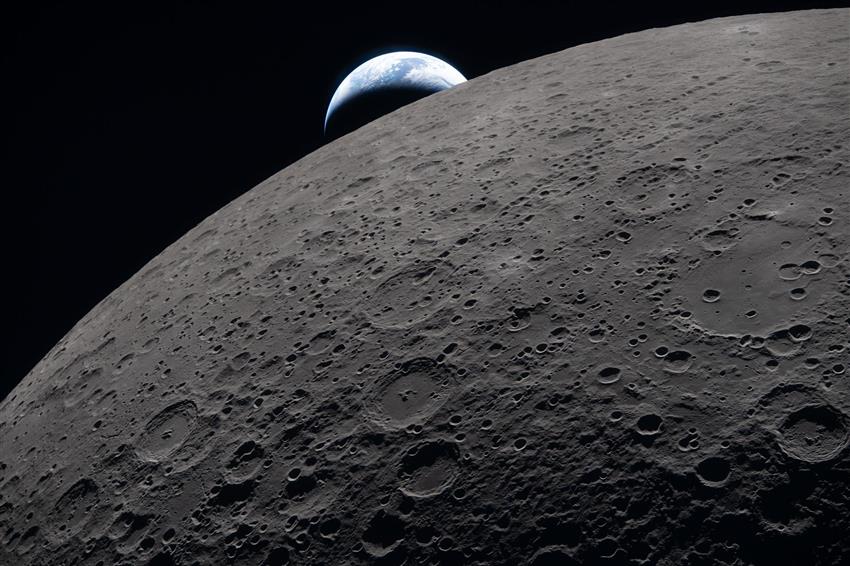
Earthset, captured by the Artemis II crew. (Credit: NASA)
CSA astronaut Jeremy Hansen tells the story of how the crew of Apollo 8 captured the famous "Earthrise" photo as they came around the far side of the Moon in . (Credits: CSA, NASA)
Transcript of the video entitled CSA astronaut Jeremy Hansen inspired by "Earthrise"
Artemis II crew
CSA astronaut Jeremy Hansen travelled with NASA astronauts Christina Koch, Victor Glover and Reid Wiseman.
Biographies
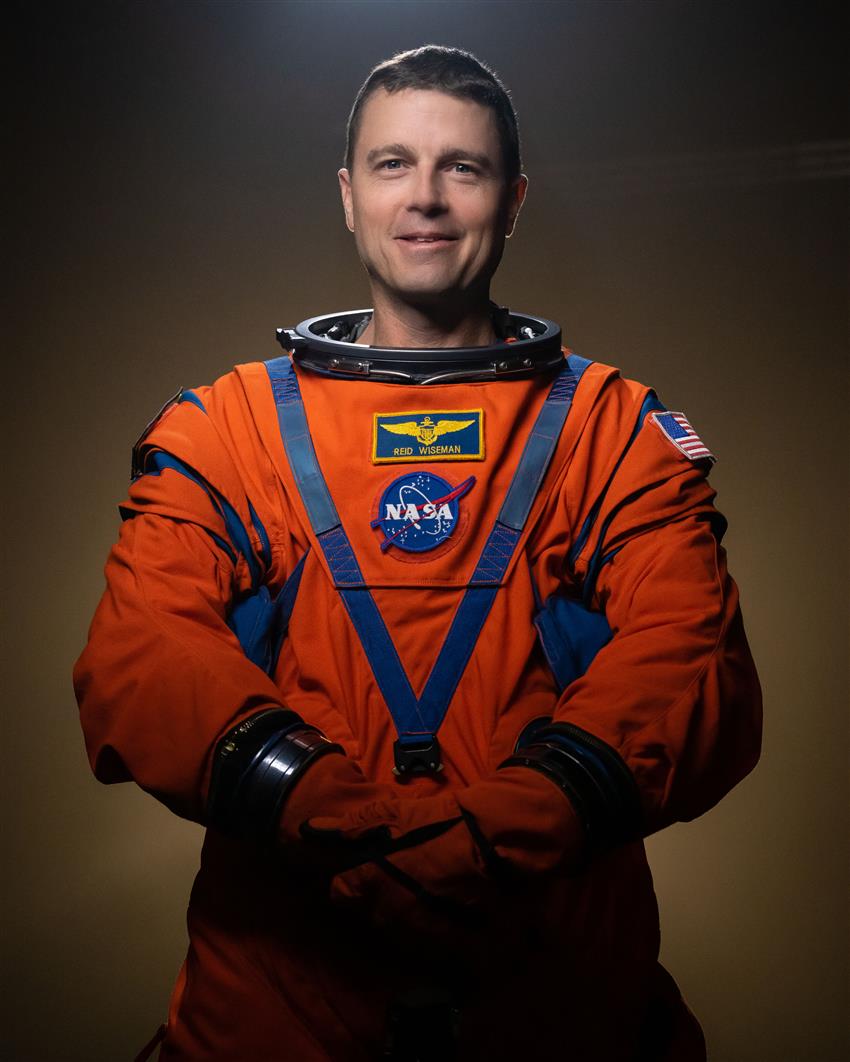
Reid Wiseman
(NASA)
Commander
Reid Wiseman is an engineer and decorated U.S. Navy pilot. In , he lived aboard the International Space Station (ISS) for six months, conducting multiple spacewalks and setting a record 82 hours of scientific research done in a single week with his crewmates. He most recently served as NASA's chief astronaut.
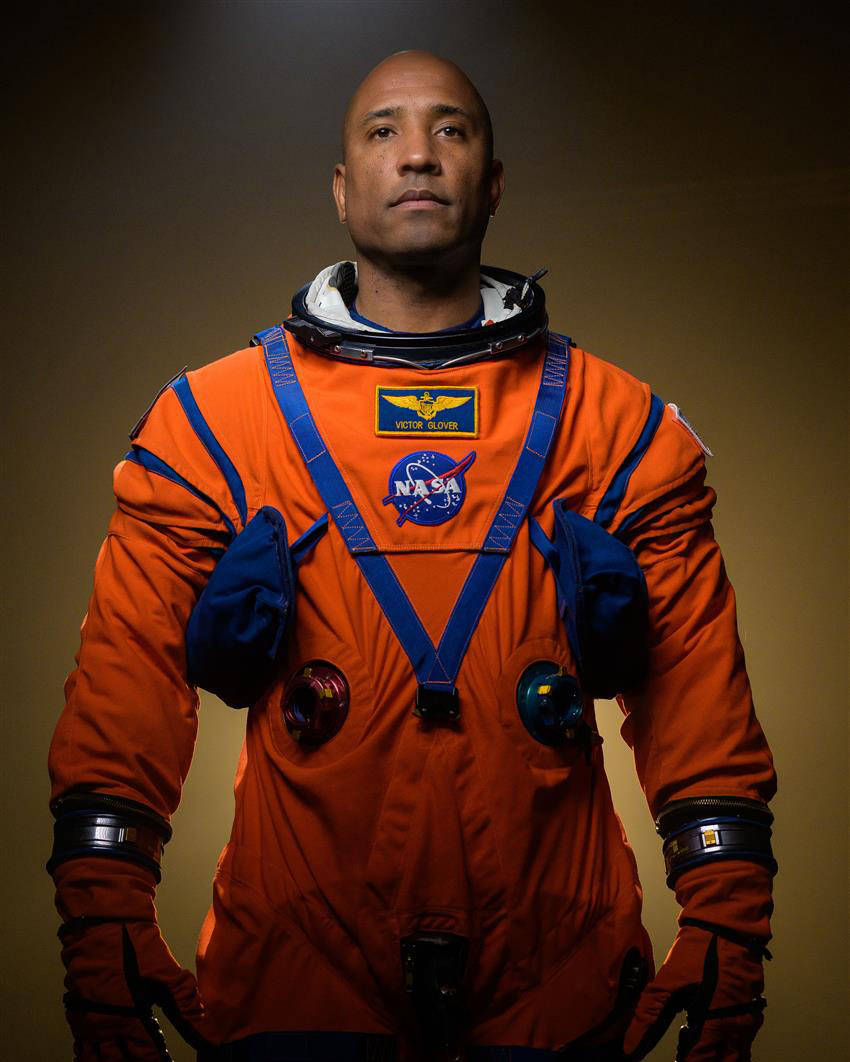
Victor Glover
(NASA)
Pilot
Victor Glover is an accomplished test pilot and engineer. In , he served as the pilot and second-in-command of the first operational flight of SpaceX's Crew Dragon. As part of this mission, he lived on the ISS for six months, during which he served as Flight Engineer.
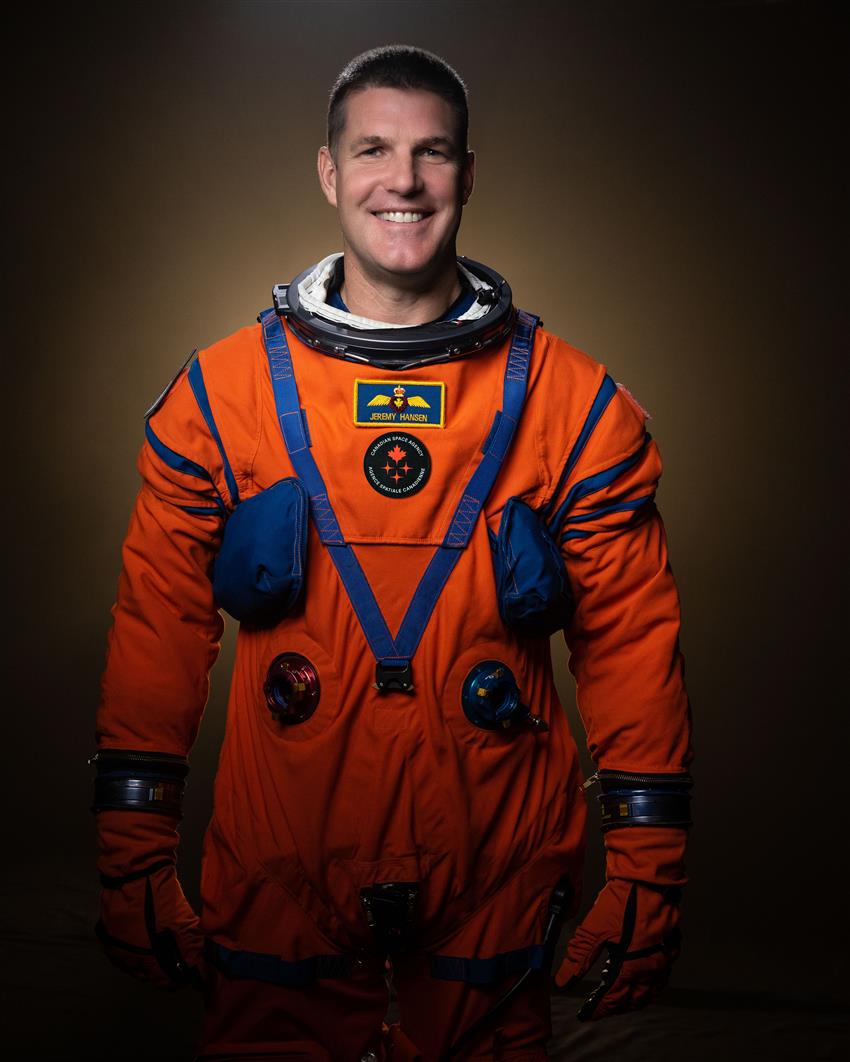
Jeremy Hansen
(CSA)
Mission specialist
Jeremy Hansen is a former fighter pilot and an active member of the Royal Canadian Air Force. He worked as capcom – the voice between the ground and the ISS – for many years at NASA's Mission Control Center. He is the first Canadian to have led a NASA astronaut class. Artemis II was his first assignment as an astronaut.
Read full bio of Jeremy Hansen
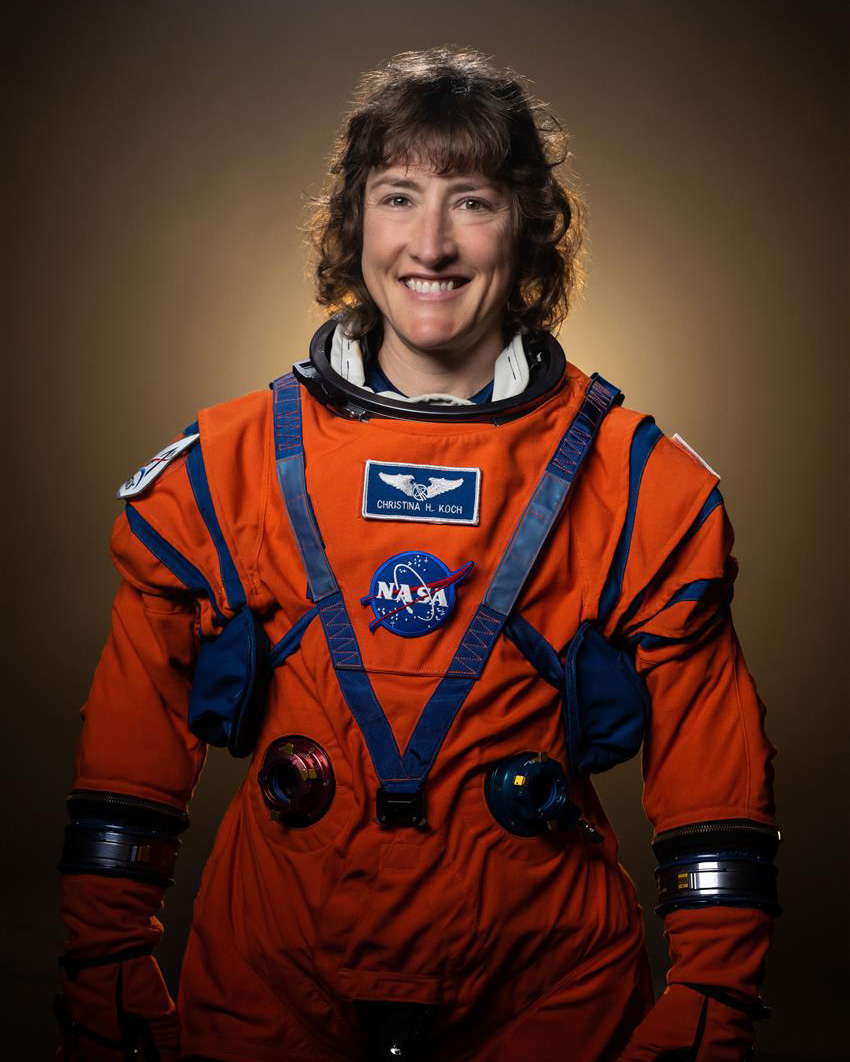
Christina Koch
(NASA)
Mission specialist
Christina Koch is an engineer and holds the record for the longest single spaceflight by a woman with a total of 328 days in space. During her stay on the ISS from to , she served as Flight Engineer and participated in the first all-female spacewalk.

CSA astronaut Jenni Gibbons poses for a portrait at the CSA headquarters in Longueuil, Quebec. (Credit: CSA)
CSA astronaut Jenni Gibbons was assigned as the official backup astronaut for Jeremy Hansen for Artemis II. Backup astronauts are typically trained in a similar way to the prime crew to ensure they are prepared to take on the same duties and responsibilities, sometimes with very little advance notice.
She played multiple roles, including in defining and validating astronaut training and processes for future lunar missions. She also acted as Artemis capcom during the mission.
They spent almost 10 days crammed in a tiny capsule together. They respect and trust each other very much, but also had lots of fun preparing for their journey to the Moon. In this vlog, CSA astronaut Jeremy Hansen introduces his fellow Artemis II crewmembers. (Credits: CSA, NASA, Fulwell 73 UK Limited)
Transcript of the video entitled Vlog 10: Get to know my Artemis II crewmates
It was busy aboard Orion during the Artemis II mission. During the first crewed test flight of the Artemis campaign, the crew worked hard during the mission. But what was be the role of CSA astronaut Jeremy Hansen? He explains in this vlog. (Credits: CSA, NASA, Fulwell 73 UK Limited)
Transcription of the video entitled Vlog 16: Sharing responsibilities on Artemis II
Artemis II flight path
The Artemis II mission launched from NASA's Kennedy Space Center, in Florida. The Orion spacecraft orbited Earth twice to ensure Orion's systems were working as expected while still close to home.
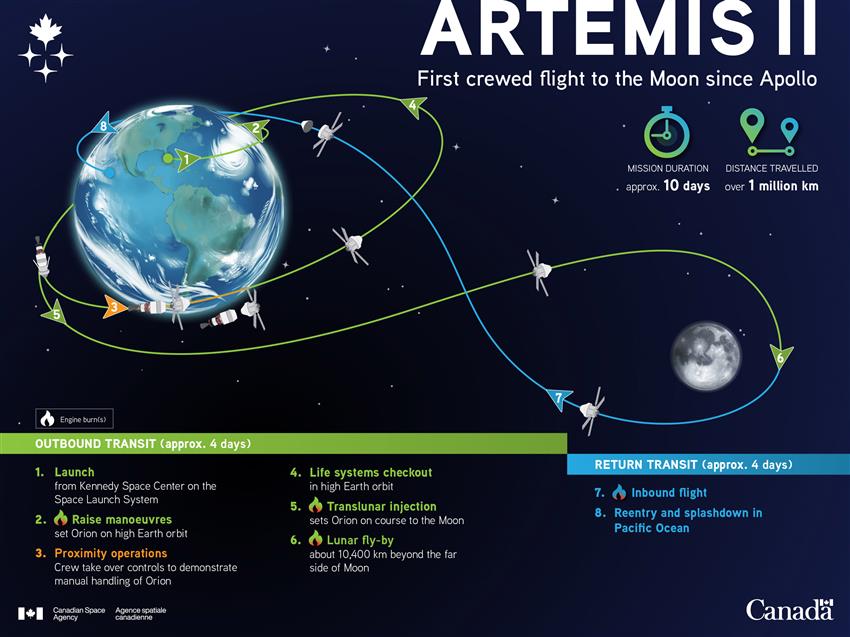
During Artemis II, four astronauts flew around the Moon in the Orion spacecraft. The approximately 10-day flight test paves the way for lunar surface missions. (Credits: CSA, NASA)
During the second orbit high above Earth, a checkout of the spacecraft began. Crew performed a sequence of manoeuvres designed to test manual piloting of Orion. The crew also assessed life support, exercise, and habitation equipment to ensure readiness before heading to the Moon.
A powerful engine burn by the European Service Module set Orion on a four-day outbound course to the Moon. Orion came within 6,544 kilometers at it's closest approach to the lunar surface during its lunar flyby before returning to Earth. Orion splashed down in the Pacific Ocean, where the capsule and crew were recovered by ship. In total, they will travel over 1 million kilometres.
From Florida to California via… the Moon! In their campervan-size Orion crew module atop the SLS rocket, CSA astronaut Jeremy Hansen and his Artemis II crewmates launched from Florida. Watch this vlog to hear Jeremy explain the Artemis II trajectory. (Credits: CSA, NASA, Fulwell 73 UK Limited)
Transcript of the video entitled Vlog 14: Over 1,000,000 kilometres in nearly 10 days
Communications and navigation during the Artemis II mission
As with the Artemis II mission, NASA's Near Space Network (NSN) and Deep Space Network (DSN) were used to track and communicate with the Orion spacecraft during the mission. Communications services allow flight controllers to send commands to the spacecraft and receive data from Orion and SLS systems. Tracking, or navigation, services enable the flight controllers to see where the spacecraft are along their trajectory through space. The NSN and DSN's sensors work together to relay and provide critical flight information.
The Artemis II crew navigated using the stars to determine the spacecraft's orientation and define the distance between Orion and these bright celestial objects.
In this vlog, CSA astronaut Jeremy Hansen explains how Orion will be piloted, at times through automation and at other times manually by the Artemis II crew. They will use Earth tracking, star-based navigation, and hand controllers to ensure precise manoeuvres, safe docking, and mission success. (Credits: CSA, NASA, Fulwell 73 UK Limited)
Transcript of the video entitled Vlog 26: How the Artemis II crew will steer the Orion capsule
In this vlog, CSA astronaut Jeremy Hansen explains how the Artemis II crew will stay connected during the mission, through radio communication with Mission Control, their families and the public. (Credits: CSA, NASA, Fulwell 73 UK Limited)
Transcript of the video entitled Vlog 25: How Orion calls home