
Exhibit hall

In the exhibit hall, you can get up close and personal with some of the iconic spacecraft and satellites the Canadian Space Agency (CSA) has contributed to.
International Space Station (ISS)

The ISS is a very special research laboratory.
The ISS is the largest human-made object ever to orbit Earth. It's also the second-brightest object you can see in the night sky with the naked eye.
Watch this video to learn more about the science we conduct there!
Did you know that many science experiments are being conducted on the ISS at any given time? Why do we do science in space? (Credit: CSA)
Where in the world is the ISS?
Check out where the ISS is right now!
The arm with two arms

Canadarm2 is part of Canada's contribution to the ISS. This 17-metre-long robotic arm was extensively involved in the assembly of the orbiting laboratory. This is a model of Canadarm2, fitted with Dextre.
Watch this animation to see how they work together to unload space cargo on the ISS.
Flight controllers on the ground use Canadian space robot Dextre to unload and reload the unpressurized trunk of the Dragon cargo vehicle. This animation shows Dextre handling the Orbiting Carbon Observatory 3, Space Test Program-Houston 6, and Cloud-Aerosol Transport System payloads. (Credit: CSA)
SCISAT

Flying high and focused on the Northern sky, this entirely Canadian satellite was designed to help study the ozone layer and the substances that deplete it. SCISAT measures more gases in the stratosphere than any other space-based instrument in the world.

Infographic showing SCISAT in numbers. (Credit: CSA)

CASSIOPE
The compact CASSIOPE hybrid satellite carries two main payloads: ePOP which observes the ionosphere; and Cascade, a communications technology demonstrator whose operational concept is to pick up very large digital data files and transfer them to almost any destination in the world.
RADARSAT Constellation Mission (RCM)
This mission makes use of three identical satellites to take daily scans of Canada and its waters, collecting valuable data for various purposes: navigation, rescue, agriculture, and more.
RADARSAT-2
The second generation of this Canadian satellite is smaller than the original and provides high-quality commercial radar imagery to users around the world.
RADARSAT-1: the OG
Launched in , RADARSAT-1 has provided invaluable Earth data to Canada and other countries, helping the world address environmental challenges, and delivering other commercial and scientific applications.
M3MSat: small and mighty
It may be tiny, but this diminutive spacecraft was used to test innovative technologies in space and to improve Canada's ability to manage maritime traffic.

The James Webb Space Telescope
The James Webb Space Telescope is the most powerful space telescope ever built. Canada has contributed a scientific instrument and a guidance sensor to the massive observatory. In exchange, Canada receives a guaranteed share of Webb's observation time, making Canadian scientists some of the first to study data collected by the telescope.
NEOSSAT: asteroids, junk and exoplanets
NEOSSAT is the world's first space telescope dedicated to detecting and tracking asteroids, comets, satellites and space debris. It can also reveal the presence of exoplanets around distant stars.
Anik-F2: bringing us closer
When the Anik F2 telecommunications satellite went out of service on , thousands of northern Canadians were left without banking, phone or Internet services. Thankfully the glitch was promptly fixed, and life went back to normal in less than 24 hours. If satellites stopped working for 24 hours, there would be many consequences, as the infographic shows.
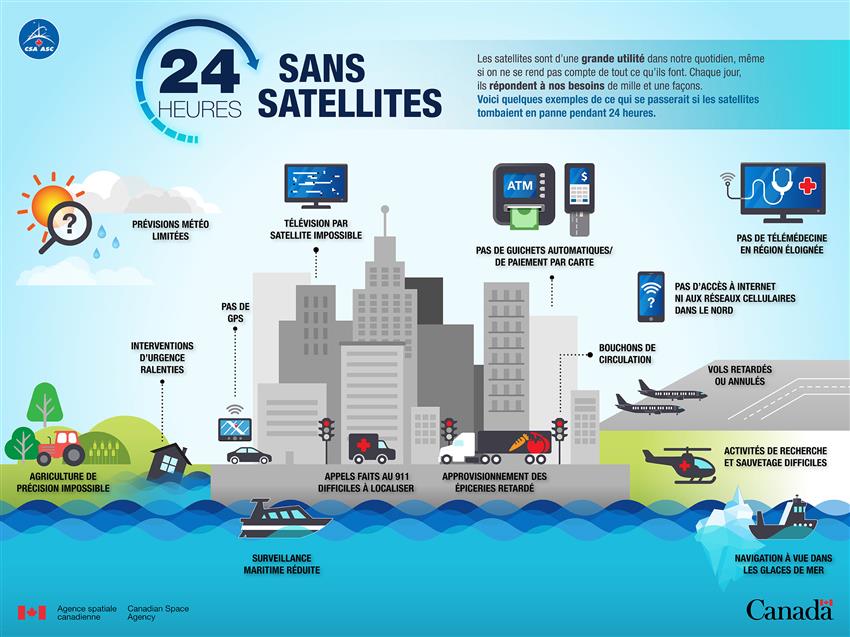
A few examples of what would happen if satellites stopped working for 24 hours. (Credit: CSA)
The MOST small?
The MOST satellite was designed to be the world's smallest space telescope, capable of measuring the age of stars in our galaxy and perhaps even unlocking the mysteries of the universe itself. It has revealed that the star Procyon does not oscillate, which contradicts previous observations made from Earth-based telescopes. The discovery suggests that long-held theories about the formation and aging of the Sun and other stars need to be reconsidered.