
Flights and Fieldwork for the Advancement of Science and Technology (FAST )
On this page
- Summary of Key Information
- 1. Introduction
- 2. AO objectives
- 3. Eligibility criteria
- 4. Application
- 5. Evaluation
- 6. Funding
- 7. Financing agreement
- 8. Frequently Asked Questions (FAQ)
- Appendix A – Additional information on projects
- Appendix B – Scoring
- Appendix C – Narrative CV Format
- Appendix D – CSA-Supported Missions/Projects
Summary of Key Information
- Eligible recipients: Canadian universities and post-secondary institutions
- Type of transfer payments: Grants
- Maximum amount per grant (3 funding categories):
- Category A: $450,000
- Category B: $300,000
- Category C: $20,000
- Total Funding Under this AO: $5,500,000
- Maximum Timeframe of Resulting Projects: up to three years
- Estimated Start Date of Resulting Projects: /
- Application Deadline:
Webinars
Webinars took place on and in French and in English.
All questions and answers have been added to the FAQ section of this AO.
Those interested in obtaining the link to one of the webinars may contact stedia-dstemu@asc-csa.gc.ca.
1. Introduction
The objective of the Flights and Fieldwork for the Advancement of Science and Technology (FAST) AO is to support research projects in Canadian universities and post-secondary institutions that will contribute to the development of new scientific knowledge and space technologies, while giving students hands-on experience in space-like missions or in building a payload destined for space.
Building Canadian capacity in space science and technology is a priority for the Canadian Space Agency (CSA). In addition to the development of space science technologies and knowledge, Canada must develop and maintain a robust and experienced workforce within industry, academia, and government to continue playing an active role in future space missions and creating socio-economic benefits for Canadians.
FAST encourages academia to propose research with hands-on elements for students to advance their knowledge, or to maintain their expertise, and to attract and train the next generation of space professionals.
This Announcement of Opportunity (AO) is consistent with the terms and conditions of the CSA's Class Grant and Contribution Program to Support Research, Awareness and Learning in Space Science and Technology – Research Component (the G&C Program).
Applicants are asked to read the following AO thoroughly before submitting their application. This AO was prepared to help applicants complete the application process and outlines key elements, including mandatory criteria for eligibility, details on eligible projects and the selection process.
2. AO objectives
In accordance with the Space Strategy for Canada, the main objectives of the FAST AO are to:
- Develop and maintain a critical mass of researchers and highly qualified personnel (HQPs) in space-related fields;
- Increase scientific knowledge and/or contribute to the development of new technologies; and
- Increase the value of students for future employers in the space sector by exposing them to practical experiences that enable them to acquire sought-after space science and technology knowledge and skills within the space sector.
3. Eligibility criteria
In this section
3.1 Eligible recipients
Canadian universities and post-secondary institutions are eligible under this AO.
3.2 Eligible projects
To be eligible under this AO, proposed research projects must meet the following eligibility criteria:
- Propose activities related to one (1) of the research disciplines and one (1) of its associated research priorities identified in Section 3.3 of this AO;
- A funding request that falls under one of the three identified funding categories outlined in Section 6.1; and
- The participation of:
- At least five (5) Canadian students for a project funded under Funding Categories A and B.
- At least two (2) Canadian students for a project funded under Funding Category C.
Please see the Appendix A1 for further details regarding Canadian students.
Important Notes Regarding Eligible Projects:
The eligible cost categories are different for each funding category. Please see Section 6 for more details.
Projects may include, but are not limited to, the following:
- Designing, building, modifying or testing scientific instruments, methodologies, or technologies with the objective of collecting data for a research problem.
- Testing instruments or technologies in a simulated space environment (e.g. test chambers), suborbital platform (e.g. aircraft, balloons, sounding rockets), an orbital platform (e.g. the International Space Station (ISS), a CubeSat), or an analogue terrain.
For further details and examples of different types of research platforms, research sites and testing platforms, including the CSA-supported research platforms, please see Appendices A3 and A4.
Applications must be submitted by only one eligible recipient (Canadian universities and post-secondary institutions). Proposals submitted by two or more eligible recipients (co-applicants) will be rejected. Eligible recipients may submit separate applications for different elements of the same project, but each application must be for separate research or scientific activities requiring the participation of different Canadian students (including postdoctoral fellows). Each applicant must demonstrate that their project can achieve the project objectives regardless of the acceptance or refusal of other applications from eligible recipients.
Sub-grants are not permitted under this AO. All expenditures must be direct and eligible costs (see Section 6.2 for further details on eligible costs for each funding category).
An eligible recipient may submit one or more proposals with the same PI or Co-Is if the proposals comply with all eligibility criteria.
All development phases necessary for a project are eligible for funding. Any logical breakdown or combination of these phases can constitute a funded project under this AO. However, breaking down a project into numerous phases submitted as distinct proposals to obtain more than the maximum grant under this AO is not allowed. Furthermore, the completion of a funded phase does not automatically guarantee future funding of the remaining phases.
Ineligible Projects:
A project may not be eligible for funding if the applicant was previously awarded funding by the CSA for a similar project that is underway. If the proposed project is directly or indirectly related to a project that was previously funded through a CSA AO or Request for Proposal (RFP), the applicant may still be eligible for funding if the proposed project activities are complementary in nature and do not overlap with those of the previously funded project(s) that is(are) ongoing.
Projects in which the primary objective is to develop applications using data from an existing space mission or to analyze data of an existing space mission are ineligible under this AO. However, projects for which data analysis is required in a supportive role as part of the project are eligible.
Projects related to the CSA-supported missions/projects listed in Appendix D are also ineligible under this AO.
Projects that propose using the ISS as their research platform are ineligible under this AO unless they propose to proceed through a commercial route (such as Voyager Space (formerly Nanoracks) platforms or Space Tango platforms) that will not require the use of Canada's ISS utilization rights.
3.3 Links to CSA priorities
To be eligible, projects supported under this AO must focus on at least one (1) of the research disciplines and one (1) of its associated research priorities indicated in Table 1 below:
| Research disciplines | Research priorities |
|---|---|
| Innovative Space Technology | Projects related to the development of innovative technologies destined for space or that have promising space applications (including prototyping, testing and/or demonstration). Projects that build on existing technologies are acceptable provided they include new methodologies or significant improvements to existing technologies. Examples of priority areas include:
Other technologies linked to space instruments or platforms, including ground segments, that are not listed here and that do not respond to one of the other research priorities below may also be eligible. |
| Space Health and Life Science | Projects that address health issues on Earth and contribute to the reduction of the following risks associated with human spaceflight:
Projects related to this research discipline for which the PI is a Co-I on a related international space mission or project, and funded by another space agency, are ineligible under FAST . |
| Space Astronomy and Planetary Science | Projects that address space astronomy objectives or planetary science objectives identified in the Science Community Topical Teams Report on Space Astronomy, Planetary Science and Astronaut Health or in the Canadian Astronomical Society's (CASCA) Long Range Plan for Canadian Astronomy (LRP) (PDF, 2.8 MB). Projects may include the development of prototypes of astronomical or planetary science instruments for which testing requires the use of observatories, balloons, rovers or nanosatellites. Projects related to this research discipline for which the PI is a Co-I on a related international space mission or project, and funded by another space agency, are ineligible under FAST . |
| Food Production for Space | Projects that advance Controlled Environment Agriculture (CEA) technologies and sciences intended for use in both space and terrestrial environments such as, but not limited to, remote regions and extreme climates. Projects must focus on Knowledge and Technology Gaps such as, but not limited to:
Examples of Technology Gaps in food production for space may be found in the article "Large-Scale Crop Production for the Moon and Mars: Current Gaps and Future Perspectives" but other sources may be used as well, as long as the information source is referenced in the application. Projects related to this research discipline for which the PI is a Co-I on a related international space mission or project, and funded by another space agency, are ineligible under FAST . |
| Atmospheric and Earth System Sciences | For atmospheric sciences: For Earth system sciences: For both science disciplines: Eligible projects may include the following activities:
Projects related to this research discipline for which the PI is a Co-I on a related international space mission or project, and funded by another space agency, are ineligible under FAST . |
| Solar-Terrestrial Science | Projects related to in situ measurements or remote sensing of the space environment, including but not limited to: energetic particles, magnetic fields, electric fields, and interactions of geospace (the region of near-Earth space comprised of the thermosphere, ionosphere, and magnetosphere) with the Earth's neutral atmosphere. Projects may include the development and deployment of new instruments and/or the deployment of existing instruments to support a research project or demonstrate a new capability. Projects related to this research discipline for which the PI is a Co-I on a related international space mission or project, and funded by another space agency, are ineligible under FAST . |
Note that applicants proposing projects that respond to more than one of the above-mentioned research disciplines must indicate one primary research discipline in the application form. The evaluation and final selection of proposals will be completed based on the applicant's selection of primary research discipline.
3.4 Links to the Class G&C Program Objectives
To be eligible, projects supported under this AO must contribute to the achievement of at least one of the following objectives:
- To support the development of science and technology relevant to the priorities of the CSA.
- To foster the continuing development of a critical mass of researchers and highly qualified people in Canada in areas relevant to the priorities of the CSA.
- To support information gathering, studies and research related to space.
4. Application
In this section
4.1 Required Documentation
The applicant must ensure that its application includes the required documents:
- A completed application form, signed by the duly authorized representative (please see instructions on accessing the application form in Section 4.2);
- The curriculum vitae (CV) of each member of the team (principal investigator (PI), Co-investigators and PDFs who are members of the project team). Each CV must not exceed 5 pages (6 pages in French) and must follow the format presented in Appendix C; and
- Letters of support from co-investigators (Co-Is) involved in the project. The letters must include the name of the organization where the CO-I is working and the role or expertise they bring to the project. Scientists at federal government research labs are accepted as co-investigators under this AO.
The following elements may be added, if necessary, to better understand the proposed research project:
- Diagrams or figures with added details pertaining to the research project and referenced in the application form.
The following documents may be required upon request:
- Letters from other funding contributors confirming their contributions (if applicable).
- Proof of incorporation or registration (i.e., Corporation Registry).
The documents must be combined in a single PDF formatted file, in the same order as presented above with all security features disabled. The application form and supporting documents must be included in the file as a searchable PDF formatted document (PDF/A-1a format preferred). If there are any accessibility issues with the submitted PDF file, all consequences reside with the applicant.
It is the applicant's responsibility to ensure that the application complies with all applicable federal, provincial/territorial and municipal laws and regulations.
The applicant must keep one hard copy of all the original documents above. The CSA may require applicants who successfully passed the evaluation stage to send a hard copy of their complete application with the original documents.
Additional governing documents might be requested at a later phase of the evaluation process.
Please note that incomplete applications will not be considered.
4.2 How to submit an application
The applicant must follow the steps below to access the application form and submit an application electronically:
- Submit an account creation request using the Electronic Proposal Portal. Note that Google Chrome is the browser of choice for submissions, but supported browsers are Google Chrome and MS Edge.
- In the "Proposal title" field of the Electronic Proposal Portal, use the following naming convention: FAST _Funding Category_Name of the post-secondary institution_Short Project Name_Last name of the PI (example: FAST _B_University XYZ_Optical sensor development_Smith). Only alphanumeric characters, spaces, underscores, and dashes are accepted.
- The "Applicant" section must contain the information for the PI responsible for the research project as well as the duly authorized representative of the institution (who will be signing the application on behalf of the institution). The applicant may add as many people as necessary to the proposal by using the "+Add an additional contact" button. It is important to note that all people added will have access to the same online application form and will have the possibility to make changes.
- Once submitted, the applicant and any additional contacts added by the applicant will each receive an email confirming the account creation. Applicants must allow up to three business days to receive the email, which will include a link to the online application form and another link to the secure portal where all required documents must be uploaded, along with the username, password and instructions (user guide). It is strongly recommended that the account creation request be submitted as early as possible.
- Using the username and the temporary password assigned by the CSA, login to the online application form. Some security features, such as firewalls, may hinder access and the CSA must be informed of any access issues as soon as possible. Applicants may save the information entered and return to the form later, if necessary, until the application submission deadline date.
- After completing the application form, print it as a PDF document before clicking "submit".
- The duly authorized representative of the institution must sign the application form.
- Combine all required documents into a single PDF document (please see Section 4.1 for details on the accepted format) and upload your complete and signed application package to the secure portal, using the link provided in the initial email, no later than Please refer to the user guide for instructions on how to securely upload documents.
Important Notes:
- If technical issues related to an account creation or to an electronic submission arise, applicants must inform the CSA as soon as possible at the email address stedia-dstemu@asc-csa.gc.ca for the issue to be investigated. Applicants are strongly encouraged to upload their complete application package well before the submission deadline.
- Applications must be submitted (successfully uploaded) by the applicants no later than .
- The onus is on the applicant to ensure that their application is complete and that all documents are uploaded to the Electronic Proposal Portal before the prescribed deadline.
- The CSA is not responsible for any delays under any circumstances and will reject any applications that are uploaded after the stipulated deadline.
- Applications hand-delivered to the CSA will not be accepted.
- Applications sent by e-mail will not be accepted.
- If multiple applications are submitted, only the latest valid version received will be considered.
4.3 Service Standards – Complete Applications
Applicants will be notified in writing of decisions regarding their application. Selected and funded applications will be announced on the CSA website. The CSA has set the following service standards for processing times: acknowledgement of receipt, funding decisions and payment procedures.
Acknowledgement: The CSA's goal is to acknowledge receipt of proposals within two (2) weeks of receiving the completed application package.
Decision: The CSA's goal is to respond to the proposal within twenty (20) weeks of the AO's closing date and to send a grant agreement for signature within eight (8) weeks after formal approval of the proposal.
Payment:
The CSA's goal is to issue payment within four (4) weeks of the successful fulfillment of the requirements outlined in the grant agreement but is under no obligation to meet this deadline.
Compliance with these service standards is a shared responsibility. Applicants must submit all required documentation in a timely fashion. Service standards may vary by Announcement of Opportunity.
5. Evaluation
In this section
5.1 Eligibility criteria
Applications will first be submitted for an eligibility assessment to verify whether they comply with the following criteria:
- The applicant is an eligible recipient as defined in Section 3.1;
- The proposed project is an eligible project as defined in Sections 3.2 and 3.3 (in alignment with the supplemental information provided in Appendix A); and
- The application complies with the funding provisions of the program stated in Section 6.1.
5.2 Evaluation criteria
Once the eligibility assessment is completed, applications will be evaluated according to the following criteria:
- Benefits to Canada and Outcomes; and
- Feasibility, Resources, and Risks.
Funding Categories A and B will be evaluated slightly differently than Funding Category C. To be considered eligible for funding under all funding categories, the total score obtained using the graded criteria must be 70/100 or greater. Table 2 below shows the evaluation criteria, sub-criteria and associated thresholds, while Table 3 shows a brief description of the graded criteria for all funding categories.
A detailed description of the evaluation criteria and sub-criteria for all funding categories can be found in Appendix B (for Funding Categories A and B, please see B1 and for Funding Category C, please see Appendix B2).
| Criteria | Maximum points for evaluation |
Minimum points to pass |
Poor | Average | Good | Excellent |
|---|---|---|---|---|---|---|
| 1. Benefits to Canada and outcomes | 50 | 35 | - | - | - | - |
| 1.1 Merit of the Proposed research | 25 | - | 5 | 15 | 20 | 25 |
| 1.2 Training plan | 25 | - | 5 | 15 | 20 | 25 |
| 1.3 Equity, diversity and inclusion (EDI) | Pass/Fail | - | - | - | - | - |
| 2. Feasibility, Resources, and Risks | 50 | 35 | - | - | - | - |
| 2.1 Project Feasibility | 20 | - | 5 | 10 | 15 | 20 |
| 2.2 Project Team | 20 | - | 0 | 10 | 15 | 20 |
| 2.3 Project risks and mitigation strategies | 10 | 5 | 0 | 5 | 7 | 10 |
| TOTAL | 100 | 70 | - | - | - | - |
Table 3: Definition and breakdown of the evaluation criteria
- 1. Benefits to Canada and outcomes
-
- Max. score: 50
- Min. score: 35
- 1.1 Merits of the Proposed research
Max. score: 25
This criterion is used to evaluate the originality of the research and its probable impact and potential to advance knowledge in the field of space science and/or technology, directly or indirectly. This criterion is also used to evaluate the alignment of the proposed research with the research priorities outlined in Section 3.3 of the AO.- 1.2 Training Plan
- Max. score: 25
This criterion is used to evaluate the quality, relevance, and clarity of the training plan as well as the impact of the knowledge and experience that the students involved are expected to acquire. - 1.3 Equity, diversity and inclusion (EDI)
- Pass/Fail
This criterion is used to evaluate whether the proposal includes a meaningful plan to foster the recruitment and engagement of members from equity-deserving groups in the research team. - 2. Feasibility, Resources, and Risks
-
- Max. score: 50
- Min. score: 35
- 2.1 Project Feasibility
- Max. score: 20
This criterion is used to evaluate the clarity, completeness, and feasibility of the research plan, whether the planned budget is adequate to achieve the project's objectives, and the timely availability of the required physical resources (equipment, instruments and/or scientific data) and infrastructure (ground-based infrastructure, suborbital/orbital platform, analogue site). - 2.2 Project team
- Max. score: 20
This criterion is used to evaluate the quality of the project team and their capacity to carry out the research project. - 2.3 Project risks and mitigation strategies
-
- Max. score: 10
- Min. score: 5
This criterion is used to evaluate the completeness of the risk assessment and the sufficiency of the mitigation strategy for each risk.
5.3 Evaluation process
Only applications that have passed the eligibility assessment listed in Section 5.1 will be given further consideration.
Once the eligibility criteria are confirmed, evaluators will assess the screened applications according to the criteria listed in Section 5.2 and detailed in Appendix B. Applicants are encouraged to provide a detailed and clear description of how they meet each criterion.
Evaluators shall be experts in the field(s) relevant to the applications and may include representatives of the Government of Canada (departments, agencies and organizations) and other governmental or non-government agencies and organizations. If applicable, a multidisciplinary evaluation committee will be formed to evaluate interdisciplinary applications.
Before a final decision is made, the CSA may conduct any consultation and seek advice or input from other organizations as it deems necessary to obtain any information useful for the evaluation of the application.
The final funding decisions will be done through a strategic overall selection, taking into consideration the following elements:
- Alignment with the identified research priorities;
- Balance between the research disciplines identified in Section 3.3 of the AO;
- Regional distribution;
- Distribution amongst universities and post-secondary institutions;
- Representation of PIs belonging to one or more of the equity-deserving groups;
- Support for early career researchers (ECRs) acting as PI. For the purposes of this AO, an ECR is defined as a person who has held their first independent academic position within the last five years, excluding any leave period(s) for family or personal reasons.
6. Funding
In this section
6.1 Available Funding and Duration
The maximum grant that a recipient can receive for each project from the CSA under this AO is:
- Funding Category A: up to $450,000 for a project of up to three years, for projects that are not requesting access to a CSA-supported research platform (please see Appendix A4 for further details) and that require substantial expenditures1 from service providers2.
- Funding Category B: up to $300,000 for a project of up to three years, for projects requesting access to a CSA-supported research platform (please see Appendix A4 for further details) or that do not require substantial expenditures from service providers.
- Funding Category C: up to $20,000 for a project of up to two years, for projects at the college/undergraduate level that support research through experiments on low-cost research platforms3.
The CSA accepts applications with budgets less than the maximum grant amount identified for each funding category above. The Project budget in the application should align with the scope of the proposed research project and allow for the project to achieve the identified objectives.
To determine the amount of funding to be allocated, consideration will be given to the availability of CSA funds, the total cost of the project, and the other confirmed sources of funds provided by other stakeholders and the applicant. The resulting number of funded projects under this AO will depend on funding availability and the results of the evaluation process.
Given the objectives of this AO and the limited available budget, an eligible recipient (institution) may submit several applications; however, if two or more applications are submitted with the same designated PI, the CSA reserves the right to select only one of these projects. Two or more eligible recipients (institutions) may submit separate applications for the same project if their applications concern the development of distinct technologies or scientific research and if the students and PDFs involved in these different projects are not the same.
The CSA reserves the right to reject any application or reduce the amount of the grant at its entire discretion.
6.2 Eligible costs
Eligible costs are costs that are directly related to the project and are essential to achieve the expected results of the project. The costs are to be incurred directly by the applicant. Incurred Costs means any expense made to carry out the project related to an Eligible Cost, which is due and payable. The redistribution of funds (sub-award) is not permitted under this AO. The CSA will not contribute to costs incurred prior to the coming into force of a Funding Agreement and after the Project Completion Date.
Eligible costs under this AO are as follows for each of the funding categories:
| Eligible Cost | Funding Category A | Funding Category B | Funding Category C |
|---|---|---|---|
Acquisition or rental of equipment |
YES |
YES |
YES |
Aircraft and watercraft charter services |
YES |
YES |
NO |
Accommodation and meal allowances |
YES |
YES |
YES |
Consultant services |
YES |
YES |
YES |
Costs related to obtaining security clearance |
YES |
YES |
NO |
Data acquisition |
YES |
YES |
YES |
Laboratory analysis services |
YES |
YES |
YES |
License and permit fees |
YES |
YES |
YES |
Launcher services |
YES |
NO |
NO |
Materials and supplies |
YES |
YES |
YES |
Participation fees at conferences, committees and events |
YES |
YES |
YES |
PST, HST and GST net of any rebate to which the recipient is entitled, and the reimbursement of any taxes for goods and services acquired in a foreign country net of any rebate or reimbursement received in the foreign country |
YES |
YES |
YES |
Publication and communication services |
YES |
YES |
YES |
Registration fees |
YES |
YES |
NO |
Salaries and benefits paid to eligible students |
YES |
YES |
YES |
Salaries and benefits paid to persons other than eligible students (not to exceed 20% of the total CSA grant value) |
YES |
YES |
YES |
Training |
YES |
YES |
YES |
Translation services |
YES |
YES |
YES |
Travel expenses |
YES |
YES |
YES |
Overhead (administrative) costs (not to exceed 10% of the total CSA grant value) |
YES |
YES |
YES |
The salaries of university faculty or college professors/teachers are not eligible expenses under this AO. However, the salaries of non-faculty co-investigators (e.g. technicians, program managers, etc.) are eligible expenses (may fall under the "Salaries and benefits paid to persons other than eligible students" eligible cost category).
Under no circumstances can the total amount of assistance from governmental sources (federal, provincial, territorial and municipal) to the recipient exceed 100% of the total project cost.
Applicants must identify all sources of funding in their applications and confirm this information in a funding agreement if the project is selected for funding. Upon completion of a project, the recipient must also disclose all sources of funding.
7. Funding agreements
In this section
7.1 Agreement
Upon favorable review of the applications, the CSA will send a Grant agreement to the successful applicant. The Grant agreement will outline the rights, roles, and obligations of each respective party. In the event of any discrepancies between this AO and a Grant agreement between the CSA and the recipient, the latter document will take precedence.
For greater clarity, no liability and no commitment or obligation exist on the part of the CSA to issue a Grant payment to the applicant until a Grant agreement is signed by both parties. Furthermore, any costs or expenses incurred or paid by the recipient prior to the execution of a written Grant agreement by both parties are the sole responsibility of the applicant, and no liability exists on the part of the CSA.
Prior to issuing a grant agreement, the successful applicant must confirm that access to the research platform has been secured (if applicable). The issuance of a grant agreement is conditional upon the applicant having secured this access (or an equivalent alternative) as outlined in their application. If this confirmation is not received within the timeframe set by the CSA, the CSA reserves the right to reject the application at its entire discretion.
7.2 Payments
For grant agreements, payments will be made in a lump sum or instalments, as described in the signed agreement. Grant funding agreements will include a clause stipulating the recipient's obligation to confirm—once a year in the case of multi-year agreements—their eligibility for the G&C Program – Research Component and inform the CSA in writing of any changes to the conditions used in determining their eligibility for this component.
7.3 Audit
The recipient of a funding agreement shall keep proper records of all documentation related to the funded project, for the duration of the project and for three (3) years after the completion date of the project, in the event of an audit. This documentation shall be available upon request.
7.4 Intellectual property
All intellectual property developed by the recipient in the course of the project shall vest in the recipient. The recipient will undertake to protect all intellectual property he will possess, acquire or develop during the project.
7.5 Organizations in Quebec
7.5.1 Act Respecting the Ministère du Conseil exécutif, CQLR c M-30
An organization in Quebec whose operations are partially or fully funded by the province of Quebec may be subject to the Act Respecting the Ministère du Conseil exécutif, CQLR c M-30.
Under Sections 3.11 and 3.12 of this Act, certain entities/organizations, as defined in the meaning of the Act, such as municipal bodies, school bodies, or public agencies, must obtain authorization from the Secrétariat du Québec aux relations canadiennes (SQRC), as indicated by the Act, before signing any funding agreement with the Government of Canada, its departments or agencies, or a federal public agency.
Consequently, any entity that is subject to the Act is responsible for obtaining such authorization before signing any funding agreement with the Government of Canada.
Quebec applicants must complete, Section 4A of the application form.
7.5.2 Loi sur la langue officielle et commune du Québec
La Loi sur la langue officielle et commune du Québec, le français (LLOQ) changes section 55 of the Charter of the French Language and came into force on . Since that date, the conclusion of a G&C Agreement in English in Quebec is subject to the following conditions for the recipient to be bound by the Agreement:
- A French version of the Agreement must be produced including the Schedules and must be given to the recipient before the signing of the English version.
- The recipient must consent to signs the Agreement in English and continue communications in English thereafter.
- Only one Agreement must be signed, either the French or English version.
7.6 Organizations in Alberta
An organization located in Alberta may be subject to the Provincial Priorities Act (Chapter P-35.5) (the Act) and its Provincial Priorities Regulation (Alberta Regulation 21/) (the Regulation).
As per section 2 of the Act, provincial entities listed in the Act and Regulations must obtain prior approval from the Government of Alberta in accordance with the process set out in the Act and in the Regulation before entering into an agreement with the Government of Canada.
Therefore, any entity that falls under the application of the Act or the Regulation must obtain such authorization prior to entering into an agreement with the CSA.
Applicants having activities in Alberta must complete Section 4B of the application form.
7.7 Performance Measurement
The CSA will ask the recipients to report on various performance measurement indicators throughout the execution of the project. Examples include but are not limited to:
Creation of knowledge:
- Advancement of knowledge (including technological breakthroughs);
- Production of knowledge (including publications, presentations, research reports). Please refer to section 7.8 for expectations regarding open publications;
- Intellectual property (including patents) generated by the project.
Increased capacity:
- Project research team (including students and PDFs involved). Note that the grant recipient may be asked to provide the names of the research team members, including the students and PDFs.
Collaboration:
- Partnerships and collaborations.
Some questions relating to Equity, Diversity and Inclusion may also be included.
7.8 Open Access Publications
In the event that publications result from the project, the CSA wishes to promote the dissemination of findings that result from the projects it funds as quickly and to the greatest number of people as possible. Improved access to scientific results not only allows scientists to use a broader range of resources and knowledge, but also improves research collaboration and coordination, strengthens citizen engagement, and supports the economy.
Thus, the CSA promotes the use of open access publication and archiving by recipients to facilitate the widest dissemination of findings that result from its funded projects. With this in mind, recipients are invited to publish, in a timely manner, their articles by using one of the following methods:
- (a) Accessible online repository (institutional or disciplinary) so that the publication is freely accessible.
- (b) Journal offering open access to articles.
It should be noted that these two methods are not mutually exclusive and that recipients are encouraged to use both.
In addition, the CSA wishes to receive, as a courtesy, a copy of the publications (if not freely accessible) or the hyperlink (if freely accessible) and its digital object identifier (DOI). These will be used to improve accessibility by including them in the CSA publications directory.
8. Frequently Asked Questions (FAQ)
It is the responsibility of the applicants to obtain clarification of the requirements contained herein, if necessary, before submitting an application.
For any questions related to the AO, applicants shall use the following email address: stedia-dstemu@asc-csa.gc.ca. Questions and answers related to this AO will be posted on the CSA website in the Frequently Asked Questions section of this AO. The CSA will respond to questions received before .
Please note that email communication does not meet government data protection requirements.
Question 1: Are shipping and import/export fees expenses eligible expenses under this AO?
Answer 1: Yes, shipping and import/export fees are eligible expenses. The eligible cost category to be used for these expenses depends on the nature of the goods or services purchased for the project.
Question 2: Section 7.1 of the AO states that "prior to issuing a grant agreement, the successful applicant must confirm that access to the research platform has been secured...". Is a letter of support from a partner PI or project leader to the applicant's representative (the FAST PI), confirming the flight with an approximate launch window (e.g., Q3 ) sufficient confirmation?
Answer 2: Yes, a letter of support from a partner, confirming availability and providing an approximate launch window, will satisfy this requirement. If the letter is not issued directly by the launch service provider, it should include the name of the launcher and the location of the launch site (if already known).
Question 3: If the applicant or its partner has signed a non-disclosure agreement (NDA) with a ride-share broker or launch service provider, is there a mechanism for the applicant to confirm to the CSA that the research platform has been secured without violating the NDA's details (such as launch cost or launcher details)?
Answer 3: If a non-disclosure agreement (NDA) relating to the launch has been signed by the applicant for the launch, sufficient information (launch provider, launch window, launch site, etc.) must be provided in the application to demonstrate the probability that the flight will take place as per the project schedule.
Question 4: We intend to collaborate with a researcher from another country and with another Canadian researcher from an American university. All HQPs, however, will be Canadians. Is this acceptable?
Answer 4: The CSA encourages international collaboration in space projects. Projects submitted for funding under this AO may include researchers of other nationalities as team members, or Canadian researchers working outside Canada. Please note that the participation of foreign researchers may be subject to an additional national security risk in terms of the research partnerships analysis.
Question 5: If a project is submitted under Funding Category A, but with a lower budget (e.g., $200,000), does the mandatory criterion of involving five students still apply?
Answer 5: All mandatory criteria apply for the chosen Funding Category, including the minimum number of students involved, regardless of the required funding to achieve the objectives of the particular project.
Question 6: Can a PDF (postdoctoral fellow) act as a PI for a project submitted under this AO? Is his or her salary considered an eligible expense?
Answer 6: It is the proponent's (post-secondary institution's) decision to designate the PI for each project submitted. The salaries of the PIs are not eligible expenses under this AO.
Question 7: What is the expected start date of the projects? Should this be an exact date?
Answer 7: The project start date is the date of the fully executed agreement between the CSA and the grant recipient and should be when the planned project activities will begin. It is expected that agreements under this AO be signed in and .
Question 8: Is a project manager's salary an eligible expense under the "Salaries and benefits paid to persons other than eligible students" eligible cost category?
Answer 8: Yes, a project manager's salary is an eligible expense under "Salaries and benefits paid to persons other than eligible students" if the position is held by a person whose full-time salary is not already entirely covered by the applicant or another organization involved in the project.
Question 9: We sometimes work with NRC Research Officers. Can NRC researchers be co-investigators on the team? Can they be collaborators? If NRC researchers can be co-investigators, can they receive CSA funds?
Answer 9: Yes, the NRC Research Officers can collaborate on the projects and can be funded by the project under one of the eligible cost categories.
Question 10: Are expenses related to PIs' course and/or salary buyout eligible expenses under this AO?
Answer 10: No, any expense related to a PIs' salary buyout or replacement is not an eligible expense under this AO.
Question 11: We have the intention to hire a PDF for the project. Should we put the PDF salary under the "Salaries and benefits paid to persons other than eligible students" eligible cost category?
Answer 11: As stated in Appendix A of this AO, PDFs are considered Canadian students for the purpose of this AO and their salaries may be charged under either the "Salaries and benefits paid to eligible students" or "Salaries and benefits paid to persons other than eligible students" eligible cost categories.
Question 12: We have the intention to involve a colleague from the United States in the project. He is working on a very interesting subject linked to our research. Is it acceptable to have a co-investigator from another country supervising a Canadian student?
Answer 12: Yes, it is acceptable to have international team members acting as supervisors for Canadian students. However, the proposal should describe the benefits of such supervision and the actions planned to mitigate any possible barrier (e.g., communications, availability) that would prevent the student from acquiring the expected skills and knowledge.
Question 13: Will there be any funding available for EDI initiatives? For example, if a student needs special travel accommodation, could this be part of the budget as an eligible expense?
Answer 13: There is no specific funding for EDI initiatives under this AO. However, special travel accommodations, if required to achieve the project objectives, may be eligible if the project includes Travel expenses as an eligible cost category (please see Section 6.2 for details on eligible cost categories).
Question 14: How would we go about requesting access to the CNES balloons before the proposal is due, as there is a requirement to at least start the discussion of launch arrangements before the submission of the full AO package?
Answer 14:As STRATOS campaigns are flight opportunities offered by the CSA, the applicants are not required to have a confirmation from the CSA regarding access to the launch. The proposal should be developed based on the information presented in Appendix A4 and in the Stratospheric Balloon User Manual, which can be provided upon request.
Question 15: Can funds from a successful proposal be distributed from the grant recipient to a CO-I or CO-Is at different institutions to pay trainees?
Answer 15: The redistribution of the funds is not permitted under this AO. However, the project can fund the participation of a CO-I or students if these costs are direct expenses and fall under one of the eligible cost categories presented in Section 6.2 of the AO and according to the Funding Category of the project.
Question 16: Are PIs allowed to provide any support to co-investigator teams at other Canadian universities listed on the proposal through university sub-awards?
Answer 16: No, under this AO, the redistribution of funds (sub-awards) is not acceptable. All expenses should be direct and eligible expenses that are associated with the delivery of the approved project.
Question 17: Are PIs able to fund travel expenses for co-investigators or stipends for graduate students working on the proposed project with a co-investigator at a Canadian university?
Answer 17: The project can fund the travel expenses or stipends for the students registered in a Canadian university (they are eligible expenses as outlined in Section 6.2) if they are direct expenses that are associated with the delivery of the approved project and required to achieve the expected results of the project. Travel expenses for other members of the team may also be eligible expenses if they are direct expenses associated with the delivery of the project and are not already covered by other sources of funding. Please note that the redistribution of the funds is not acceptable under this AO.
Question 18: Will the FAST opportunity be published again next year or the year after? Some researchers have ideas that are not fully developed yet and are curious if there will be another opportunity to apply next year.
Answer 18: The CSA aims to publish the FAST AOs every two years as it has since the first FAST AO in . However, no proposal should be developed based on the previous publications of the AO, since modifications are made for each iteration.
Question 19: In the FAST AO, it is mentioned that overhead (administrative costs) is an eligible cost category and that it should not exceed 10% of the CSA grant. I'd like to confirm whether this percentage is different in the case of university applications, and whether this amount must be included in the amount requested by the researcher, or whether it is added to the amount awarded (for example, the researcher requests the maximum amount of $450,000 under Funding Category A and receives an additional $45,000 in overhead).
Answer 19: As detailed in Section 6.2, the 10% limit for overhead costs is the same for all funding categories under this AO. The overhead costs must be included in the total amount requested. Under no circumstances can the funding request exceed the maximum amount for each funding category (see Section 6.1 for further details on the maximum amount per funding category).
Question 20: If I understand correctly, Fine Pointing is not available with the CNES balloons campaigns. What other options might a PI have for arcsecond-accuracy pointing? Might an add-on sensor be possible? Also, are night-time launches possible (for astronomical observations)?
Answer 20: The gondola offered by CSA/CNES cannot achieve arcsecond-accuracy pointing. It may be possible for a payload to add their own secondary pointing system to try to achieve this level of accuracy. Yes, it is possible to launch and fly at night.
Question 21: If I hold a FAST grant, and the project I will submit under FAST differs substantially from the ongoing project, would this still be perceived as an overlap?
Answer 21: If an applicant (institution) holds a grant for an ongoing project, led by the PI that is submitting a grant under FAST , they will be required to complete the questions in section 1B of the application form in which they will provide a list of ongoing projects and an explanation of how the proposed project under FAST is complimentary in nature and does not overlap with those of the previously funded projects.
Question 22: Is there a maximum number of FAST grants that an applicant can hold at once?
Answer 22: While there is not an identified maximum number of grants an applicant can hold at once, as stated in section 6.1 of the AO, the CSA reserves the right to select only one project if two or more applications are submitted by the same eligible recipient and with the same PI.
Question 23: For several research disciplines, the FAST AO states that "Projects related to this research discipline for which the PI is a Co-I on a related international space mission or project, and funded by another space agency, are ineligible under FAST ". If I am the PI of an ESA funded project, which was recently awarded a contract, and the project is not one of those listed in Appendix D of the FAST AO, would my project be eligible under FAST ?
Answer 23: The CSA cannot comment on the eligibility of specific projects at this stage in the process. However, as stated for several of the research disciplines in section 3.3, if the proposed project under FAST is related to an international space mission or project, funded by another space agency, for which the PI of the proposed project under FAST is the Co-I, the project is not eligible under FAST . It is also important to note that proposed projects that are unrelated to the missions/projects listed in Appendix D but that are already fully funded would not be eligible under FAST and it is the eligible recipient's responsibility to properly disclose project funding in the application form. As stated in section 3.2 of the AO, different eligible recipients may submit separate applications for different elements of the same project, but each application must be for a separate research or scientific activity, requiring the participation of different Canadian students, and each project must be in a position to achieve the project objectives regardless of the acceptance or refusal of other applications. Eligible recipients that determine that their project would not be eligible under FAST are encouraged to visit the CSA's funding opportunities page as their project may be eligible under other funding opportunities, such as Research Opportunities in Space Science -.
Question 24: If we secure a suborbital flight, the locker cost is approximately CAD $160,000. Can this cost be covered under the FAST AO? If not, what is the maximum amount that can be allocated toward it?
Answer 24: The locker cost could be considered under launcher services, which is an eligible cost under Funding Category A (see section 6.2 for more details). There is no maximum amount established for launcher services under the FAST AO, however, projects will be evaluated according to the evaluation criteria and process outlined in section 5.2 and 5.3 and detailed in Appendix B, including whether the planned budget is reasonable, and adequate, to achieve the project's objectives (under Project Feasibility).
Question 25:What is the maximum budget permitted for a one-year period? For instance, if we apply for the $450,000 total over two years, could we allocate $300,000 for Year 1 and $150,000 for Year 2?
Answer 25: There is no maximum amount indicated per year under FAST . However, prior to an agreement being established for selected projects, the CSA may be required to adjust amounts per fiscal year according to budget availability. In addition, each application is evaluated according to the evaluation criteria and process outlined in section 5.2 and 5.3 and detailed in Appendix B, including whether the planned budget is reasonable, and adequate, to achieve the project's objectives (under Project Feasibility).
Question 26: If we don't have a pre-existing link with the CSA, how do we know what platforms are available that we can request in our research?
Answer 26: Applicants do not need to have a pre-existing link with the CSA. Examples of research platforms (not offered by the CSA) are provided in Appendix A3 and details regarding CSA-supported infrastructure and facilities are provided in Appendix A4.
Question 27: Is it better to submit an application in English or in French?
Answer 27: Applicants may submit the application in the official language of their choice (English or French). Reviewers will be well-equipped to review applications in either official language.
Question 28: Can projects only have one research discipline?
Answer 28: While a project may contribute to many different fields, only one research discipline can be chosen under FAST and the applicant must demonstrate how the project responds to the priorities outlined in section 3.3 of the AO for the chosen research discipline. Projects under funding categories A and B that have potential benefits in several fields or applications, may obtain higher points with the point-rated criteria (see Merit of the Proposed Research in Appendix B).
Question 29: Do we need to include costs for the CNES stratospheric balloons in the application?
Answer 29: No, as indicated in Appendix A4.1, expenses associated with the STRATOS balloon launch, flight operations, and payload recovery will be covered by the CSA and these costs do not need to be included in the application. However, expenses associated with the project team's travel in relation to the flight campaign and any delivery costs for the payload must be included in the application.
Question 30: The AO mentions stratospheric balloon flights in Brazil in - and in Timmins in . What about the next flights from Sweden (Esrange) for a transatlantic flight?
Answer 30: These are the only flight campaigns that are currently tentatively planned. If new information becomes available before the FAST AO closes, it will be published in this AO, but the CSA currently does not have this information and planning for future flight campaigns is ongoing.
Question 31: Would a project that includes collaboration with an industry partner be evaluated more favorably?
Answer 31: Each application will be evaluated using the criteria and the process outlined in section 5 of the AO and using the language detailed in Appendix B. As stated in Appendix A2, the CSA strongly encourages collaborative research activities involving academia and industry, in which students may be exposed to an industrial work environment that allows them to acquire sought-after skills. However, each project is different, and it is up to the applicant to demonstrate the value and impact of the proposed research.
Question 32: Can you please explain what is meant by "sub-award"?
Answer 32: Sub-awards or sub-grants are when a recipient transfers a portion of the grant or the entire grant amount to another institution or organization. This is not permitted under FAST . Expenses must be direct costs and must fall under the eligible cost categories identified in section 6.2 of the AO.
Question 33: Our research group is interested in applying for Category C. We think that $20,000 may not be enough but we do not need $300,000. What options do we have to apply for an intermediate-sized grant (e.g., $50,000)?
Answer 33: Applicants may request less than the maximum amount under each of the funding categories. However, it's important to note that projects submitted under funding categories A and B will be evaluated differently than those submitted under funding category C (see Appendix B for further details).
Question 34: Must a project have additional cash funding as leverage to be reviewed successfully?
Answer 34: Having additional cash funding on a project is not required under FAST . However, projects with additional sources of funding may obtain a higher score with the point-rated criteria, such as for the Project Feasibility criterion.
Question 35: Seeing that most of my collaborations are outside Canada, does having foreign collaborators affect positively or negatively on the evaluation of a project?
Answer 35: As indicated for question and answer #4, the CSA encourages international collaboration in space projects. Each project will be evaluated using the criteria and process outlined in section 5 of the AO and detailed in Appendix B of the AO.
Question 36: If a post-secondary institution or university collaborates with a private company on a project submitted under FAST , is there a maximum amount that the company could receive in support of the project?
Answer 36: All eligible costs are outlined in section 6.2 of the AO and all project expenses must be direct and eligible costs. Some eligible costs have a maximum threshold while others do not.
Question 37: I work at an American university and am collaborating on a project with universities in Canada. Would a joint proposal from Canadian and American universities be eligible under the FAST AO?
Answer 37: As indicated in section 3.2 of the AO, applications must be submitted by only one eligible recipient. Joint proposals will not be accepted. All agreements resulting from the FAST AO will be signed between the CSA and only one eligible recipient.
Question 38: Is there any guidance available on the CSA website on how we can address Equity, Diversity and Inclusion (EDI) for the grant requirements?
Answer 38:The way in which applications will be evaluated for the EDI aspect is well described in section 5.2 and detailed in Appendix B of the AO. It is the applicant's responsibility to demonstrate how they will ensure that equity-deserving groups have access to and may benefit from the project.
Question 39: Would a project previously funded by ESA be considered ineligible?
Answer 39: Projects that are already fully funded would be ineligible under FAST . However projects that meet all eligibility criteria and that propose a different element of the previously funded project, meaning that the project will be for separate research or scientific activities and will require the participation of different Canadian students, may be eligible.
Question 40: I am a Co-I on an ESA-funded project. Would I be eligible to submit a project under FAST ?
Answer 40: Projects that are already fully funded would be ineligible under FAST . If the project is for work related to an ESA-funded project, but for separate research or scientific activities that require the participation of different Canadian students, it may be eligible if it meets all eligibility criteria, including the links to the CSA priorities in section 3.3 of the AO. For certain research disciplines, related projects for which the PI is a Co-I on an international space mission or project, funded by another space agency, are ineligible.
Question 41: Does FAST use TRL (technology readiness level) when evaluating proposals?
Answer 41: No, TRL is not used in the evaluation of proposals under FAST . The evaluation criteria and process are outlined in section 5 and detailed in Appendix B of the AO.
Question 42: Are proposals that seek less CSA funding more likely to be selected?
Answer 42: No, applications are all evaluated using the evaluation criteria and process outlined in section 5 and detailed in Appendix B of the AO. It is the applicant's responsibility to demonstrate that the budget is reasonable and sufficient to achieve the proposed project's objectives.
Question 43: If the university wishes to invite an international student to come to Canada to study and work under the scope of an awarded FAST project, are immigration costs of international students eligible under the FAST AO?
Answer 43: Immigration costs are not an eligible cost under FAST . All eligible costs are listed in section 6.2 of the AO. However, the student's salary and benefits would be an eligible cost (Appendix A1 has details on which students are considered Canadian students under the FAST AO).
Question 44: Are you able to share the acceptance rate for CSA's FAST funding initiative?
Answer 44: Each FAST AO is slightly different, with different eligibility criteria, funding categories, and evaluation processes. The acceptance rates also vary from one call to the next. Generally, FAST has become more widely known over the years and is a competitive process.
Question 45: Are projects for which the primary objective is the development of applications using data from existing space missions eligible under FAST ?
Answer 45: Section 3.2 of the AO provides information on what constitutes an eligible project and information on ineligible projects. Indeed, if the main objective of the project is the development of applications using data from an existing space mission, the project is not eligible under the FAST AO.
Question 46: Can this initiative be limiting in terms of applying for other funding initiatives, such as CUBICS in particular?
Answer 46: There is currently no open call for CUBICS and the CSA cannot comment on the eligibility conditions of future funding initiatives. For applicants under FAST that are involved in a previously funded project, such as CUBICS, the applicant must demonstrate that the activities proposed under FAST do not overlap with those of the previously funded and ongoing project.
Question 47: Is the FAST funding category B similar to the old category A (from a previous FAST AO)?
Answer 47: Each FAST AO differs, which may include different funding categories, priorities, as well as differences in the evaluation criteria and process. Applicants must therefore read the FAST AO carefully, prior to submitting an application, and not rely on past FAST AOs for guidance.
Question 48: We have created a large collection of ex vivo samples during the previously funded FAST (-). Can we apply for this FAST to analyze this vast collection from the space health point of view?
Answer 48: We cannot reply to specific questions about project eligibility. Applicants are invited to carefully read through the AO, and in particular section 3.3 for this question, to determine if their project aligns with the identified priorities of FAST .
Question 49: How do I add images to the application form?
Answer 49: Images cannot be uploaded directly to the application form. However, applicants that wish to include images, figures, or diagrams to better explain the proposed project, must reference this in the application form and must include the images, figures, or diagrams in the scanned PDF document that will be uploaded to the secure portal when submitting the application package. Further details on the application process are provided in section 4.2 of the AO.
Question 50: Can part of the proposed budget be used to upgrade a lab testbed, which is planned to be used to experimentally validate the proposed technology?
Answer 50: All eligible costs are outlined in section 6.2 of the AO. Certain eligible cost categories have thresholds, so it is important to keep this in mind when preparing the application. It is the applicant's responsibility to demonstrate that the budget is reasonable and sufficient to achieve the proposed project's objectives.
Question 51: Can you please clarify the difference between funding categories A and B regarding the need for external resources?
Answer 51: Projects under funding category A are for projects with substantial expenditures, which means a contract value over $80,000 from a service provider (details and definitions provided in section 6 of the AO), and that are not requesting access to CSA-supported research platforms or facilities. Projects for which access to a CSA-supported research platform or to CSA facilities is requested (further details in Appendix A4) cannot apply under funding category A.
Question 52: Is the applicant able to include additional contact information later in the process or can this be done only during the account creation in the portal?
Answer 52: Yes, applicants can simply send an email to stedia-dstemu@asc-csa.gc.ca, specifying which proposal they would like to make the changes to, with the information that needs to be added. It is the same process if applicants see an error that needs to be corrected in section 1A of the application form.
Question 53: Do Canadian students refer to students enrolled in Canadian universities or is there a requirement for Canadian citizens only?
Answer 53: Appendix A1 provides the definition of "Canadian students" in the context of the FAST AO.
Question 54: Under Section "3.2 - Eligible projects", specifically the "ineligible projects" subsection, it states that "the applicant may still be eligible for funding if the proposed project activities are complementary in nature and do not overlap with those of the previously funded project(s) that is (are) ongoing". However, it then states, "Projects related to the CSA-supported missions/projects listed in Appendix D are also ineligible under this AO". Does this mean that a project funded by the CSA, but within one of the schemes in Appendix D (e.g., GO Canada), is ineligible even if the proposed activities are "complementary and do not overlap"?
Answer 54: Yes, any project related to a CSA-supported missions/project listed in Appendix D is ineligible under this AO, even if the new project's activities are complementary and do not overlap with previous or on-going activities.
Question 55: For the Atmospheric and Earth System Sciences research disciple, what is meant by an existing instrument in the sentence "measurements using existing instruments with modifications" and does the existing instrument need to be a remote sensing instrument, or would it encompass all types of instruments?
Answer 55: In the sentence referred to from the research priorities for Atmospheric and Earth System Sciences in section 3.3 of the AO, an instrument refers to any existing instrument that is modified to perform measurements of new physical or chemical atmospheric or Earth surface processes.
Question 56: I would like to propose a project that is not necessarily related to one of the projects in Appendix D but that may use certain opportunities provided by one of those projects (rideshare opportunity) or that may have objectives somewhat aligned with one of the projects. Would my project be eligible under FAST ?
Answer 56: We cannot respond to questions about the eligibility of specific projects. If the proposed project is unrelated to the missions or projects listed in Appendix D of the AO, this must be clear in the application package.
Question 57: If an applicant has an ongoing project (Project A) for which they are applying to FAST and is considering submitting a proposal to the CSA for a new project (Project B), which will be under the scope of a project listed in Appendix D, but for which they will not receive news of a funding decision until after the FAST grants are awarded, would submitting a proposal for Project B affect the eligibility to apply under FAST for Project A, given that the applicant was not previously awarded funding for Project B and that Project A has no relation to an Appendix D project?
Answer 57: To be eligible, the project must meet the eligibility criteria outlined in sections 3.2, 3.3, and 3.4 of the FAST AO and cannot be directly related to projects or missions listed in Appendix D. Each application submitted under FAST will be evaluated using only the eligibility and evaluation criteria under FAST . If an applicant is proposing a research project that is related to a project previously funded by the CSA, they will be required to explain how the previously funded project does not overlap with the activities of the proposed research project under FAST .
Question 58: For Category A applicants, can the requirement for a minimum $80,000 service expenditure be fulfilled by several smaller contracts with different service providers that total more than $80,000, instead of one contract?
Answer 58: As indicated in the definitions (Footnotes of the AO), substantial expenditures are defined as "a contract value over $80,000 from a service provider". Category A is for projects that require substantial expenditures from service providers and that are not requesting access to CSA-supported research platforms. This means that projects submitted under Category A must have at least one contract with a value of $80,000 or more from a service provider. A cumulation of small contracts that add up to $80,000 from various service providers would not fit this definition.
Question 59: Under funding category B, are the CSA's Stratospheric Expandable Balloons (SEBs) admissible as a CSA-supported research platform?
Answer 59: Yes, as indicated in section 6 of the AO, funding category B is for projects "requesting access to a CSA-supported research platform or that do not require substantial expenditures from service providers". Details of the CSA-supported research platforms are in Appendix A4, which includes SEBs as part of the STRATOS program (please see details on the campaign). Those requesting access to CSA-supported SEBs under the STRATOS program for their research project could therefore apply under Funding Category B.
Question 60: I started working at my current institution more than five years ago, but since I started part-time I have less than five cumulated years of experience (I was doing my MSc and PhD). Am I considered an early career researcher?
Answer 60: As indicated in section 5.3, early career researchers are defined as those who have "held their first independent academic position within the last five years, excluding any leave periods for family or personal reasons". There are therefore two elements to consider: the position you hold (we use the same definition as NSERC for an independent academic position) as well as the total period of time in the position (excluding any leave for personal or family reasons).
Question 61: If a CO-I on the project is from the same institution as the PI, does a letter of support from the CO-I still need to be included in the application package?
Answer 61: Yes, letters of support from co-investigators (Co-Is) involved in the project, regardless of whether or not they are at the same institution as the PI, are part of the required documents of an application under FAST , as indicated in section 4.1 of the AO.
Question 62: If our project includes a contract valued at over $80,000 from a service provider but we prefer to use another source of funding to pay for this rather than CSA funding, would the project still be eligible under Funding Category A?
Answer 62: A project that includes substantial expenditures (a contract value over $80,000 from a service provider) would be eligible under Funding Category A, regardless of whether the funds for this expense would be from another source of funding or from the CSA funds, and if all other eligibility criteria are met. The applicant would still be required to include this expense in the project costs in the application form and must specify the other funding source.
Question 63: Our project proposal will include a parabolic flight campaign. Do we need to include the cost of the campaign (payment to the NRC Flight Laboratory) in the proposed budget? Is the total budget still limited to $450K with parabolic flights?
Answer 63: All project costs must be included in the application. The maximum amount that may be requested from the CSA under Funding Category A is $450,000, however the total project cost may be more than this. Other sources of funding must also be included in the application form.
Question 64: Another organization has been supporting several aspects of our experiment over many years. Should we include the cost of the previous expenses or only the cost of the hardware modification for the coming flight? Since the flight will include other experiments, we are not sure that we can obtain a separate quotation for the launch cost of our experiment. Should we cite the total launch cost?
Answer 64: All project costs after the start date of the project indicated in the application form must be included in the application, with all known or estimated direct costs (only direct costs) for the proposed project over the project duration stated in the application.
Question 65: If we wish to hire a project manager, should that person also be listed as a member of the Project Team (e.g., under Other) and do they then require a CV? What if they are not an academic and there are no mentorship components, publications etc.?
Answer 65: Any team member that brings a particular scientific or technical expertise essential to the success of the research project should be listed in the Project Team table. As indicated in section 4.1 of the AO, you must include co-investigators' CVs. Otherwise, you could simply provide additional information in the optional field for this purpose in the application form, which can be found below the Project Team table.
Question 66: If I'm hiring a project manager for my research, should I include them in the Project Team table or describe their role in the budget table under "Salaries and benefits paid to persons other than eligible students"?
Answer 66: If the project manager role in the research project is limited to managing the project (e.g. cost, schedule, risk and WBS), then a description of their role in the budget table under "Salaries and benefits paid to persons other than eligible students" is sufficient.
Question 67: How should we define a co-investigator vs. a scientist (in the drop-down menu for Team members)?
Answer 67: A Co-investigator on the project is someone who conducts a significant portion of the research while a scientist who is not a co-investigator is a member of the research team who is involved in the project to a lesser degree.
Question 68: Do references need to be part of the text boxes, or can they be included separately in the uploaded PDF?
Answer 68: Any images or figures referenced in the text should be included as a separate page in the PDF application package that will be uploaded to the secure portal. If a study is referenced in the text, the title of the study and a link to the study should be provided. For studies or previous research, the links can be provided in the separate reference page of the PDF document as well.
Appendix A – Additional Information on Projects
In this section
A1. Canadian students
For this AO, Canadian students include:
- College students;
- Undergraduate students;
- Graduate students (master's and doctorate levels); and
- Post-doctoral fellows (PDFs).
For this AO, the term "Canadian students" refers to all students (including international students) that are registered at a Canadian university or post-secondary institution as well as post-doctoral fellows. In entering the number of students in the application form, please ensure that the same student is not counted multiple times.. Each student is counted as only one (1) student.
A2. Training plan
Applications must include a training plan, details of which must be entered in the application form, and that consists of the following:
- Detailed information on project activities in which the students will participate, according to their academic level, along with a detailed breakdown of tasks;
- Information on the method or methods that will be used to supervise the students along with the team members responsible for each task; and
- Information on the skills the students involved are expected to acquire and how those skills are relevant to the space sector (i.e.: sought-after by potential employers in the space sector).
The training level and content should be tailored to the research discipline as well as the academic level of the students involved and should include opportunities to interact and collaborate with other researchers within or outside the educational institution, as applicable.
The CSA strongly encourages collaborative research activities involving academia and industry in which students may be exposed to an industrial work environment.
A3. Details on the use of suborbital/orbital platforms, research sites, ground infrastructure, and instruments
If the project includes the use of a flight, fieldwork, infrastructure, or of scientific or data analysis instruments, the application should describe any mitigation measures that will be undertaken to address the risk associated with the non-availability of those elements and the potential impact on the success of the project.
The following are provided as examples:
A3.1 Suborbital/orbital platforms
- Stratospheric and/or high-altitude balloons.
- Airplanes, helicopters and/or drones.
- Aircraft conducting parabolic flights, such as the National Research Council's Falcon-20 (please see their website for further detail).
- Rockets.
- Sounding rockets.
- Nanosatellites or CubeSats.
- Suborbital Reusable Launch Vehicles (SRLV) (e.g., commercially developed reusable space vehicles that may carry humans or cargo).
A3.2 Research sites
- Analogue sites that replicate some features and/or conditions that could be found on Mars, the Moon, or on other planetary bodies and asteroids (see Appendix A4.2 for details on the analogue terrain at the CSA headquarters)
- Laboratories or institutions that are suitable for research relevant to human spaceflight.
- Isolated, remote field stations or similar environments that are analogs of spaceflight, and that can be used to study health on Earth (for research projects pertaining to life sciences and space health).
A3.3 Ground-based infrastructure
- Terrestrial prototypes of stationary or mobile surface structures for planetary exploration (e.g., planetary rovers, landers).
- Astronomical observatory infrastructure.
- Remote sensing infrastructure located in a remote environment.
- Microgravity simulation infrastructure.
- Scientific instruments similar to those on board a spacecraft.
- Environmental test chambers, including those simulating the pressure, temperature, humidity, wind, atmospheric composition and/or regolith of planetary bodies.
- Health monitoring instruments or infrastructure that simulate certain components or conditions of human spaceflight (e.g., isolation and confinement, extra-vehicular activity (EVA), operational environment, living and working conditions).
- Drop-towers, human or animal centrifuges.
- Microgravity simulation using rotating wall bioreactors (RWBs) or clinostats (relevant microbial, cellular or whole-animal based research)
- Radiation facilities.
A4. CSA-supported access to a research platform
Under this AO, applicants may request CSA-facilitated access to the following research platforms:
- Access through the CSA to the Centre national d'études spatiales (CNES) stratospheric balloons;
- Access to certain CSA infrastructure and facilities, pending availability, at the CSA in Longueuil, for field investigations.
If a proponent requests access to and/ or use of CSA-supported research platforms (including facilities, equipment, technical expertise), an additional agreement may have to be signed between the CSA and the recipient provided that the proposal has been selected for funding.
A4.1 CSA-supported access to the CNES stratospheric balloons
In and again in , scientists recommended that the CSA establish an active and sustainable Canadian balloon program with regular yearly flight opportunities. This was achieved through a ten-year agreement, signed in with the CNES, to jointly conduct stratospheric balloon flights from Canada.
The CSA invested in the construction of a launch base in Timmins, Ontario, allowing the CNES to launch its zero-pressure balloons (ZPB) from Canada. In exchange, the CNES provides annual flight opportunities on ZPB for Canada from Timmins and abroad.
Building on their successful partnership, both organizations renewed the ten-year agreement in during the International Astronautical Congress (IAC) in Paris. As part of this second agreement, the CSA has invested in new dedicated infrastructure for scientists and balloon operators.
Selected grant recipients may be allowed to launch their instruments on these ZPB as part of the CSA's STRATOS program. The altitude of stratospheric balloons typically ranges between 18 and 42 kms, depending on mission objectives, payload specifications and weather conditions. Possible balloon launch sites include the following: Timmins, Ontario (mid-latitude); Kiruna, Sweden (Arctic); and Alice Springs, Australia (South Hemisphere mid-latitude). In addition, the CNES and the Brazilian Space Agency (Agência Espacial Brasileira - AEB) signed an agreement in for the development of a new launch site in Palmas, Brazil (equatorial latitude). The first flight at this new launch site is tentatively planned in .
The CSA has also developed in-house capability to launch and recover stratospheric expandable balloons (SEBs) and has offered SEB opportunities for scientific research since . A SEB reaches an altitude of approximately 25-30 kms before the balloon bursts, at which time a parachute is released to ensure a soft landing. Unlike ZPB flights, SEB flights cannot maintain altitude and the flight duration is approximately 120 minutes. In addition, the maximum capacity for a SEB flight is approximately 10 kg.
A STRATOS balloon campaign can have three formats: only ZPB flights, only SEB flights, or both ZPB and SEB flights. The campaign schedule and location are decided jointly by the CSA and the CNES based on scientific needs. Launch locations are still to be confirmed for the coming years and are tentatively planned as follows:
- campaign: Only SEB flights, likely in August (Timmins, Ontario).
- campaign(s): Only ZPB flights over 2 campaigns; one during the wet season in February/March and one during the dry season between July and September (Palmas, Brazil). Only SEB flights, likely in August (Timmins, Ontario)
- campaign: ZPB and SEB, dates to be determined but likely in August (Timmins, Ontario)
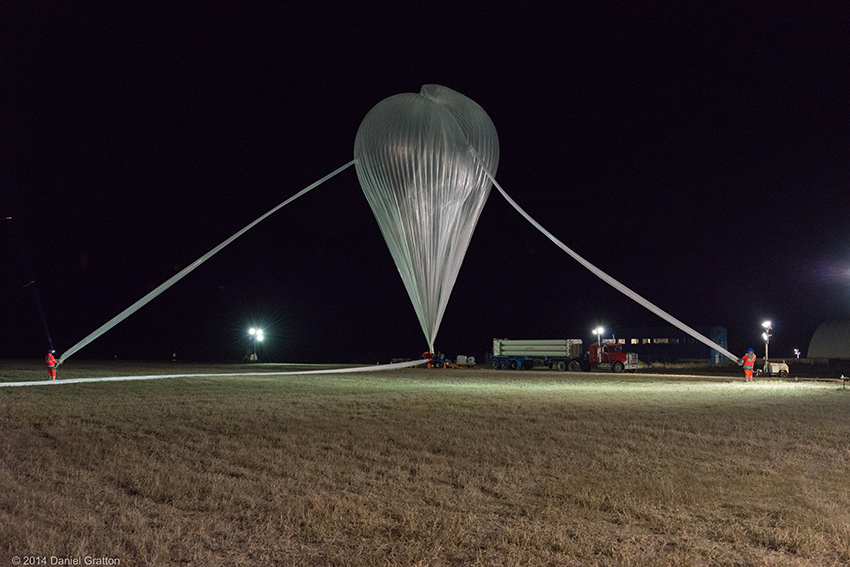
ZPB launched from the base in Timmins, Ontario (Credit: CSA)

SEB launched from the base in Timmins, Ontario. (Credit: CSA)
During a ZPB launch campaign, multiple balloons are launched. All launches can accommodate a single primary payload, multiple secondary payloads, or both. Consequently, applicants will be considered for either a primary slot or a secondary slot, depending on their payload's mass and volume and power requirements. Typically, a primary payload can weigh up to 800 kg, and a secondary payload can weigh up to 100 kg.
For primary payloads greater than 400 kg, grant recipients may be required to provide their own gondola to accommodate their payload. If that is the case, neither the CNES nor the CSA will be responsible for providing such a gondola, including the structure and pointing systems. However, the CSA and the CNES can provide the telemetry and telecommunications subsystem (the CNES PASTIS communication system downlink is limited to 1400 kbit/s) that will allow the payload communications system to send data to the ground and uplink commands. In some cases, the CSA can also provide a power subsystem (unregulated, 28 V nominal), including battery packs and a power distribution capacity.
In the case of secondary payloads, the recipient must provide a self-contained payload that will not interfere with the primary payload. Secondary payloads will be accepted depending on the volume, mass, and power available on board the gondola. Although power and communications subsystems can be provided by the gondola, there may be special cases where payloads would need to supply their own power. These will be assessed on a case-by-case basis. The total communications downlink bandwidth allocation (1400 kbit/s) will be shared by all the payloads onboard. All primary and secondary payloads flying with the CSA/CNES balloons can use the provided CSA uPRISM system for in-flight position and attitude knowledge. Post-flight position and attitude knowledge may also be shared with recipients upon their request.
Grant recipients intending to use a ZPB flight will be required to fill out a questionnaire providing additional information on the payload, the flight requirements, constraints, and payload hazards. The recipient will subsequently be responsible for ensuring that its payload and its gondola (if applicable) will be ready on time for the given flight window. Payload safety and interface requirements, which are outlined in the CNES User Manual, will be provided to the recipient. Payloads shall meet all requirements in order to fly, and any deviations or non-compliance must be reviewed and approved by the CSA and/or CNES in advance of the flight. The recipient will follow the CSA's payload certification process, which includes submitting an Experiment Safety Data Package along with a Requirements Compliance Matrix, Hazard Sheets and a Safe Recovery Procedure, in order to get flight certification and approval for the flight. The CSA will carry out an internal technology assessment several months prior to the balloon campaign to confirm whether or not the proposed payload is ready for the flight.
Payload certification is also required for SEB flights. The CSA will provide instructions and guidance for grant recipients who would like to fly their research experiments on a SEB.
The CSA will do its utmost to fly all FAST grant recipient payloads that meet the payload requirements and that are compatible with the STRATOS balloon campaign plans and schedule.
Applicants interested in using a STRATOS balloon flight must clearly state so in their application and provide information on their payload as well as their flight preferences (such as period of the year for a flight, launch site, required flight profile and the expected support required by the CNES and the CSA). However, the CSA cannot guarantee a flight at the location, period of the year or time of day stated in a recipient's application.
Expenses associated with a STRATOS balloon launch, flight operations, and payload recovery will be supported by the CSA. An additional agreement may have to be signed between the CSA and the recipient, provided that the proposal has been selected for funding.
For general information on the CSA's balloon program, please refer to the Stratospheric balloons Web page.
To obtain a copy of the Stratospheric Balloon User Manual, please send a request to: stedia-dstemu@asc-csa.gc.ca. This document is subject to change at any time. Notice of such changes will be sent only to organizations that have officially requested a copy of the document.
A4.2 Access to CSA infrastructure and facilities for field investigations in Longueuil, Quebec
In order to facilitate the ground testing and demonstration of planetary exploration technologies and to support field investigations to prepare Canada for future planetary exploration missions, the CSA has developed infrastructure and facilities to test, integrate and operate planetary exploration systems and equipment, such as rovers and scientific instruments, in an environment similar to that of a planetary mission. The facilities include integration labs, test facilities, and a planetary analogue terrain.
The CSA may make available to grant recipients, subject to availability, its outdoor facilities and infrastructure to support the testing, integration and operation of exploration systems and equipment (e.g. rovers, instruments, payloads). This access may include expert engineering and technical staff resources to operate the CSA-provided facilities and infrastructure and to support the recipients while on site at the CSA, subject to experts' availability.
Applicants interested in accessing the CSA facilities must clearly state so in their application and provide information on their rover, instrument, or payload as well as their schedule. However, the CSA cannot guarantee that a specific facility or technical expert will be available at the location, period of the year, or time of day stated in a recipient's application. The application must also mention the risks and mitigation measures if the requested CSA facilities and resources cannot be made available.
A4.2.1 Description of facilities
The following documentation regarding CSA facilities may be provided upon request:
- Analogue Terrain (AT) Health and Safety Guidelines; and
- Digital Elevation Map of the Analogue Terrain (AT).
To obtain copies of these documents, please send a request to stedia-dstemu@asc-csa.gc.ca. Brief descriptions of the facilities are provided below.
Analogue Terrain (AT)
The analogue terrain located at the CSA is a 60 x 120-metre outdoor facility offering various surface features and topographies to simulate the planetary surface, such as rock bed, crater, summit, and flag stone patch.
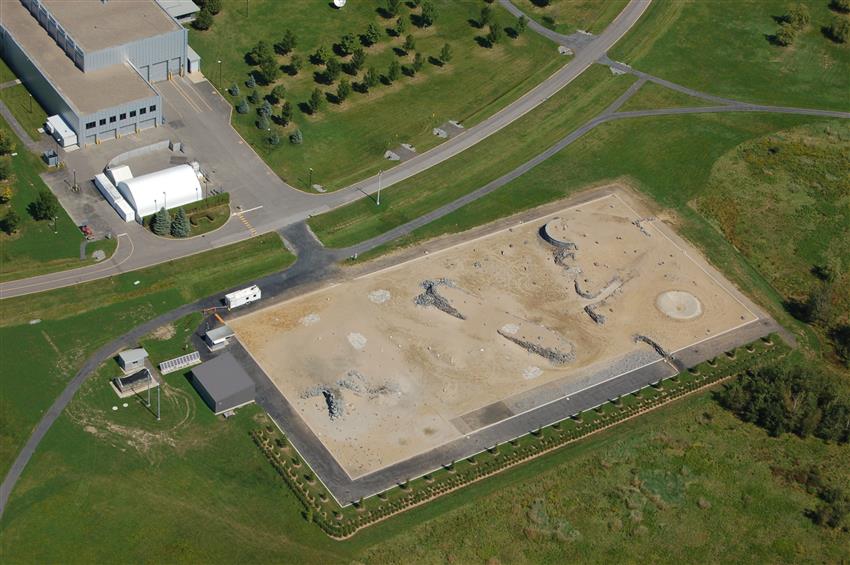
An aerial photo shows the analogue terrain located at the CSA. It is a large sandy field with topographic irregularities. (Credit: CSA)
A4.2.2 Details regarding the process
Once a project has been selected, the CSA will organize a technical meeting during which the applicant will have to provide additional technical information on its rover, instrument or payload as well as field investigation requirements relative to its use of CSA facilities and infrastructure. The applicant will subsequently be responsible for ensuring that its equipment will be ready on time and that it meets the CSA safety and interface requirements.
The preliminary schedule provided in the application must include target dates for the demonstration of capacities (deployment) and a readiness review that must be carried out four weeks prior to the deployment. The CSA aims to accommodate all selected FAST requests that meet the CSA health and safety (H&S), security, and interface requirements and that are compatible with ongoing CSA plans for the use of its facilities, infrastructure and technical support resources.
Users of the CSA facilities (e.g. Analogue Terrain) will be sent facility-specific H&S plan(s) prior to their arrival. All participants will be asked to respond with an email stating that they have read, understood, and will comply with the H&S requirements.
CSA badging will be arranged prior to arrival. Depending on the length of the visit and the frequency of trips to the CSA, either a visitor's badge (escort required) or a CSA access badge (no escort required) will be issued upon arrival. For CSA Visitor Badges, Canadians must show ID (e.g. driver's license) and non-Canadians must show ID, a student/work visa, and a passport. For CSA access badges, a government security check will be done, including fingerprinting, and requiring a form to be filled out and submitted approximately two weeks prior to the visit.
Appendix B - Scoring
Applications will be evaluated using the detailed scoring scales outlined in this Appendix. It is strongly recommended that applicants include information in their applications related to the highest score or passing score for each criterion.
In this section
B1. Funding Categories A and B
1. Benefits to Canada and Outcomes
Maximum Points: 50
Minimum Points to Pass: 35
1.1 Merit of the Proposed Research
Maximum Points: 25
This criterion is used to evaluate the originality of the research and its probable impact and potential to advance knowledge in space sciences and/or technologies, directly or indirectly. This criterion is also used to evaluate the alignment of the proposed research with the research priorities outlined in Section 3.3 of the AO.
This criterion will be used to answer the following questions:
- Is the research clearly aligned with one of the research priorities outlined in Section 3.3?
- Is the research original with the potential to have a broad impact in several fields or applications?
- Will the proposed research advance knowledge in space sciences or contribute to the advancement of space technologies?
Evaluation source: Application form (including any supporting documents)
Weak: (Score: 5)
The proposed research does not present new concepts and will not contribute to the advancement of new knowledge in space science and/ or technology. In addition, the alignment of the project with one of the research priorities of the FAST AO is not well-described.
Average: (Score: 15)
The proposed research is a derivative of previous work but could advance knowledge in space science or could lead to the advancement of a technology. The proposed research is aligned with one of the research priorities.
Good: (Score: 20)
The proposed research is original and will likely benefit Canadians (Canada's reputation, services for Canadians, etc.) with potential impacts primarily in one field or application. In addition, the proposed research will advance knowledge in space science or will lead to the advancement of a technology. The proposed research is aligned with one of the research priorities.
Excellent: (Score: 25)
The proposed research is original and could have significant benefits for Canadians (Canada's reputation, services for Canadians, etc.) with potential impacts in several fields or applications. The proposed research will also significantly advance knowledge in space science or will lead to the advancement of a technology. The proposed research is aligned with one of the research priorities.
1.2 Training Plan
Maximum Points: 25
This criterion is used to evaluate the quality, relevance, and clarity of the training plan as well as the impact of the knowledge and experience that the students involved are expected to acquire.
This criterion will be used to answer the following questions:
- Is the training plan well-defined, with detailed information on the activities in which the students will participate along with the distribution of tasks?
- Do the training activities suit the academic level of the students involved in the project?
- Will the students gain knowledge and experience that is relevant and sought-after by potential employers in the space sector?
Evaluation source: Application form (including any supporting documents)
Weak: (Score: 5)
The training plan is poorly defined and contains few details on the activities in which the students will participate and on the distribution of tasks.
Average: (Score: 15)
The training plan is partially defined with some details missing on the activities in which the students will participate as well as the distribution of tasks. Overall, the activities or projects suit the academic level of the students involved in the project.
Good: (Score: 20)
The training plan is well-designed and provides detailed information on the activities in which the students will participate and on the distribution of tasks. The activities or projects suit the academic level of the students involved and detailed information is provided on the knowledge and skills that the students will acquire.
Excellent: (Score: 25)
The training plan is well-designed and provides clear and detailed information on the activities in which the students will participate along with the distribution of tasks. The activities or projects suit the academic level of the students involved in the project (undergraduate, Master's, PhD, etc.) and detailed information is provided on the knowledge and skills that the students will acquire as well as the potential impact this research may have on their careers. The students will gain knowledge and experience that is relevant and sought-after by potential employers in the space sector and examples of this are provided.
1.3 Equity, Diversity, and Inclusion (EDI)
Pass/Fail
This criterion is used to evaluate whether the proposal includes a meaningful plan to foster the recruitment and engagement of members from designated and equity-deserving groups in the research team.
This criterion will be used to answer the following questions:
- Will the research project meaningfully engage members from designated and equity-deserving groups within the research team?
- Have measures been put in place or will measures be put in place to facilitate access and participation of members of designated and equity-deserving groups in the research team (e.g.: Indigenous people, women, members of visible minorities, persons with disabilities, 2SLGBTQ+, people from socio-economically disadvantaged communities) and will the impact of these measures be measured?
Evaluation source: Application form (including any supporting documents)
Fail: The proposal does not show an understanding of EDI considerations or systemic barriers. No information is provided regarding concrete measures that have been or will be put in place to facilitate access and the participation of members from designated and equity-deserving groups.
Pass: The proposal shows an understanding of EDI consideration and systemic barriers in the context of the research team. Concrete EDI measures have been or will be implemented to facilitate access and the participation of members from designated and equity-deserving groups and impact will be measured.
2. Feasibility, Resources, and Risks
Maximum Points: 50
Minimum Points to pass: 35
2.1 Project Feasibility
Maximum Points: 20
This criterion is used to evaluate the clarity, completeness, and feasibility of the research plan, whether the planned budget is adequate to achieve the project's objectives, and the timely availability of the required physical resources (equipment, instruments and/or scientific data) and infrastructure (ground-based infrastructure, suborbital/orbital platform, analogue site).
This criterion will be used to answer the following questions:
- Is the schedule appropriate for the proposed research project, allowing for flexibility?
- Is the proposed research well-defined, including proposed methodology, with detailed justification, and key milestones?
- Is access to physical resources or infrastructure, required to complete the research, confirmed or highly likely?
- Is the proposed budget sufficient for the work to be completed and does it include other sources of funding?
Evaluation source: Application form (including any supporting documents)
Weak: (Score: 5)
There is a high likelihood that the project objectives will not be met because of a combination of at least two of the following:
- the research plan is poorly defined (e.g. incoherent or incomplete WBS);
- the methodology for the proposed research is inappropriate;
- the schedule is incomplete or overly optimistic;
- the budget is insufficient;
- information is missing regarding timely access to the required physical resource(s) or infrastructure(s).
Average: (Score: 10)
It is likely that the project objectives will be met, however there is concern with one of the following:
- the research plan is poorly defined (e.g. incoherent or incomplete WBS);
- the methodology for the proposed research is inappropriate;
- the schedule is incomplete or overly optimistic;
- the budget is insufficient;
- information is missing regarding timely access to the required physical resource(s) or infrastructure(s).
Good: (Score: 15)
There is a good likelihood that all the objectives will be met because of the following:
- the research plan is well-defined;
- appropriate methodology is proposed;
- the schedule is appropriate ;
- the proposed budget is sufficient;
- they will likely have timely access to the required physical resource(s) or infrastructure(s).
Excellent: (Score: 20)
There is a strong likelihood that all the objectives will be met because of the following:
- the research plan is well defined with key milestones listed;
- appropriate methodology is proposed with a detailed justification;
- the schedule is appropriate, allowing for flexibility;
- the budget is sufficient and includes other sources of funding;
- timely access to the required physical resource(s) or infrastructure(s) is confirmed or highly likely.
2.2 Project Team
Maximum Points: 20
This criterion is used to evaluate the quality of the project team and their capacity to carry out the research project.
This criterion will be used to answer the following questions:
- Does the project team have demonstrated experience in the field of study concerned?
- Does the project team have the expertise required to undertake the project?
- Has the project team demonstrated its capacity to manage and carry out similar projects?
Please note that in evaluating the project team, the CSA reserves the right to take into consideration how the PI managed CSA-funded projects in the past, if applicable (including reporting accuracy and reliability).
Evaluation source: Application form, Curricula vitae, CSA evaluations of the PI's previous progress and final reports (if applicable)
Weak: (Score: 5)
The application package, including the provided CVs, demonstrate that the project team members do not have the experience and/or expertise to carry out the proposed research.
Average: (Score: 10)
The application package, including the provided CVs, demonstrate that the project team members have some experience and expertise to complete the proposed research. There is a missing area of key expertise required that may have an important impact on the project.
Good: (Score: 15)
The application package, including the provided CVs, demonstrate that the project team members have some experience and expertise required to complete the proposed research. There is a missing area of expertise that would have a limited impact on the project and it is sufficiently addressed in the application package.
Excellent: (Score: 20)
The application package, including the provided CVs, clearly demonstrate that the project team members have the experience and the expertise required to complete the proposed research.
2.3 Project-Related Risks and Mitigation Measures
Maximum Points to Pass: 10
Minimum Points to Pass: 5
This criterion is used to evaluate the completeness of the risk assessment and the sufficiency of the mitigation strategy for each risk.
This criterion is used to answer the following questions:
- Has the applicant identified and described in detail all technical and programmatic risks associated with the project?
- Are the proposed mitigation strategies for each risk appropriate?
- Is a thorough risk assessment done, including a realistic and credible impact/likelihood assessment?
Note: the evaluation of the risk criterion will be based on whether all risks were identified, whether the impact and probability assessment is realistic and credible, and whether the proposed mitigation strategies are appropriate. The project will not be penalized for having high risks or unconfirmed sources of funding if the risks have been identified and the mitigation strategies provided are appropriate.
Evaluation source: Application form (including any supporting documents)
Weak: (Score: 0)
The proposal does not mention any of the main risks associated with the project OR the proposal does not contain a mitigation strategy OR the proposal includes some risks, but the associated mitigation strategies are missing.
Average: (Score: 5)
Most expected technical and programmatic risks are listed but lack some detail OR the impact/likelihood assessment is incomplete for some risks OR the proposed mitigation strategy is insufficient for one of the main risks.
Good: (Score: 7)
All expected technical and programmatic risks are listed with a brief explanation. An impact/likelihood assessment is provided for each risk but raises some questions or minor concerns. The risk mitigation strategy proposed for each risk is provided with some justification but lacks some detail.
Excellent: (Score: 10)
All expected technical and programmatic risks are explained in detail. An impact/likelihood assessment is provided for each risk and is credible. The risk mitigation strategy proposed for each risk is appropriate.
B2. Funding Category C
1. Benefits to Canada and Outcomes
Maximum Points: 50
Minimum Points to Pass: 35
1.1 Merit of the Proposed Research
Maximum Points: 25
This criterion is used to evaluate the originality of the research and its probable impact and potential to advance knowledge in space sciences and/or technologies, directly or indirectly. This criterion is also used to evaluate the alignment of the proposed research with the research priorities outlined in Section 3.3 of the AO.
This criterion will be used to answer the following questions:
- Is the research clearly aligned with one of the research priorities outlined in Section 3.3?
- Is the research likely to advance knowledge in space science or improve the capability of an instrument/payload?
- Is the proposed research suitable for college or undergraduate student research?
Evaluation source: Application form (including any supporting documents)
Weak: (Score: 5)
The proposed research aligns with one of the research priorities of the FAST AO but the proposed research is inappropriate (e.g. complexity) for college or undergraduate student research.
Average: (Score: 15)
The proposed research aligns with one of the research priorities of the FAST AO and is suitable for college or undergraduate student research but is unlikely to advance knowledge in space science nor improve the capability of an instrument/payload.
Good: (Score: 20)
The proposed research aligns with one of the research priorities of the FAST AO and is suitable for college or undergraduate student research. In addition, the proposed research will likely advance knowledge in space science or improve the capability of an instrument/payload.
Excellent: (Score: 25)
The proposed research aligns with one of the research priorities of the FAST AO and is suitable for college or undergraduate student research. In addition, the proposed research is highly likely to advance knowledge in space science or improve the capability of an instrument/payload.
1.2 Training Plan
Maximum Points: 25
This criterion is used to evaluate the quality, relevance, and clarity of the training plan as well as the impact of the knowledge and experience that the students involved are expected to acquire.
This criterion will be used to answer the following questions:
- Is the training plan well-defined, with detailed information on the activities in which the students will participate along with the distribution of tasks?
- Will the students gain knowledge and experience that is relevant and sought-after by potential employers in the space sector?
Evaluation source: Application form (including any supporting documents)
Weak: (Score: 5)
The training plan is poorly defined and contains few details on the activities in which the students will participate and the distribution of tasks.
Average: (Score: 15)
The training plan is partially defined with minor details missing on the activities in which the students will participate as well as the distribution of tasks.
Good: (Score: 20)
The training plan is well-designed and provides detailed information on the activities in which the students will participate and on the distribution of tasks. Detailed information is provided on the knowledge and skills the students will acquire.
Excellent: (Score: 25)
The training plan is well-designed and provides clear and detailed information on the activities in which the students will participate along with the distribution of tasks. Detailed information is provided on the knowledge and skills the students will acquire and the potential impact on their careers. The students will gain knowledge and experience that is relevant and sought-after by potential employers in the space sector.
1.3 Equity, Diversity, and Inclusion (EDI)
Pass/Fail
This criterion is used to evaluate whether the proposal includes a meaningful plan to foster the recruitment and engagement of members from designated and equity-deserving groups in the research team.
This criterion will be used to answer the following questions:
- Will the research project meaningfully engage members from designated and equity-deserving groups within the research team?
- Have measures been put in place or will measures be put in place to facilitate access and participation of members of designated and equity-deserving groups in the research team (e.g.: Indigenous people, women, members of visible minorities, persons with disabilities, 2SLGBTQ+, people from socio-economically disadvantaged communities) and will the impact of these measures be measured?
Evaluation source: Application form (including any supporting documents)
Fail: The proposal does not show an understanding of EDI considerations or systemic barriers. No information is provided regarding concrete measures that have been or will be put in place to facilitate access and the participation of members from designated and equity-deserving groups.
Pass: The proposal shows an understanding of EDI consideration and systemic barriers in the context of the research team. Concrete EDI measures have been or will be implemented to facilitate access and the participation of members from designated and equity-deserving groups and impact will be measured.
2. Feasibility, Resources, and Risks
Maximum Points: 50
Minimum Points to pass: 35
2.1 Project Feasibility
Maximum Points: 20
This criterion is used to evaluate the clarity, completeness, and feasibility of the research plan, whether the planned budget is adequate to achieve the project's objectives, and the timely availability of the required physical resources (equipment, instruments and/or scientific data) and infrastructure (ground-based infrastructure, suborbital/orbital platform, analogue site).
This criterion will be used to answer the following questions:
- Is the schedule appropriate for the proposed research project, allowing for flexibility?
- Is the proposed research well-defined, including proposed methodology, with detailed justification, and key milestones?
- Is access to physical resources or infrastructure, required to complete the research, confirmed or highly likely?
- Is the proposed budget sufficient for the work to be completed and does it include other sources of funding?
Evaluation source: Application form (including any supporting documents)
Weak: (Score: 5)
There is a high likelihood that the project objectives will not be met because of a combination of at least two of the following:
- the research plan is poorly defined (e.g. incoherent or incomplete WBS);
- the methodology for the proposed research is inappropriate;
- the project schedule is incomplete or overly optimistic;
- the budget is insufficient;
- information is missing regarding timely access to the required physical resource(s) or infrastructure(s).
Average: (Score: 10)
It is likely that the project objectives will be met, however there is concern with one of the following:
- the research plan is poorly defined (e.g. incoherent or incomplete WBS);
- the methodology for the proposed research is inappropriate;
- the project schedule is incomplete or overly optimistic;
- the budget is insufficient;
- information is missing regarding timely access to the required physical resource(s) or infrastructure(s).
Good: (Score: 15)
There is a good likelihood that all the objectives will be met because of the following:
- the research plan is well-defined;
- appropriate methodology is proposed;
- the project schedule is appropriate;
- the proposed budget is sufficient;
- they will likely have timely access to the required physical resource(s) or infrastructure(s).
Excellent: (Score: 20)
There is a strong likelihood that all the objectives will be met because of the following:
- the research plan is well defined and with key milestones listed;
- appropriate methodology is proposed with a full detailed justification;
- the project schedule is appropriate, allowing for flexibility with margin;
- the budget is sufficient and includes other sources of funding;
- timely access to the required physical resource(s) or infrastructure(s) is confirmed or highly likely.
2.2 Project Team
Maximum Points: 20
This criterion is used to evaluate the quality of the project team and their capacity to carry out the research project.
This criterion will be used to answer the following questions:
- Does the project team have demonstrated experience in the field of study concerned?
- Does the project team have the expertise required to undertake the project?
- Has the project team demonstrated its capacity to manage and carry out similar projects?
Evaluation source: Application form, Curricula vitae
Weak: (Score: 5)
The application package, including the provided CVs, does not demonstrate that the project team members have the experience and/or expertise to carry out the proposed research.
Average: (Score: 10)
The application package, including the provided CVs, demonstrates that the project team members have some experience and expertise but will be required to seek some additional expertise and have outlined a plan to do so.
Good: (Score: 15)
The application package, including the provided CVs, demonstrates that the project team members have some experience and expertise likely permitting them to complete the proposed research.
Excellent: (Score: 20)
The application package, including the provided CVs, demonstrates that the project team members have experience and expertise that would make them well-equipped to complete the proposed research.
2.3 Project-Related Risks and Mitigation Measures
Maximum Points to Pass: 10
Minimum Points to Pass: 5
This criterion is used to evaluate the completeness of the risk assessment and the sufficiency of the mitigation strategy for each risk.
This criterion is used to answer the following questions:
- Has the applicant identified and described in detail all technical and programmatic risks associated with the project?
- Are the proposed mitigation strategies for each risk appropriate?
- Is a thorough risk assessment done, including a realistic and credible impact/likelihood assessment?
Note: the evaluation of the risk criterion will be based on whether all risks were identified, whether the impact and probability assessment is realistic and credible, and whether the proposed mitigation strategies are appropriate. The project will not be penalized for having high risks or unconfirmed sources of funding if the risks have been identified and the mitigation strategies provided are appropriate.
Evaluation source: Application form (including any supporting documents)
Weak: (Score: 0)
The proposal does not mention any of the main risks associated with the project OR the proposal does not contain a mitigation strategy OR the proposal includes some risks, but the associated mitigation strategies are missing.
Average: (Score: 5)
Most expected technical and programmatic risks are listed but lack some detail OR the impact/likelihood assessment is incomplete for some risks OR the proposed mitigation strategy is insufficient for one of the main risks.
Good: (Score: 7)
All expected technical and programmatic risks are listed with a brief explanation. An impact/likelihood assessment is provided for each risk but raises some questions or minor concerns. The risk mitigation strategy proposed for each risk is provided with some justification but lacks some detail.
Excellent: (Score: 10)
All expected technical and programmatic risks are explained in detail. An impact/likelihood assessment is provided for each risk and is credible. The risk mitigation strategy proposed for each risk is appropriate.
Appendix C – Narrative CV Format
C1. General Instructions
Each application must include the CV of each of the research team members. The English version of the CV must not exceed five pages (six pages for French). There is no limit per section as long as the CV does not exceed the total page limit. Please follow the template and instructions below.
You must use the provided narrative CV template and respect the following formatting requirements:
- 12-point, Arial font in black type.
- Different fonts and sizes can only be used in tables, figures and legends but must remain readable.
- Single line spacing.
- Normal/standard character spacing (not condensed).
- Minimum margin of 0.79″ (2 cm) around all pages.
- Size all pages to 8 ½″ x 11″ (216 mm x 279 mm).
If you are listing publications:
- Use any citation style common in your field.
- Add an asterisk (*) after each of your supervised highly qualified personnel (e.g., First Name Last Name* or Last Name, First Name*) if you are their supervisor.
- If the lead author is not listed first (e.g., if authorship is alphabetical), bold the lead author's name.
Highly qualified personnel are college and university students (undergraduate and graduate), postdoctoral researchers, and members of the workforce that have a minimum of a bachelor's degree.
C2. Instructions for each portion of the narrative CV
C2.1. Personal Statement
Describe why you are well suited for your proposed role relevant to the application. For example, you may include:
- Collaborations or past performance in the field or related fields.
- Expertise related to the specific topic or related topics.
- Impact of your research, and its benefits to society and science.
- Leadership activities and skills.
- Previous work, progress, or productivity that provides context to the results of your research activities which support your current application.
- Recognitions (e.g., prizes, awards, community letters).
C2.2. Most Significant Contributions and Experiences
Describe up to 10 important contributions or experiences that relate to your application. Contributions described in the previous section can be used here.
Explain the impact, significance, usefulness, and your role in each contribution or experience. A contribution does not have to be a single publication or report. This can include a collection of related publications.
For example, you may include:
- Articles and other publications (e.g., communications, monographs, memoirs or special papers, review articles, conference/symposia/workshop proceedings, government publications, reports documenting industrial contributions or contributions to professional practice, posters, abstracts, preprints).
- Assessment and review activities (e.g., journal review, conference review, funding assessment).
- Community service or involvement that leverages expertise (e.g., membership on expert/advisory committees).
- Contributions to Indigenous leadership, self-determination, and capacity-building in research.
- Dataset creation, curation, sharing or re-use.
- Equity, diversity, inclusion and accessibility advances in the research ecosystem.
- Intellectual property (e.g., patents, copyrights, trademarks, trade secrets).
- Knowledge mobilization, including knowledge translation and communication of research results to specialist or non-specialist audiences, including policy-makers and the public (e.g., magazine/newspaper articles, media interviews, blogs, social media, policy briefs, public lectures).
- Methodologies, knowledge systems, cultural practices and approaches (e.g., Indigenous knowledge and science).
- New companies or organizations created to further the promotion/use of research.
- Partnerships or collaborations within or with Canadian or international research or non-research communities or non-profit / public / private sector organizations (e.g., through research networks, large collaborative projects, community-engaged research/citizen science, non-academic career information, voluntary work).
- Policies, guidelines, regulations, laws, rights, standards or practices.
- Products, technology, processes, services or advice useful to specific organizations (from the private, public or non-profit sectors), communities, or society.
- Software or tool development for use by researchers or others in the private or public domain.
C2.3 Supervisory and Mentorship Activities
Describe how you have helped mentor or train future generations. This can include the development of highly qualified personnel for careers within and outside of academia.
For example, you may include:
- Creation of safe, equitable and inclusive research environments, practices and norms.
- Development and delivery of training workshops outside of research or course requirements.
- Mentorship (formal or informal) of highly qualified personnel, early career researchers, colleagues, collaborators, relevant partners, other professionals, or community members.
- Outreach and engagement with students, youth, or members of the general public, including through in-person or online targeted activities or capacity building.
- Supervision of highly qualified personnel.
- Training in methodologies, knowledge systems, or cultural practices and approaches in the research context (e.g., Indigenous knowledge and science).
Appendix D – CSA-Supported Missions/Projects
Projects related to the following missions or projects are ineligible under this AO.
- ARIEL (Atmospheric remote-sensing infrared exoplanet large-survey)
- AstroSat
- CloudSat
- CSA Lunar Rover Mission
- Geospace Observatory (GO) Canada
- HAWC (High-altitude Aerosols, Water Vapour and Clouds)
- JWST (James Webb Space Telescope)
- LEAP (Lunar Exploration Accelerator Program) – please also see the news release from , for further details on LEAP investments.
- MSL (Mars Science Laboratory)
- Odin
- OSIRIS-REx (Origins, Spectral Interpretation, Resource Identification, Security, Regolith Explorer)
- RADICALS (RADiation Impacts on Climate and Atmospheric Loss Satellite)
- SCISAT
- Swarm
- SWOT (Surface Water and Ocean Topography)
- THEMIS (Time History of Events and Macroscale Interactions During Substorms)
- WildFireSat
- XRISM (X-Ray Imaging and Spectroscopy Mission XGS)