
The SpaceX Falcon 9 rocket and Dragon spacecraft
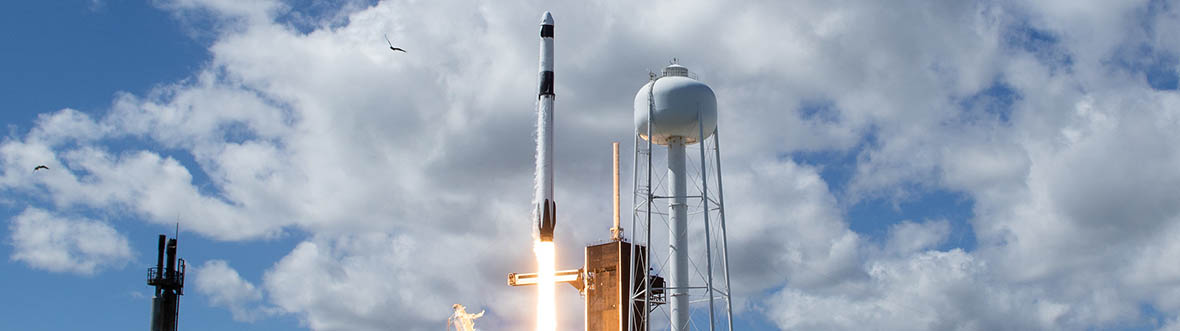
Falcon 9 rocket
Falcon 9, developed by SpaceX, is the world's first orbital class reusable rocket. It has two stages, one to escape Earth's gravity and the second, to deliver a payload to its intended orbit. The current Falcon 9 is the fifth generation of the rocket, which has been upgraded to meet human spaceflight standards.
The first stage of the rocket is capable of landing vertically, back on Earth, and can be reused multiple times.
On , Canada's RADARSAT Constellation Mission launched to space on a Falcon 9 rocket.
Dragon spacecraft
The Dragon spacecraft currently has two different styles: one for cargo and one for humans. The Dragon that supports human spaceflight missions can seat up to seven people. It is 8.1 metres tall and has a diameter of 4 metres. It consists of two parts:
- The spacecraft: a pressurized section which can carry environmentally sensitive cargo or astronauts.
- The trunk: an unpressurized section for cargo that also supports the spacecraft during launch. The trunk has solar panels that provide power to the vehicle while it is docked at the International Space Station (ISS). It is then jettisoned after Dragon completes its deorbit burn and ahead of splashing down in the Pacific Ocean.
Propulsion
The Dragon spacecraft has 16 Draco thrusters that are used to manoeuvre and adjust the spacecraft. Each thruster is capable of generating 400 newtons in the vacuum of space. SpaceX has also developed a more powerful version of thruster, called the SuperDraco, that assists with Dragon's launch escape system. In the unlikely event of an emergency, the eight SuperDraco engines can power Dragon almost one kilometre away from the rocket in less than eight seconds.
Re-entry
The Dragon spacecraft returns to Earth assisted by a system that consists of two drogue parachutes and four main parachutes. The drogue parachutes are designed to stabilize the spacecraft following re-entry. Shortly after the drogue parachutes are deployed, Dragon's four main parachutes deploy and further decelerate the spacecraft prior to splashdown.
NASA's Demo-2 mission was the Dragon spacecraft's first human spaceflight to dock with the ISS on , making it the first privately owned crewed spacecraft to ever dock with the orbiting laboratory.
CSA and the Dragon spacecraft
During CSA astronaut David Saint-Jacques' mission on the ISS, he used Canadarm2 to capture a Dragon cargo vehicle. This was the first time a CSA astronaut performed a cosmic catch.
Also, during David's mission, SpaceX launched Demo-1, Dragon's first demonstration mission in support of human spaceflight missions, to the ISS. David was the first astronaut to enter the docked Dragon.
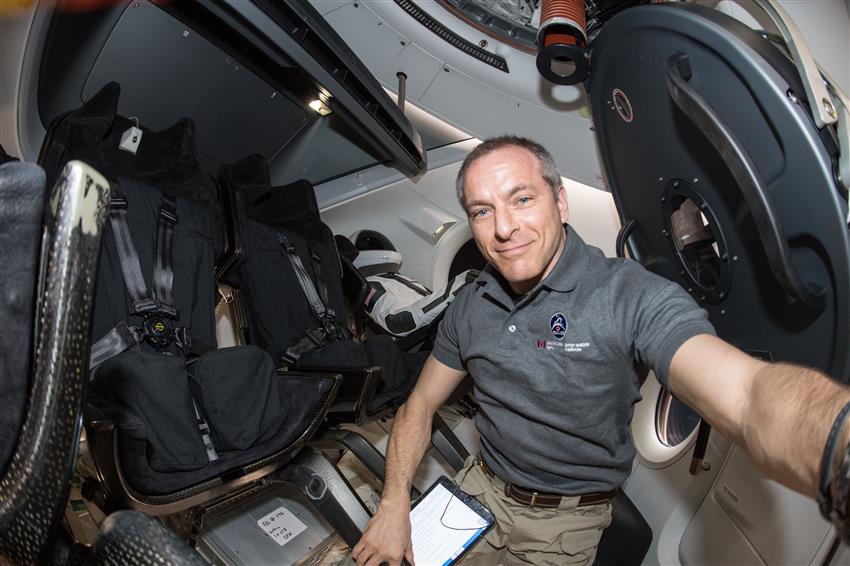
CSA astronaut David Saint-Jacques inside the SpaceX Dragon spacecraft. (Credit: CSA / NASA)