
SPARK: Investigating anemia in space

The SPARK experiment will gather data on why and how astronauts experience anemia in space.
Background
Since the beginning of human spaceflight, it has been common for astronauts to return with fewer red blood cells – which can lead to anemia. Anemia is a condition where your body lacks enough healthy red blood cells to carry sufficient oxygen to your body's tissues. The most common symptoms of anemia are tiredness, feeling weak and shortness of breath.
SPARK is using results from the Canadian-led experiment MARROW to continue to investigate the root of space anemia. MARROW showed that the severity of anemia experienced by astronauts as well as the time to recover to pre-spaceflight levels of health depended on how long the astronaut was in microgravity.
As humanity prepares for space missions to the Moon and eventually Mars, understanding what causes space anemia and how to alleviate the symptoms is increasingly important.
Objectives
This study will:
- measure changes in spleen size, shape, and structure in astronauts on long-duration space missions to the International Space Station (ISS)
- measure the destruction of red blood cells (hemolysis) in astronauts before, during and after their missions
Impacts on Earth
Anemia is common on Earth and is strongly tied to immobility and aging. In long-term care facilities, 48% to 63% of residents experience anemia. People who are bedridden or on long-term bed rest experience similar challenges as astronauts on the ISS, where the microgravity environment leads to less muscle use. Learning more about anemia in space could lead to solutions for many patients on Earth.
How it works
- Astronauts will have their spleen measured before, during and after their missions.
- Astronauts will measure their carbon monoxide elimination (the most precise way to measure red blood cell destruction in space). They will do this by collecting breath and ambient air samples on the ISS.
- Blood samples of the astronauts will be taken before, during and after spaceflight.
This experiment will draw on a sample size of 10 astronauts on long-duration space missions abord the ISS.
Timeline
Preparations for SPARK began in fall , and data analysis is scheduled to finish in .
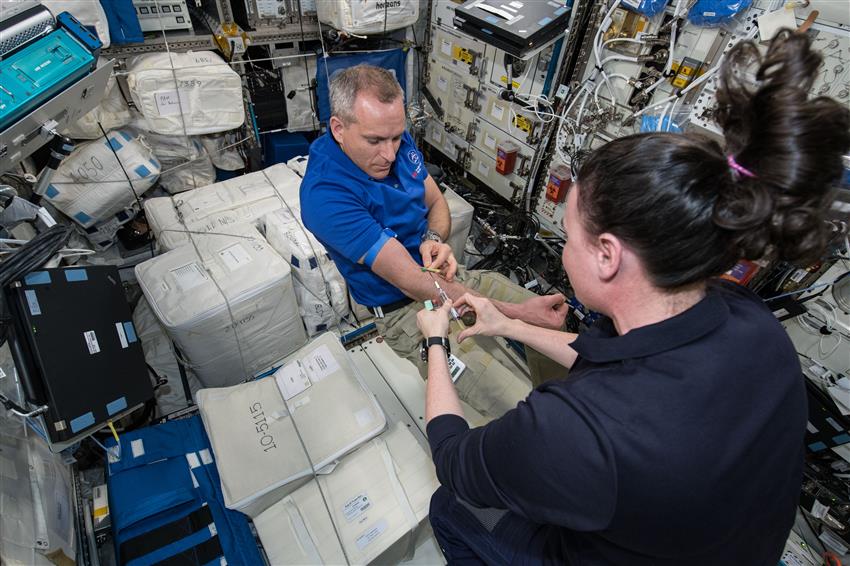
CSA astronaut David Saint-Jacques has blood taken while collecting samples for MARROW, the predecessor of SPARK. (Credit: NASA)
Research team
Principal investigator
- Dr. Guy Trudel, Ottawa Hospital Research Institute and University of Ottawa
Co-investigator
- Dr. Pablo Bartolucci, Mondor Institute of Biomedical Research
- Hakim Louati, Ottawa Hospital and the Bone and Joint Research Laboratory at the University of Ottawa
- Associate Professor Odette Laneuville, University of Ottawa
- Professor Marc-André Langlois, University of Ottawa
- Professor Joseph Borg, University of Malta
- Dr. Mark Campbell, University of Ottawa
- Assistant Professor Gerd Melkus, University of Ottawa
- Associate Professor Tim Ramsay, Ottawa Hospital Research Institute
- Dr. Adnan Sheikh, University of British Columbia
- Dr. Wael Shabana, University of Ottawa
- Dr. Philip Berardi, University of Ottawa
- Damian Carragher, Ottawa Hospital Research Institute
Research Coordinator
- Tiffany Stern, Ottawa Hospital Research Institute