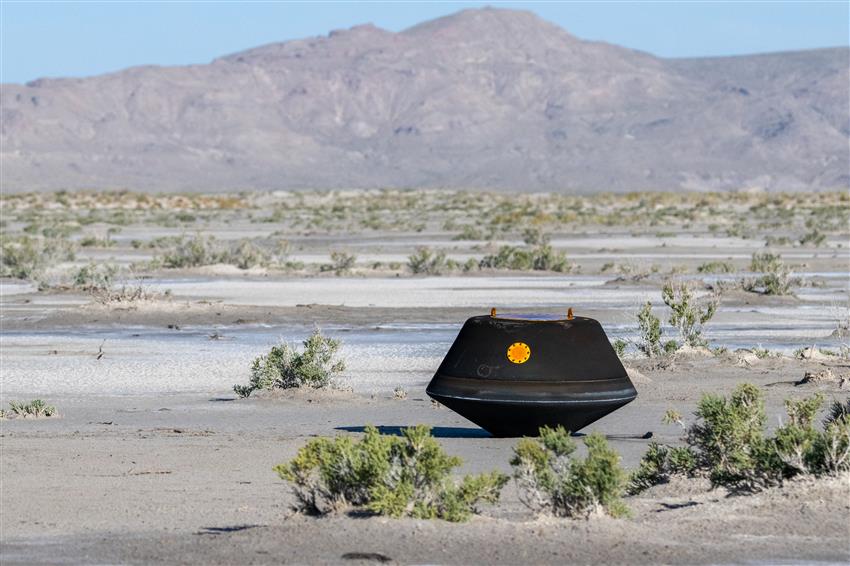
The following list highlights significant dates of the Canadian space history as well as major events and news of interest related to Canada's activities in space.
1839
Astronomy; Space history
Sir Edward Sabine establishes the first magnetic observatory at the University of Toronto, to study the proposition made by Edmund Halley in that northern lights were formed according to the Earth's magnetic field. Sabine is first to determine that magnetic disturbances occur worldwide and are related to the number and strength of sunspots.
This same year, the Meteorological Service of Canada is set up, also at the University of Toronto.
1882-1883
Astronomy
The First International Polar Year (IPY), organized on an international basis, includes measurements of meteorological, magnetic, and auroral phenomena in northern Canada.
1916
June 6, 1916
Space history
During World War I, the Government of Canada decides to coordinate national scientific research with the creation of the Honorary Advisory Council on Scientific and Industrial Research, which after June 19, 1925, as the National Research Council of Canada (NRCC).
1921
August 28, 1921
Space history; Presidents
John Herbert Chapman, who will gain wide recognition as the father of the Canadian Space Program is born in London, Ontario. He will be instrumental in initiating and directing the successful Alouette/ISIS scientific Earth satellite program.
1932-1933
Astronomy
Second IPY.
Canada participates by establishing measurement field stations of meteorological, magnetic and auroral phenomena beyond the Arctic Circle. New technology, unknown during the first IPY 50 years earlier, makes use of radio-equipped balloons and kites to extend measurements high above the Earth's surface.
Radio techniques are used for the first time in Canada to demonstrate the correlation between solar radiation and the ionosphere.
1952
Space history
The Defence Research Board (DRB), founded five years earlier, merges two National Research Council laboratories (Radio Propagation Lab and Electronics Lab) into the Defense Research Telecommunications Establishment (DRTE) in Shirley's Bay, west of Ottawa. The latter is the predecessor of the Communications Research Centre (CRC).
1954
Space history
The DRB builds the Defence Research Medical Laboratories in Downsview, Ontario, that merges, in 1971, with the Royal Canadian Air Force Institute of Aviation Medicine, to form the Defense and Civil Institute of Environmental Medicine (DCIEM).
1957-1958
Astronomy
International Geophysical Year (IGY)
From July 1957 to December 1958, is a period of maximum solar activity, and the science community worldwide conducts research to better understand Earth's physics and the interactions between the Sun and our planet.
During this period, Canada and the U.S. build the Churchill Research Range in northern Manitoba, for launching suborbital sounding rockets that will probe the upper atmosphere. Until it is decommissioned in 1989, more than 3,500 suborbital flights are launched there.
1957
October 4, 1957
Satellites
Opening of the Space Age with the successful launch of the Soviet Sputnik 1 satellite, the first human-made object to orbit the Earth. The small 58-cm. aluminium sphere, launched from Baikonur, Kazakhstan, on an R-7/Semiorka rocket, circles the globe for three months before burning upon re-entry in the atmosphere.
Within hours of its launch, John Chapman and fellow scientists at DRTE are the first to record Sputnik 1's beeps.
1958
October 1, 1958
Space history
The National Aeronautics and Space Administration (NASA) officially begins operations. Two months earlier, on July 29, U.S. President Dwight Eisenhower had approved a bill voted by Congress to create the first-ever civilian space agency.
October 4, 1958
Space history
During its annual meeting in Washington, the International Council of Scientific Unions decides to create the COSPAR organization (Committee on Space Research) to extend space research that had been carried out under the various IGY programs. Canada is a founding member. The charter is adopted in Amsterdam the following year, on November 13, 1959.
November 8, 1958
Space history
Launch of a Nike-Cajun sounding rocket from the Churchill Range with the first Canadian science payload.
1959
March 11, 1959
Satellites
NASA approves a Canadian proposal, submitted by the DRB, to build the Alouette I satellite for the study of the ionosphere. NASA agrees to launch this first Canadian satellite.
June 6, 1959
Space history
The Prince Albert Radar Laboratory is inaugurated in Prince Albert, Saskatchewan. On this day, Prime Minister John Diefenbaker and President Dwight Eisenhower have a telecommunication conversation by means of a radar signal that bounces back from the moon.
September 5, 1959
Space history
The Black Brant 1, the first all-Canadian sounding rocket, built by Bristol Aerospace of Winnipeg, Manitoba, is launched at the Churchill Range. Over 3,500 suborbital sounding rockets would be launched from the site to probe the upper atmosphere.
1960
June 22, 1960
Satellites
Launch of U.S. navigation satellite Transit 2A with a cosmic noise receiver, the first Canadian hardware in space.
August 12, 1960
Satellites
Deployment in space of Echo 1, a U.S. satellite-balloon used as a passive communications satellite that was the first to provide a two-way telephone conversation. Echo 1, a 30-m inflatable structure, orbits the Earth at an altitude of 1600 km. One of its receiving stations is in Prince Albert, Saskatchewan.
1961
April 12, 1961
Space missions
After completing one orbit around the Earth during a 108-minute flight on his Vostok 1 spacecraft, Soviet cosmonaut Yuri Gagarin, a 27-year-old pilot, makes history as the first human being in space.
May 5, 1961
Space missions
Astronaut Alan B. Shepard becomes the first American in space after a 15-minute suborbital flight aboard his Freedom 7 capsule. The communication antenna of the spacecraft is Canadian, and is known as STEM (storable tubular extendible mechanism), built by de Havilland Aircraft of Downsview, Ontario.
1962
February 20, 1962
Space missions
Astronaut John H. Glenn achieves the first U.S. orbital crewed flight when his Friendship 7 capsule, also equipped with a Canadian-built STEM antenna, circles the Earth three times during a five-hour space flight.
September 29, 1962
Satellites
With the Alouette launch, Canada became the third nation, after the Russian and American superpowers, to design and build its own satellite. Alouette I was launched on a Thor-Agena B rocket at Vandenberg Air Force Base in California on an 80-degree-inclination orbit, at an altitude of 1000 km. (Official local date of the launch is September 28, 10:30 pm, PDT.) Designed with a one-year lifetime, the topside sounder will transmit useful data for over 10 years. It studies the ionosphere, the electrically-charged layer of the upper atmosphere that can affect long-distance radio transmission. Alouette II is launched on November 29, 1965.
Ok
Engineer Colin Franklin discusses the design challenges of Alouette I. (Credit: Canadian Space Agency [CSA])
Launch of Relay-1, a communication satellite built by RCA Limited. The transponder onboard the spacecraft, provided by a microwave group at the RCA plant in Montreal, is the first Canadian-built hardware in a communications satellite.
1963
May 23, 1963
Satellites
Memorandum of Understanding between the Defence Research Board and NASA for the ISIS (International Satellites for Ionospheric Studies) program, a follow-on of the Alouette program.
December 21, 1963
Satellites
First weather photo transmitted in Canada from U.S. satellite TIROS 8.
1964
August 20, 1964
Satellites
Creation, in Washington, D.C., of the International Satellite Telecommunication Organization (Intelsat). Canada is a founding member.
1965
April 6, 1965
Satellites
Launch of Early Bird (Intelsat 1), first commercial communication satellite, used by the Canadian Overseas Telecommunications Corporation for transatlantic communications (in 1975, it would become Teleglobe Canada).
November 29, 1965
Satellites
A Thor-Agena B rocket launches Canada's Alouette II from Vandenberg AFB, to continue ionospheric research from space. This first of the ISIS scientific satellites will compile useful data on the ionosphere for almost 10 years. It was designed and built by Canada, but launched by NASA.
1967
February 1967
Space history
In February, John Herbert Chapman, the leading manager of the Alouette program, submits a report to the federal government into which he recommends the creation of a national space agency.
1968
January 1, 1968
Space history
Spar Aerospace Limited is formed out of de Havilland Aircraft's Special Products and Advanced Research division.
March 28, 1968
Space history
John H. Chapman presents a White Paper on satellite communications to the Government entitled, "A Domestic Satellite Communications System for Canada."
1969
January 30, 1969
Satellites
Launch of ISIS I. More sophisticated than the Alouette spacecraft, ISIS is designed to make a comprehensive study of the upper section of the ionosphere, and to capture the first picture of the aurora borealis (northern lights) from space. Launch of ISIS 2 on March 31, 1971.
July 20, 1969
Space missions
At 10:56 pm (EDT) on this historic Sunday, U.S. astronaut Neil A. Armstrong, commander of mission Apollo 11, becomes the first person to set foot on the Moon. Fifteen minutes later, Buzz Aldrin climbs down the ladder of the lunar module to join his commander. Using a landing gear built by Héroux Aerospace of Longueuil, Quebec, the Eagle had touched down more than six hours earlier (4:17 pm) in the Sea of Tranquility. Apollo 11, is launched July 16, and splashes down on the Pacific Ocean on July 24.
September 1, 1969
Space history
The federal government announces the creation of Telesat Canada to own and exploit Canadian communication satellites. The government also sets up a Department of Communications that immediately takes over the Communications Research Centre (formerly Defence Research Telecommunications Establishment) and the Interdepartmental Committee on Space.
1970
September 30, 1970
Satellites
Telesat Canada signs an agreement with Hughes Aircraft of California to build Anik A1, Canada's first communications satellite.
1971
March 31, 1971
Satellites
Launch of the ISIS II scientific satellite on a Thor-Delta rocket, to continue ionospheric studies performed the two Alouette spacecrafts and ISIS I. In 1984, years after all Canadian research needs have been fulfilled, the operation of the two ISIS spacecraft is transferred to Japan for additional research.
April 1, 1971
Space history; Satellites
Creation of the Canada Centre for Remote Sensing (CCRS).
April 20, 1971
Satellites
Memorandum of Understanding is signed between Canada's Department of Communications and NASA to start the CTS (Communications Technology Satellite) experimental communications satellite program, named Hermes upon launch, in 1976.
1972
July 26, 1972
Satellites; Earth observation
First Landsat-1 remote-sensing image is acquired in Canada, at the Prince Albert receiving station.
September 29, 1972
Space history
The federal government creates the David Florida Laboratory, an integration and environmental testing facility that will first support the Hermes/CTS program. The laboratory is named in honour of C. David Florida, manager of the ISIS program until 1971.
September 30, 1972
Satellites
Alouette I ceases activity nine years after its planned termination.
November 9, 1972
Satellites
The Anik A1 communications satellite is launched. Canada is the first country with a domestic communications satellite in geostationary orbit.
1973
April 20, 1973
Satellites
Launch of Anik A2, Canada's second communications satellite. Anik A2 is launched to bring network radio, TV and improved telephone services to Canadians living in the North.
1974
NASA awards Canada the responsibility of designing, developing, and building the Shuttle Remote Manipulator System (SRMS) for the Space Shuttle. The result is Canadarm, the 15-metre robotic arm. Canada also invests $100 million for its development contributing the first unit to the space shuttle program. Four other Canadarms are ordered from industrial main contractor Spar Aerospace Limited of Brampton, Ontario.
Ok
Canadarm Project Manager Garry Lindberg discusses Canadian interest in outer space. (Credit: CSA)
Anik A3 is launched on a Delta rocket. Telesat Canada accomplishes another world first by teaming Anik A3 with A2 in the same orbital position to permit the still usable channels on each satellite to be operated as if they were onboard the same spacecraft.
August 1, 1975
Satellites
Nearly 10 years after launch, Alouette II is terminated.
1976
January 17, 1976
Satellites
The experimental CTS, is named Hermes upon launch, by Science Minister Jeanne Sauvé. The most powerful satellite of the time, Hermes is the first communications satellite to operate in the 14/12-GHz frequency band. In four years of joint operation with the United States, Hermes explores new ways of using satellite technology and paves the way for the development of future direct broadcast satellites.
1977
March to June 1977
Satellites
Memorial University of Newfoundland and the University of Western Ontario conduct telemedicine experiments using the Hermes satellite.
August 20, 1977
Space exploration
Interplanetary probe Voyager 2 leaves Earth. Canada has played a role in the development of the probe: the telemetry instruments of Voyager 2 are attached to the tip of a Canadian-designed boom. On September 5, a Titan-Centaur rocket launches Voyager 1 that will perform a flyby of Jupiter on March 5, 1979, and Saturn on November 13, 1980. Voyager 2 reaches Jupiter by July 9, 1979, Saturn on August 26, 1981, Uranus on January 24, 1986, and Neptune on August 24, 1989.
1978
June 26, 1978
Satellites; Earth observation
NASA launches the oceanography satellite Seasat, the first civilian satellite with synthetic aperture radar. Canada sets up the Sursat (Surveillance Satellite) program to use its imagery data. Based on this experience, planning begins for RADARSAT.
December 15, 1978
Satellites
Anik B, Canada's fourth communications satellite, is launched atop a Delta rocket. Anik B is the world's first dual-band communications satellite, replacing the Anik A series as a commercial satellite operating in the 6/4-GHz frequencies, and continuing the promising Hermes experiments using six channels in the higher 14/12-GHz range.
1979
January 1, 1979
Space history
Canada and the European Space Agency (ESA) sign their first five-year cooperation agreement. Canada is a cooperating member state of the European organization.
July 16, 1979
Space history; Satellites
Creation in London, of Inmarsat, an international organization for satellite communications between sea and land, and for air, land and maritime mobile telecommunications. Canada is a founding member of Inmarsat.
November 24, 1979
Satellites
Termination of the Hermes/CTS experimental communications satellite.
1980
Space history; Satellites
Canada signs an agreement with ESA to participate in the development and exploitation of Olympus, the largest hybrid communications satellite launched by Western countries. Canada, with an 11% stake in the Olympus program, will supply solar panels, amplifiers, hyperfrequency components, and support assembly, integration and testing at the David Florida Laboratory of the $1-billion spacecraft.
In July, during their annual meeting, the leaders of Canada and other G7 countries agree to create CEOS (Committee on Earth Observation Satellites).
1981
October 23, 1981
Satellites
The Toronto-based Globe and Mail uses Anik A3 to relay news in computerized form Toronto to Montreal, and later, to Calgary and Vancouver.
November 12, 1981
Technologies
Launch of Canadarm aboard Space Shuttle Columbia (STS-2).
1982
August 26, 1982
Satellites
Anik D1 is launched atop a Delta rocket. The more capable D series will replace the A and B series, and form the backbone of Canada's domestic satellite communications system until the early 1990s.
September 9, 1982
Satellites
The first operational rescue made possible because of the COSPAS-SARSAT search and rescue satellite-assisted system set up by United States, USSR, France and Canada.
September 29, 1982
Space history; Astronauts
Because Canadarm performs so well, NASA extends an invitation to fly a Canadian in space. This is the beginning of the Canadian astronaut program.
November 12, 1982
Satellites
Anik C3 is deployed out of the cargo bay of Columbia during the first commercial mission of the space shuttle (mission STS-5). Anik C3 carries the equivalent of 32 colour television channels and 21,504 voice circuits. It is the world's first direct broadcast satellite for commercial use, and is more powerful than the previous Anik series, allowing the use of smaller, 1.2-metre receiving dish antennas, and transmissions to city areas without fear of radio interference.
1983
June 22, 1983
Technologies
The first operational use of Canadarm deploys the SPAS-01 out of the cargo bay of shuttle Challenger, four days into mission STS-7.
June 23, 1983
Satellites
With the help of a payload assist module, Anik C2 is deployed out of Challenger's cargo bay, five days into mission STS-7. C2 followed C3 into orbit because satellites are numbered according to when they are built, not when they are launched. Sally Ride is the first American female astronaut in space.
During mission STS-41C aboard space shuttle Challenger, astronauts James Van Hoften and George Nelson do the first on-orbit repair of a satellite, Solar Maximum. Canadarm is used for the seventh time on a space shuttle mission to support spacewalking astronauts and to deploy the Long-Duration Exposure Facility (LDEF). This is a platform the size of a school bus that contains 57 materials experiments; three trays are from Canada.
October 5-13, 1984
Space history; Astronauts; Technologies
Astronaut Marc Garneau becomes the first Canadian in space on mission STS-41G aboard Challenger. As a Payload Specialist, he is responsible for CANEX-1, a set of Canadian experiments. On this mission, Canadarm is operated for the ninth time on a space shuttle flight.
November 9, 1984
Satellites
On day 2 of mission STS-51A, the inaugural flight of space shuttle Discovery, Anik D2 is deployed. With sister satellite D1, launched in 1982, it is one of the biggest communications satellites of the time. On the same mission, two stranded communications satellites, Palapa B2 and Westar VI, are the first on-orbit spacecraft retrieved by the space shuttle and returned to Earth.
December 1984
Satellites; Earth observation
The Government of Canada approves the definition phase of the RADARSAT-1 remote-sensing satellite program.
1985
February 8, 1985
Satellites
An Ariane 3 rocket is launched from the space centre in Kourou, French Guiana, carrying Brazil's first communications satellite Brasilsat F1, into orbit. This first Canadian-Brazilian effort to bring the benefits of satellite communications to Brazil is also the first time that a Canadian company, Spar Aerospace, is selected as prime contractor for satellites and ground equipment for an international client.
March 17, 1985
International Space Station
During the "Clover Summit" in the city of Québec, Prime Minister Brian Mulroney accepts the invitation extended by President Ronald Reagan to take part in the space station project.
March 19, 1985
International Space Station
Details are released for a Canadian Space Plan, with a funding of $195 million for fiscal year 1985-1986. The Space Plan includes Canada's participation in the space station project and a mobile communications satellite (MSAT).
April 12, 1985
Satellites
On day 1 of mission STS-51D, Anik C1 is deployed out of the payload bay of Discovery.
April 16, 1985
International Space Station
Canada and the U.S. sign a Memorandum of Understanding for the space station project.
November 26 - December 3, 1985
International Space Station
During the inaugural flight of Shuttle Atlantis, on mission STS-61B, a Canadian experiment on the manufacturing of mirrors in space is performed. The experiment is designed by Jean-François Deschênes and Daniel Rey, two students at École secondaire Charlebois in Ottawa. Astronauts Jerry Ross and Sherwood Spring perform a spacewalk for the first experiment to assemble space station elements.
1986
January 28, 1986
Space history
Shuttle Challenger explodes in a huge fireball 73 seconds after lift-off, killing all seven crewmembers of mission STS-51L, including teacher Christa McAuliffe. On this mission, Canadarm would have been used to deploy and retrieve a Spartan 203 autonomous platform.
Space history; Astronauts; International Space Station
Canada and Japan sign in Tokyo an Agreement on Science and Technology Cooperation between the two countries.
The National Research Council Canada creates a Space Division to manage the Canadian Astronaut Program Office (the Astronaut Office is now part of the CSA) and Canada's new Space Station Program.
1987
March 19, 1987
Sciences
Canada's GEODE (Gravity Experiment On Detector Elements) is launched on a Maser sounding rocket from the European Space Range in Kiruna, Sweden. The Canadian experiment is to produce cadmium/mercury telluride (CMT) crystals in microgravity.
June 19, 1987
Space history
The Institute of Space and Terrestrial Science (ISTS) is inaugurated at York University as one of Ontario's Centres of Excellence. ISTS is renamed Centre for Research in Earth and Space Technology (CRESTech), September 24, 1997.
1988
April 21, 1988
Technologies; International Space Station
With Spar Aerospace Limited (now MacDonald, Dettwiler and Associates Ltd. [MDA]), confirmed as the industrial prime contractor, Canada invests $1.19 billion until the year 2000 as its contribution to the Space Station, the Mobile Servicing System.
September 29, 1988
Sciences; International Space Station
After a hiatus of nearly three years, Shuttle Discovery lifts off into the Florida sky for mission STS-26R, a mission to deploy a TDRS relay satellite. During this five-day mission, a Canadian fluid experiment, designed by Dr. Don Brooks of the University of British Columbia, is activated and monitored by astronaut George D. Nelson.
On the same day in Washington, D.C., Canada, the ESA, Japan, and the United States sign multilateral and bilateral agreements that officially launch the Freedom International Space Station Program.
1989
January 30, 1989
Sciences
A Black Brant 10 three-stage sounding rocket built by Bristol Aerospace is launched from Andoya, Norway, to perform a 15-minute suborbital flight experiment OEDIPUS-A (Observation of Electrical field Distributions in the Ionosphere Plasma: A Unique Strategy).
February 22, 1989
Technologies, Satellites
Launch from ISAS range in Kagoshima of Japan's EXOS-D science satellite (renamed Akebono after reaching orbit), carrying a Canadian-built instrument, the suprathermal ion mass spectrometer. It is the first foreign-built instrument to fly aboard a Japanese spacecraft.
March 1, 1989
Space history, Presidents
Creation of the CSA; Larkin Kerwin is the first President.
Ok
Former CSA President William "Mac" Evans discusses the creation of the CSA. (Credit: CSA)
Renewal for 10 years of the Canada-ESA Cooperative Agreement. With status as Cooperative Member, Canada is the only non-European Member State.
July 12, 1989
Technologies, Satellites
Launch of the ESA's experimental communications satellite Olympus, in which Canada participates. Inserted in a geostationary orbit, at 19 degrees longitude west, Olympus provides a test bed for advanced satellite communications technologies with four separate payloads: a two-channel high power direct broadcasting payload; a four-channel Specialized Services Payload; a payload for advanced communications experiments; and a beacon package for propagation experiments. Service is interrupted August 11, 1993 when the satellite loses Earth pointing attitude and begins spinning.
September 13, 1989
Satellites; Earth observation
Industry, Science and Technology Canada Minister signs a Memorandum of Understanding with colleagues in nine provinces for the RADARSAT Program. Quebec, Ontario, Saskatchewan and British Columbia agree to invest $52.9 million into the program. The federal government announces that its investment in RADARSAT has reached $330 million.
1990
January 12, 1990
Sciences
Four days into the 12-day mission STS-32, the astronauts of Shuttle Columbia retrieve the LDEF, or Long-Duration Exposure Facility, a school-bus sized platform that had been left in orbit for nearly six years. Three trays on the facility contain material experiments that had been designed by Prof. Rod Tennyson of University of Toronto's Institute of Aerospace Science.
January 19, 1990
Space missions; Astronauts
CSA astronaut Roberta Bondar is selected to be a Payload Specialist on mission STS-42/IML-1, a Spacelab mission aboard Discovery that will launch to space January 22, 1992 (see below).
March 1990
Space exploration; Technologies
Canada invests $15 million in the U.S. FUSE (Fair Ultraviolet Spectroscopic Explorer) space telescope. Canada provides optical subsystems and will contribute to the exploitation of the satellite data.
April 25, 1990
Space exploration; Technologies
On day 2 of the six-day mission STS-31, the Hubble Space Telescope, the first of NASA's Great Observatories, is deployed out of Discovery's cargo bay, with the help of Canadarm. Five Canadian university teams gain access to observation time on the space telescope.
The same day, a Canadian Black Brant 5 suborbital rocket lifts off the White Sands range, in New Mexico, to launch the COBRA (cosmic background radiation) astronomy payload. This Canadian experiment, which consists of a particle detector to measure fossil radiations resulting from the original Big Bang explosion, confirms discoveries made earlier by U.S. astronomy satellite COBE (cosmic background explorer).
October 6, 1990
Space exploration; Technologies
For the first time, a Canadian scientific instrument is launched beyond Earth's orbit. The High Flux Telescope (HFT), designed by the National Research Council's Herzberg Institute of Astrophysics, is one of many instruments carried on the ESA's Ulysses space probe, deployed out of the cargo bay of Shuttle Discovery, on the first day of mission STS-41. Ulysses, with a mission to study the two poles of the Sun, is the first human-made object to travel in space outside the ecliptic plane of solar orbit. The European probe flies over the Sun's south pole at a distance of 300 million kilometres on September 13, 1994, and climbs to its maximum latitude of 80.2 degrees north of the Sun's equator on Monday, July 31, 1995. The solar probe completed its first orbit of the Sun through its poles April 17, 1998.
October 30, 1990
Space history
Memorandum of Understanding is signed detailing space cooperation between Canada and Russia.
Telesat Mobile of Ottawa and American Mobile Satellite Corporation of Washington, D.C., award a contract to a team formed by Spar Aerospace (now MDA) and Hughes Aircraft of El Segundo, California, to build two MSAT mobile communications satellites.
1991
March 7, 1991
International Space Station
The federal government awards a $195-million Phase C contract to Spar Aerospace (now MDA) for advanced design of the space station's Mobile Servicing System (MSS).
April 4, 1991
Satellites
Anik E2 communications satellite is launched by an Ariane 44P rocket. After the problematic C-band antenna is finally deployed in July, the geostationary satellite becomes operational in September.
April 5-11, 1991
Space history; Technologies; Sciences
During mission STS-37, the 17-ton Compton Gamma-Ray Observatory (GRO) is deployed out of Atlantis' cargo bay, with the help of the Canadarm, used for the 23rd time on a space shuttle mission. The GRO, second of NASA Great Observatories, is the heaviest payload ever deployed by the space shuttle. In the middeck of Atlantis, astronauts monitor the BIMDA (Bioserve Instrumentation Technology Associates Materials Dispertion Apparatus) series of protein crystal growth (PCG) experiments to which participates Dr. Jurgen Sygusch of University of Sherbrooke, Quebec.
July 16, 1991
Satellites; Earth observation
Launch of ERS-1, the first European Earth Observation satellite. Canada has been involved in its development and receives its data, which are downlinked to CCRS receiving stations in Prince Albert, Saskatchewan, and Gatineau, Quebec.
September 12, 1991
Technologies; Satellites
Space Shuttle Discovery lifts-off for mission STS-48 and the deployment in a 57-degree-inclination orbit of the UARS (Upper Atmosphere Research Satellite), the first spacecraft of NASA's Mission To Planet Earth program. The science satellite carries 10 instruments, including Canada's WINDII (Wind Imaging Interferometer), an instrument of which the Principal Investigator is Prof. Gordon Shepherd of Toronto's York University.
September 26, 1991
Satellites
Anik E1 is launched from Kourou, French Guiana, on an Ariane 44P rocket.
October 7-11, 1991
Space history
The 42nd Annual Congress of the International Astronautical Federation (IAF) takes place in Montreal, sponsored by the CSA.
CSA astronaut Roberta Bondar becomes the second Canadian, and first Canadian woman, in space. During her eight-day mission aboard Space Shuttle Discovery (STS-42), Dr. Bondar participates in the first International Microgravity Laboratory Mission.
March 19, 1992
Technologies
At the White Sands range, in New Mexico, launch of a Canadian Black Brant 9 sounding rocket that carries the CSAR-1 (CSA Rocket) microgravity payload.
March 24, 1992
Space history
The privatization process of Telesat Canada is completed when the federal government sells all remaining shares to Alouette Telecommunications Inc.
March 25, 1992
Sciences
Cosmonauts Aleksandr Volkov and Sergueï Krikalev, and German astronaut Klaus-Dietrich Flade return to Earth on Soyuz TM13. Krikalev has spent more than 10 months aboard space station Mir, during the historical events that saw the disbandment of USSR and the emergence of Russia as a new country. The crew is also bringing back a set of 24 Canadian microgravity experiments that were sent to Mir on January 25.
May 4, 1992
Presidents
Dr. Roland Doré, former director of the École Polytechnique de Montréal, becomes the second President of the CSA.
May 7–16, 1992
Technologies
During the inaugural flight of Shuttle Endeavour, astronauts of mission STS-49 proceed to repair the stranded Intelsat-VI communications satellite. Canadarm on its 26th mission, is used extensively to support spacewalks. For the first time, three astronauts walk in space at the same time, performing a record-breaking spacewalk that lasts 8 hours, 29 minutes.
June 8, 1992
Astronauts
From 5330 application forms, the CSA selects the four candidates who will form the second group of CSA astronauts. They are: Air Force Capt. Chris A. Hadfield; Julie Payette, an engineer specialized in human-machine interface; Robert Stewart, a geophysicist; and Dr. Daffyd (David) R. Williams, an emergency medical doctor. A week later, Robert Stewart resigns for personal reasons. He is replaced by Air Force Capt. Michael John Mackay.
July 3, 1992
Astronauts
Astronauts Marc Garneau and newly-selected Chris Hadfield are selected by the CSA to become the first Canadian Mission Specialists. A month later, the two begin training in Houston, along with ESA astronauts Jean-François Clervoy and Maurizio Cheli, and Japanese astronaut Koichi Wakata.
July 31 – August 8, 1992
Technologies; Space missions
For the first time during a mission (STS-46), a non-American Mission Specialist flies on the space shuttle. ESA astronaut Claude Nicollier from Switzerland is then responsible, as Mission Specialist, to deploy the EURECA platform out of the cargo bay of Shuttle Atlantis, operating Canadarm on its 27th mission.
September 12 – 20, 1992
Sciences; Space missions
During mission STS-47/Spacelab J, Mae Jemison becomes the first African-American woman in space, and Mamoru Mohri, the first professional Japanese astronaut on the space shuttle. Canada's Bread in Space experiment compares the behaviour of bread yeast in the absence of gravity to yeast in normal atmospheric conditions. The experiment is a Canadian Get Away Special (GAS) experiment, performed in a can stored in the cargo bay with little intervention required by astronauts.
October 6, 1992
Technologies
A Chinese Long March CZ-2C rocket launches Freja, a Swedish science satellite that carries two Canadian instruments: the Ultra-Violet Auroral Imager (UVAI) and the Cold Plasma Analyser (CPA).
October 22 – November 1, 1992
Astronauts; Space missions
The third CSA astronaut in space, Payload Specialist Steve MacLean, oversees the CANEX-2 set of Canadian experiments on mission STS-52, in particular, the Space Vision System (SVS) using Canadarm, now on its 29th mission. The geodesic satellite LAGEOS is deployed out of the cargo bay of Columbia.
1993
February 1, 1993
Sciences
Cosmonauts Anatoly Soloviev and Sergueï Avdeev return to Earth after a 189-day stay on Mir, during which Avdeev activates a Canadian experiment to measure radioactivity in the station environment.
March 10, 1993
International Space Station
U.S. President Bill Clinton orders an overall restructuring of the Freedom International Space Station Program. On 17 June, the Clinton administration select Option Alpha that will replace Freedom.
End of June, 1993
Space history
Space Agency headquarters completed in Saint-Hubert, Quebec. The design evokes the space station. The building houses the astronaut training facilities, the RADARSAT Mission Control Room, the MOC (MSS Operation Centre) and labs devoted to life sciences, robotics, space systems, optics, and computer technology. In 1996, the building is officially designated as the John H. Chapman Space Centre, commemorating the scientist Canadians consider the father of their space program.
September 2, 1993
International Space Station
United States and Russia sign bilateral space agreements to include Russia in the ISS Program. During a meeting in Paris, on October 16, the four original partners greet Russia who becomes an official partner, on December 6 in Washington, D.C.
October 18 – November 1, 1993
Sciences; Space missions
During mission STS-58/SLS-2, a life sciences mission that takes places in the Spacelab module, fitted inside the cargo bay of Shuttle Columbia, astronauts perform three Canadian experiments on the vestibular system designed by Dr. Douglas Watt, director of McGill University's Aerospace Medical Research Unit.
December 2-13, 1993
Technologies; Space missions
During mission STS-61, the astronauts of Endeavour perform the first Hubble Space Telescope repair and servicing mission. Claude Nicollier operates the Canadarm to deploy the space telescope, and to support the record number of EVAs (five spacewalks) in a single mission.
1994
June 3, 1994
Space history; Technologies; Sciences; International Space Station; Satellites; Earth observation; Space missions; Astronauts
The outlines of the Second Long-Term Space Plan are released. For the next ten years, the Canadian Space Program will be allocated $2.7 billion, including $500 million as the Canadian contribution to the ISS program and upgraded support facilities for the RADARSAT program. There are also provisions for an Advanced Communications research program, the development of space technologies in partnership with industry and with other space agencies, funding for space science research in Canada, in particular in the areas of atmospheric studies and microgravity, and assignments of Canadian Astronauts for space shuttle missions.
July 8-23, 1994
Sciences; Astronauts; Space missions
During this second International microgravity laboratory mission (STS-65, aboard Shuttle Columbia), a series of Canadian experiments dealing with physiological changes of the spine in microgravity are performed by the crew. On this mission, CSA astronaut Marc Garneau becomes the first non-American CapCom (Capsule Communicator) at Mission Control in Houston.
July 15, 1994
Presidents
Roland Doré resigns as CSA President to become president of the International Space University in Strasbourg, France.
September 2, 1994
Astronauts; Space missions
Air Force Major Chris Hadfield, Canadian astronaut, has just completed Mission Specialist training and is assigned to mission STS-74, the second Shuttle-Mir Docking mission, scheduled to launch November 12, 1995.
November 21, 1994
Presidents
William MacDonald (Mac) Evans becomes third President of the CSA, for a five-year mandate.
December 8, 1994
Technologies; Sciences
The CSAR-2 (CSA Rocket-2) mission is launched on a 14-minute suborbital flight from White Sands, New Mexico. CSAR-2 consists of five material processing experiments in microgravity.
1995
January 13, 1995
Astronauts
Dave Williams is selected as the third Canadian Mission Specialist. He starts training in Houston on March 6.
February 8, 1995
International Space Station
NASA contracts the Russian Space Agency US$190 million for the construction of what would become the first element of the ISS, the FGB module, renamed Zarya (Dawn), after its launch November 20, 1998.
April 19, 1995
Astronauts; Sciences; Space missions
Robert Thirsk is assigned as a Payload Specialist for his first space flight, mission STS-78, scheduled to launch June 20, 1996. The Life and Microgravity Spacelab mission will be the longest ever performed by a CSA astronaut.
June 13, 1995
Astronauts; Space missions
Canadian Astronaut Marc Garneau is assigned as a Mission Specialist to his second space flight, mission STS-77. This 10-day mission aboard Shuttle Endeavour will launch to space May 19, 1996.
November 4, 1995
Satellites; Earth observation
RADARSAT is launched, making it Canada's first Earth-observation satellite.
November 6, 1995
Technologies
A four-stage Black Brant XII sounding rocket lifts-off from the Poker Flat Research Range in Alaska, to launch the 16-minute Oedipus-C experiment. At an altitude of 869 km, a payload consisting of two masses attached to each other by a conducting tether is released in such a way that the two masses move one km apart.
November 12-20, 1995
Astronauts; Technologies; Space missions
The fourth Canadian in space, Air Force Maj. Chris A. Hadfield, is not only the first Canadian Mission Specialist, he is also the first Canadian aboard space station Mir when he joins four crewmates on mission STS-74, the second Atlantis-Mir Docking Mission. Hadfield operates Canadarm to install the five-ton Russian Docking Module on the Orbiter Docking System.
December 5, 1995
Space history
In Beijing, the CSA signs an agreement with the China National Space Administration for an eventual cooperation in space science and technology between the two countries.
1996
March 22-31, 1996
Sciences; Space missions
Third Atlantis-Mir Docking Mission. The astronauts of mission STS-76 proceed to the transfer of supplies and experiments to the Russian orbital complex, including the Canadian furnace QUELD II (Queen's University experiment in liquid-metal diffusion).
March 26, 1996
Satellites
A short circuit in the power supply between one solar array and the communications payload of Telesat's Anik E1 satellite reduces its communications capacity.
April 20, 1996
Satellites
An Ariane 42P lifts-off from Kourou to launch into orbit an MSAT mobile communications satellite on behalf of TMI Communications of Gloucester, Ontario.
April 26, 1996
Sciences; Technologies
Russian space station Mir is now complete with the docking of Priroda, the last of its six modules. The 20-ton module, launched three days earlier by a Proton rocket, carries various science hardware, including Canada's Microgravity Isolation Mount (MIM) which protects experiments from vibrations of the spacecraft.
May 19-29, 1996
Astronauts; Sciences; Space missions
Aboard Shuttle Endeavour, Marc Garneau becomes the first Canadian astronaut to fly in space twice, this time as a Mission Specialist on mission STS-77. This mission includes a number of experiments: Spacehab-4, Spartan 207, Inflatable Antenna Experiment, TEAMS. Garneau operates the Canadarm to retrieve the Spartan 207 platform. He monitors the Commercial Float-Zone Furnace (CFZF), a CSA-led joint project also involving NASA and Germany. It is the first flight of the Aquatic Research Facility, another CSA experiment. In the payload bay of Endeavour, are two Canadian GAScan experiments: ACTORS (Atlantic Canada Thin Organic Semiconductors) and NANOGAS (Nanoporous Crystalline Semiconductors). The Canadian Get Away Special (GAS) GAScan experiments are performed in a can stored in the cargo bay with little intervention required by astronauts.
June 20 – July 7, 1996
Astronauts; Space missions
Robert Thirsk becomes the fifth Canadian in space when he participates as a Payload Specialist on mission STS-78/Life and Microgravity Sciences (LMS), inside the Spacelab module in the cargo bay of Columbia. This 17-day mission is the longest for a CSA astronaut.
June 27, 1996
Astronauts
CSA astronauts Steven G. MacLean and Julie Payette are selected to train as Mission Specialists. They move to Houston and join the 1996 class of NASA astronauts for initial training on August 12.
July 10, 1996
Space history
In Ottawa, Industry Canada Minister John Manley and ESA Director General Jean-Marie Luton sign agreements on Canada's part in two ESA programs: the General Support Technology Programme (GSTP) and the Advanced Research in Telecommunications Systems Programme (ARTES).
August 12, 1996
Astronauts; Sciences; Space missions
CSA astronaut Dave Williams has completed his training as Mission Specialist and is assigned to the crew of mission STS-90/Neurolab, a 16-day mission to study the neurological system in microgravity, launched April 17, 1998.
August 29, 1996
Technologies; Satellites
From the Russian Cosmodrome of Plesetsk, the Interball-2 spacecraft is launched, carrying 11 scientific instruments, including Canada's Ultra-Violet Auroral Imager (UVAI), a camera system to study magnetic storm movements that take place in very high altitude over Earth's surface.
October 2, 1996
Space history
The CSA headquarters in Saint-Hubert, Quebec, are officially renamed the John H. Chapman Space Centre to commemorate John Herbert Chapman, known as the father of the Canadian Space Program.
October 10, 1996
Space history
In Beijing, William MacDonald Evans, then CSA President, signs a Cooperative Agreement on Space between Canada and China with Wang Tongye, Deputy Minister of COSTIND (Commission for Science, Technology and National Defense Industry).
October 15, 1996
Space history
In Bangalore, India, Mac Evans, then President of the CSA, signs a Cooperative Agreement on Space between Canada and India with Prof. Kasturi Rangan, President of the Indian Space Research Organization (ISRO).
November 4, 1996
Astronauts; Technologies; Space missions; Space history
Canadian astronaut Bjarni Tryggvason is selected to fly as a Payload Specialist on mission STS-85/CRISTA-SPAS, slated to launch August 7, 1997. On Shuttle Discovery, Tryggvason tests the new version of the Microgravity Isolation Mount (MIM) he codesigned.
The same day, the CSA unveils its new logo.
1997
January 1997
International Space Station
At its Space Systems facility in Brampton, Ontario, Spar Aerospace completes integration of the Space Station Remote Manipulator System (SSRMS). The 17-metre long robotic arm is launched April 19, 2001.
January 11, 1997
Satellites
A giant solar storm is suspected of having caused the loss of Telstar 401, a communications satellite. The solar radiation surge is recorded on Earth by the 13 observatories of CANOPUS (Canadian Auroral Network for the Observation of Plasma in the Upper Atmosphere and Space), part of the CSA's Earth-Sun Physics Program.
January 12-22, 1997
Sciences; Space missions
During mission STS-81, the fifth Atlantis-Mir Docking Mission, U.S. astronaut Jerry Linenger climbs aboard the Russian space station. During his four-month stay, Linenger performs a Canadian experiment to measure astronaut sleep pattern in space. The Canadian-sponsored experiment is designed by Dr. Harvey Moldofsky, director of the Center for Sleep and Chronobiology of the Toronto Hospital. Linenger also processes more than 100 samples of another Canadian experiment, the QUELD-2 furnace (Queens University experiment in liquid-metal diffusion) mounted on the MIM (Microgravity Isolation Mount).
February 12, 1997
Satellites; Technologies
Launch from the Kagoshima space range, in Japan, of the HALCA (highly advanced laboratory for communications and astronomy) radio-astronomy satellite. The downlinked signals of the Japanese spacecraft are merged with those received through the radio telescopes of the VLBI (Very Long Baseline Interferometry) world network. Astronomers use a recording correlator system designed in Canada by the Centre for Research in Earth and Space Technology at York University, and the Herzberg Institute's Radio Astronomy Observatory in Penticton, British Columbia.
February 28, 1997
Satellites
Telesat announces plans to contract Lockheed Martin in building NIMIQ, the first Canadian direct broadcast satellite, for launch in May 1999.
April 8, 1997
International Space Station; Technologies
During a visit to the White House in Washington, Prime Minister Jean Chrétien announces that his government will invest $207 million in the Special Purpose Dexterous Manipulator, a key element of the MSS, Canada's contribution to the ISS.
May 24, 1997
Sciences; Space missions
Shuttle Atlantis returns to Earth after completion of mission STS-84, with astronaut Jerry Linenger who brings back 102 samples that he processed in a special furnace for Canada's QUELD 2, or the Queens University experiment in liquid-metal diffusion.
August 7-19, 1997
International Space Station; Technologies
Bjarni Tryggvason becomes the sixth Canadian astronaut in space for mission STS-85 to deploy the CRISTA-SPAS pallet. As a Payload Specialist, he tests the next-generation Microgravity Isolation Mount (MIM), a unique Canadian device that he codesigned. A first-generation MIM is operating on space station Mir.
September 14, 1997
Satellites; Earth observation
The first high-resolution satellite image ever taken of the South Pole is acquired by RADARSAT-1, Canada's first Earth Observation satellite operated by the CSA. This unique image was obtained by a yaw rotation of 180°. This manoeuvre is performed for the Antarctic Mapping Mission, so the radar can image to the left of the satellite track instead of the right to cover the South Pole.
September 25, 1997
Sciences; Space missions
Shuttle Atlantis lifts off for mission STS-86, the 7th docking mission with Mir. The CAPE experiments, the most important set of space protein crystal growth (PCG) experiments that Canada has ever performed are transferred. Some 800 protein samples from 15 universities and 12 secondary schools are processed in four months by U.S. astronaut David Wolf. The CAPE samples are taken back to CSA headquarters in Quebec on February 2, 1998.
1998
February 27, 1998
Satellites; Earth observation
The CSA selects MDA of Richmond, British Columbia, to build RADARSAT-2, a lighter, cheaper and more advanced follow-on satellite to RADARSAT-1. The second Canadian Earth-observation satellite has a resolution of three metres.
April 17 – May 3, 1998
Sciences; Astronauts; Space missions
Mission Specialist Dr. Dave R. Williams becomes the seventh Canadian astronaut in space and the first non-American medical officer on a space shuttle mission when he joins six crewmates for mission STS-90/Neurolab, the last mission on the Spacelab module, in the cargo bay of Shuttle Columbia. During the 16-day mission, Williams performs 26 experiments studying the influence of microgravity on the nervous system. Two are Canadian: one on visuo-motor coordination during space flight using the Visuo-Motor Coordination Facility (VCF) developed by Dr. Barry Fowler of York University; the other on the role of visual cues in spatial orientation (VISO), developed jointly by MIT professor Charles Oman and Dr. Ian Howard of CRESTech, York University.
July 3, 1998
Satellites; Technologies; Space exploration
Launch (July 4, in Japan) of Japan's first Martian probe, Planet-B, from the Kagoshima Space Center. The probe, renamed Nozomi as soon as it reaches orbit, carries a small, 3.25-kilogram Canadian instrument, the Thermal Plasma Analyzer (TPA) to measure the local Martian plasma density, drift velocity of charged particles in the thin atmosphere, and temperature, in an effort to understand energy processes in the planet's magnetosphere. Andrew Yau, a professor at the Institute of Space Research of the University of Calgary, Alberta, is the Principal Investigator for this experiment. In April 2002, Nozomi experiences a very strong solar energetic proton event associated with a strong solar flare. This causes a short circuit in one of the subsystems which makes the Mars orbit insertion impossible. On December 10, 2003, Japanese officials confirm that it was impossible to place Nozomi in orbit around Mars. With its mission now canceled, the satellite follows a harmless large elliptic solar orbit.
October 29 – November 7, 1998
Sciences; Astronauts; Space missions
Legendary U.S. astronaut John Herschel Glenn returns to space 36 years after his historic flight on Friendship 7. The 77-year-old Ohio Senator participates in mission STS-95 aboard Shuttle Discovery. During this mission, the oldest astronaut in space is responsible for tending two of three Canadian experiments: the OSTEO experiment for growing bone cells in microgravity, and SepTech, a fluid physics experiment to separate healthy cells from cancerous ones. The third is a protein crystal growth experiment.
November 20, 1998
International Space Station
A Proton rocket lifts off in Baikonur, Kazakhstan, to launch the first element of the ISS, the Zarya (formerly known as FGB, by its Russian acronym). The 17-tonne module is covered with five special 16.5-cm black targets, elements of the Canadian Space Vision System (CSVS).
December 4, 1998
International Space Station; Technologies
Launch of Shuttle Endeavour with the six-member crew of mission STS-88/2A, the first International Space Station Assembly mission. Using the upgraded Canadarm for its first operational mission, Astronaut Nancy Currie builds the Unity node on the Orbiter Docking System and, two days later, grabs the Zarya module to connect the two first components of the station. During this process, the use of the Orbiter Space Vision System (OSVS), an offshoot of the CSVS, is essential, as the Unity node blocks the view of the approaching Russian module.
December 21, 1998
Satellites; Earth observation
MDA awards an $90-million contract to Spar Aerospace Space Systems in Sainte-Anne-de-Bellevue, Quebec, for the design and development of the synthetic aperture radar for RADARSAT-2.
1999
March 12, 1999
International Space Station; Technologies
The Canadarm2, a 17.6-metre long robotic arm, a key element of Canada's MSS for the ISS, is officially transferred to its owner, the CSA, by its industrial prime contractor, Spar Aerospace Ltd. of Brampton, Ontario. The $1.4-billion Canadarm2 is shipped two months later (see May 16) to Florida, at the Kennedy Space Center's Space Station Processing Facility, to undergo integration testing with other elements of the space station. The SSRMS is slated for launch in 2001, on Mission STS-100/6A.
May 16, 1999
Technologies
Canada's new space station robotic arm, Canadarm2, is duly delivered to the Space Station Processing Facility of NASA's Kennedy Space Center in Florida.
May 21, 1999
Satellites
A Russian Proton-K heavy-lift launcher lifts off the launch pad at Baikonur, Kazakhstan, carrying to geostationary orbit the new Telesat Canada's NIMIQ high-powered Direct Broadcast Satellite. Built by Lockheed Martin Space and Communications, the NIMIQ satellite provides direct-to-home satellite television services, available to the user on a 46-cm dish antenna.
May 27 – June 6, 1999
International Space Station; Technologies; Astronauts; Space missions
Aboard Shuttle Discovery, Mission Specialist Julie Payette becomes the eighth CSA astronaut in orbit and the first one to board the embryonic space station when she joins her crewmates on mission STS-96/2A.1, the first logistics mission to the ISS, making use of the Canadarm in its 53rd shuttle flight. Payette becomes the third Canadian astronaut to operate the arm when she uses it to inspect the targets of the Canadian Space Vision System. Upon completion of the station leg of the mission, Payette is responsible for the ejection out of the cargo bay, of the basketball-shaped STARSHINE educational satellite.
June 8, 1999
International Space Station
John Manley, Minister of Industry and Minister responsible for the CSA, introduces legislation in the House of Commons which legally formalizes Canada's partnership in the ISS. The Civil International Space Station Agreement Implementation Act benefits Canada by staking out a long-term formal role for the Station in the Canadian Space Program.
June 24, 1999
Technologies; Satellites
Following successful lift-off at 11:44 am (EDT), a Boeing Delta II Med-Lite rocket places the 1,360-kg FUSE, a six-metre-tall astronomy satellite, into the planned 768-km circular orbit inclined 25 degrees. The CSA has provided critical hardware for the spacecraft, two Fine Error Sensor instruments for pointing accurately the telescope.
September 18, 1999
Space history; Technologies; Astronauts
William MacDonald Evans, President of the CSA, and Isao Uchida, President of Japan's National Space Development Agency (NASDA), sign an Agreement on the exchange of personnel to allow for the training of Japanese astronauts to operate Canada's MSS.
December 18, 1999
Technologies; Satellites; Earth observation
The long-awaited launch of the Terra (formerly called EOS-AM) satellite finally takes place as a Lockheed Martin Atlas 2AS takes to orbit the remote sensing spacecraft, the first of 25 spacecraft of various sizes to be launched through 2003 to serve NASA's Earth Observing System (EOS) program. Terra carries five instrument packages, three from NASA, one from Japan, and Canada's MOPITT (Measurements of Pollution in the Troposphere) sensor. EMS Technology Canada Ltd., of Sainte-Anne-de-Bellevue, Quebec, has also designed and developed the steerable antenna system that allows Terra to communicate with the Tracking and Data Relay Satellite System.
December 19-27, 1999
Space exploration; Technologies
Mission STS-103: third servicing mission of the Hubble space telescope, aboard the shuttle Discovery.
During this mission, the Hubble telescope is buttressed by a major increase in computer and data storage capability, new battery components, an upgraded guidance system and new gyroscopes. Operated by ESA astronaut Jean-François Clervoy, Canadarm is used for a 54th time during a shuttle mission.
December 23, 1999
Satellites; Earth observation
MDA, the company responsible for the development, marketing and operation of the RADARSAT-2 remote sensing radar satellite, awards a contract to Italy's Alenia Spazio to build the bus and antenna deployment platform for the RADARSAT-1 follow-on spacecraft.
2000
January 12, 2000
Space exploration; Technologies
Dr. John Hutchings of the NRCC's Herzberg Astrophysics Institute, reports at the annual meeting of the American Astronomical Society in Atlanta about early Canadian discoveries, working with the FUSE spacecraft. The astronomy satellite made the discovery that thousands of exploding stars left a football-shaped halo of searing hot gas extending 5,000 to 10,000 light-years above and below the plane of the Milky Way.
February 7, 2000
Space history
John Manley, Minister of Industry and Minister responsible for the CSA, announces the creation of the John H. Chapman Excellence Award, to recognize and reward exceptional accomplishments in the space science and technology sector.
February 26, 2000
Astronomy; Technologies
To mark 160 years of Canadian scientific research on the Northern Lights, a Black Brant-12 Canadian sounding rocket lifts off the NASA launching pad at Poker Flat, near Fairbanks, Alaska, and hurtles the GEODESIC (Geoelectrodynamics and Electro-Optical Detection of Electron and Suprathermal Ion Currents) mission 1,000 km into the heart of the aurora borealis, before falling into the Beaufort Sea.
October 20, 2000
Earth observation; Satellites
The CSA joins the ESA and the French space agency, the Centre national d'études spatiales (CNES), in founding the International Charter "Space and Major Disasters". From here on, satellite data supports rescue and humanitarian operations during major disasters.
November 30, 2000
Astronauts; Space missions; International Space Station
Marc Garneau, first Canadian to ever go to space, embarks on his third space mission as a crew member of STS-97. STS-97 features the installation of the first of four pairs of huge solar power arrays on the ISS. The 12-day mission is the CSA astronaut Marc Garneau's third—a record for Canadian astronauts at that time.
2001
February 20, 2001
Earth observation; Satellites
Launch of OSIRIS onboard Sweden's third scientific satellite, Odin.
March 8, 2001
Sciences; International Space Station
Launch of STS-102 (ISS-5A.1), carrying Canada's first space science experiment for the ISS, H-Reflex, a space life science experiment on spinal cord excitability.
April 19 to May 1, 2001
Astronauts; Space missions; International Space Station; Technologies
Launch of Space Shuttle Endeavour CSA astronaut Chris Hadfield, on the STS-100, to deliver Canadarm2 to the ISS. Chris Hadfield becomes the first Canadian to perform an Extra Vehicular Activity, or spacewalk.
Ok
Chris Hadfield discusses the installation of Canadarm2 aboard the ISS. (Credit: CSA)
Marc Garneau becomes President of the the CSA. The Honourable Brian Tobin announces Garneau's appointment, effective .
December 5, 2001
Sciences; International Space Station
Space Shuttle Endeavour, launched December 5 carries a double dose of Canadian science towards the ISS. The innovative Extra-Vehicular Activity Radiation Monitors (EVARM) experiment is used to measure the amount of radiation astronauts receive during spacewalks. The Hoffman-Reflex experiment, or H-Reflex is flying for the third time on a shuttle mission to the Station. H-Reflex measures how human reflexes are affected by microgravity.
2002
January 17, 2002
Earth observation; Satellites
To help rescue operations during disasters, the space agency members of the International Charter: Space and Major Disasters launch a website during the Charter Evaluation Workshop in Paris: The International Charter: Space and Major Disasters website.
ENVISAT, ESA's most advanced Earth-observation satellite is launched successfully. The CSA, a cooperating member of ESA, and Canadian private sector partners, play a key role in the success of this project.
March 6, 2002
Earth observation; Satellites
The CSA, RADARSAT International (RSI) and the Department of Industry, Trade and Rural Development of the Province of Newfoundland and Labrador agree to provide the Province of Newfoundland and Labrador access to RADARSAT-1 data and data products at favourable government rates, as negotiated with RSI, the Canadian company responsible for the worldwide marketing, processing, and distribution of RADARSAT-1 data.
Canada's newest contribution to the ISS—the Mobile Base System (MBS)—is launched with Space Shuttle Endeavour.
June 9, 2002
International Space Station; Technologies
On June 9, astronauts Franklin Chang-Diaz and Philippe Perrin began their first spacewalk to begin installation of the second element of Canada's contribution to the ISS, the MBS.
June 10, 2002
International Space Station; Technologies
Canadarm2's new work platform, the MBS is now fully operational after being "plugged in" by space shuttle astronauts Franklin Chang-Diaz and Philippe Perrin.
Canada unveils SCISAT-1 first science satellite in over 30 years
It was unveiled at a ceremony at Magellan Aerospace's Bristol facility in Winnipeg.
August 1, 2002
Astronomy; Technologies; Satellites
Canada's first space telescope unveiled
The CSA, Dynacon Enterprises Limited, the University of Toronto and the University of British Columbia (UBC) unveiled Canada's first microsatellite, housing its first space telescope, MOST (microvariability and oscillations of stars). The launch subsequently takes place on June 30, 2003.
2003
April 23, 2003
International Space Station; Technologies
The official name of the Special Purpose Dexterous Manipulator "Dextre" is announced. This Canadian advanced technology robot represents the power of innovation, technology and engineering that brings our space operations to a new plane. Dextre is the third and last component of the MBS, Canada's contribution to the ISS.
May 22, 2003
Earth observation; Satellites
The CSA announces that the OSIRIS instrument (Optical Spectrograph and InfraRed Imager System), flying onboard Swedish satellite Odin, will keep providing detailed data relating to ozone depletion for one more year, as the satellite and instruments, including an advanced radiometer for microwave radiation, are still functional after having completed their two- year initial mission.
June 30, 2003
Astronomy; Technologies; Satellites
CSA confirms the successful launch of MOST (microvariability and oscillations of stars) its first space telescope from the Plesetsk Cosmodrome in northern Russia.
July 21, 2003
Astronomy; Technologies
The FUSE satellite is given a new lease on life following the successful implementation of new software in three on-board computers controlling the precision pointing of the telescope.
August 4, 2003
Astronomy; Technologies; Satellites
After a perfect launch and orbit insertion one month earlier, Canada's first space telescope — MOST — opens its eye to the cosmos for the first time. Astronomers traditionally call this milestone for a telescope "first light."
August 12, 2003
Earth observation; Satellites
The CSA launches SCISAT from NASA's launch facilities near Lompoc, California. During its two-year mission, SCISAT will help a team of Canadian and international scientists improve their understanding of the depletion of the ozone layer, with a special emphasis on the changes occurring over Canada and in the Arctic.
September 26, 2003
Space history; Astronauts
Historic Stamp Unveiling Brings Canada's Eight Space Travellers Together for the First Time Ever.
Gordon G. Shepherd is bestowed the prestigious John H. Chapman Award of Excellence in recognition of his exceptional contribution to the Canadian Space Program, by Marc Garneau, President of the CSA.
The CSA is celebrating the third anniversary of the launch and activation of OSIRIS onboard the Swedish satellite Odin. OSIRIS is a Canadian instrument that continues to capture precise data on ozone depletion. The scientific mission, with partners Sweden, Finland and France, is completing its third year and the instrument and satellite are continuing to perform very well.
July 17, 2004
Earth observation; Satellites
In a picture-perfect launch at 8:44 pm (EDT), Anik F2, Telesat Canada's innovative, high-speed Ka-band, multimedia telecommunications satellite ascends from the forest canopy of the Arianespace launch facilities in Kourou, French Guiana, aboard an Ariane 5 rocket. With Ka-band technology, low-cost, two-way satellite delivery will be available for wireless broadband Internet connections, telemedicine, telelearning, teleworking and e-commerce in the most remote regions of Canada.
At the International Astronautical Congress (IAC) world space conference, Marc Garneau, then President of the CSA, and Jean-Jacques Dordain, Director General of the ESA, highlight 25 years of collaboration between Canada and Europe.
October 6, 2004
Space history; Astronauts
The 20th anniversary of historic space flight of Marc Garneau, the first Canadian to go to space is celebrated in Vancouver during the International Astronautical Congress.
October 7, 2004
Earth observation; Satellites
CSA marks beginning of breakthrough satellite services for Canadians
The world's largest commercial communications satellite, Telesat's Anik F2, begins full operations following final in-orbit testing.
Two of Canada's finest space pioneers, Larry Clarke and John D. MacNaughton are presented the John H. Chapman Award of Excellence. The award acknowledges those who have contributed to the advancement of the Canadian Space Program through a lifetime of achievement in space science and technology.
June 13, 2005
Astronomy; Technologies
BLAST
Canada, the U.S., the U.K. and Mexico conduct an unusual experiment using a 2,000-kg telescope attached to a huge helium balloon flying at 38,000 metres. BLAST (Balloon-borne Large Aperture Sub-millimetre Telescope) stares deep into the sky to study distant stars and galaxies. From Kiruna, Sweden BLAST flies for five days before reaching Inuvik.
September 26, 2005
Astronomy; Technologies
JWST
The CSA will provide a fine guidance sensor and a tuneable filter for NASA's next-generation space telescope.
The fine guidance sensor supplied by Canada is essential to the success of the mission. It will track the positions of very faint stars with great accuracy so that the James Webb Space Telescope (JWST) can be pointed steadily while its other instruments generate high-quality images.
2006
April 3 to 20, 2006
Astronauts
NEEMO 9
CSA astronaut Dr. Dave Williams is commander of the 18-day underwater NEEMO 9 mission off Key Largo, Florida. Williams and his crew conduct experiments using the latest remote surgical technologies and techniques, guided by Dr. Mehran Anvari, director of the Centre for Minimal Access Surgery (CMAS) in Hamilton, Ontario. The NEEMO 9 mission demonstrates and evaluates innovative remote medical care technologies and procedures.
September 9, 2006
Astronauts; Space missions; International Space Station
CSA astronaut Steve MacLean launches successfully onboard Space Shuttle Atlantis at 11:15 am (EDT) from the Kennedy Space Center. The crew of mission STS-115 resumed assembly of the ISS, which had halted after the grounding of NASA's Shuttle fleet in 2003. They deliver and install new truss segments and solar arrays on this mission, doubling the power capacity of the ISS.
Although this is his second space flight, mission STS-115 is the first visit to the station for Steve MacLean and his first opportunity to perform a spacewalk. The Canadian astronaut operates the Shuttle's Canadian-made robotic arm and extension boom to help inspect the surface and tiles of the spacecraft for signs of damage that may have occurred during launch. MacLean also becomes the first Canadian to operate the Station's Canadarm2 and the Mobile Base System in space as his crewmate hand over the new set of solar arrays to him using the Shuttle's Canadarm.
2007
February 17, 2007
Earth observation; Satellites
THEMIS
Five NASA satellites are launched from Cape Canaveral to form a constellation over northern Canada every four days to gather scientific data about the aurora borealis. A network of 20 observatories record the same phenomenon from the ground. The CSA is supporting THEMIS ground operations in Canada. THEMIS is a NASA-funded mission led by researchers at the University of California at Berkeley and involves scientists from the U.S., Canada, and Europe. The mission investigates what causes auroras in the Earth's atmosphere to dramatically change from slowly shimmering waves of light to wildly shifting streaks of colour.
April 12, 2007
Space history
Laurier (Larry) Boisvert is appointed president of the CSA following a long career at Telesat from which he retired in . During his career, Mr. Boisvert worked 34 years in the satellite industry.
NASA's Phoenix Mars lander launches on a Delta 2 from pad SLC-17, at Cape Canaveral Air Force Station, Florida. Canada is providing the meteorological instruments onboard the Phoenix spacecraft which will track the weather and climate on Mars.
August 8, 2007
Astronauts; Space missions; International Space Station
STS-118 Space Shuttle Endeavour launches from the Kennedy Space Center, Florida to the ISS. CSA astronaut Dave Williams conducts 3 spacewalks during the 22nd Shuttle mission to the Station. The flight will deliver and attach the S5 starboard truss. Barbara Morgan, NASA's Educator Astronaut makes this a high profile mission.
December 14, 2007
Earth observation; Satellites
RADARSAT-2 is launched from Russia's Baikonur Cosmodrome in Kazakhstan on a Soyuz vehicle. Canada's next-generation commercial radar satellite offers powerful technical advancements that enhance marine surveillance, ice monitoring, disaster management, environmental monitoring, resource management and mapping in Canada and around the world.
2008
March 11, 2008
International Space Station; Technologies
Dextre Launch
Dextre, Canada's latest contribution to the robotics systems on the ISS, is launched with Space Shuttle Endeavour from the Kennedy Space Center
This historic mission STS-123 completed the Mobile Servicing System, which includes Canadarm2 and the Mobile Base System.
The two-armed specialized robot is to play a critical role in operations and maintenance outside the Space Station. It can remove and replace components that require precise handling, reducing the amount of time that astronauts must spend outside the Station and leaving them more time to perform scientific experiments aboard the space laboratory.
Like Canadarm2 and the Mobile Base System, Dextre can be controlled from a workstation inside the Station or by controllers on the ground in mission control centres in Houston, Texas and at CSA headquarters in Longueuil, Quebec. Astronauts, cosmonauts, and controllers are trained to operate the Mobile Servicing Systems elements at the Agency's simulation facilities in Longueuil.
May 22, 2008
Astronauts
The CSA officially launches its national astronaut recruitment campaign on May 22, 2008, to select astronauts to join its Canadian Astronaut Corps
Those selected by the CSA will take part in long-duration spaceflights on the ISS. Among their tasks, astronauts will help assemble and maintain the Station and conduct scientific and industrial research enhancing our quality of life on Earth.
By May 2009, two candidates taken from this process will be selected and begin their training to represent Canada in future space exploration missions, including long-duration spaceflights on the ISS.
May 25, 2008
Space exploration, Technologies
The Maple Leaf Lands on Mars: Phoenix Carries Canadian Science and Technology to the Red Planet
NASA's Phoenix Mars Lander carrying Canada's meteorological station successfully touches down in the Arctic region of Mars, where it begins a planned 90-day science mission. Its 2.35-metre robotic arm allows it to dig for clues about the history of water on Mars, as well as the soil's potential for harbouring life. Canada's meteorological station will help accurately model Mars's climate and predict future weather processes. This information may improve understanding of Earth's dynamic Polar Regions by comparing the two planets. The meteorological (MET) station is designed to track the weather and climate on Mars. The mission marks the first time Canadian technology has landed on the surface of another planet.
September 1, 2008
Space history; Astronauts
Astronaut Steve MacLean Appointed President of the CSA
The Honourable Jim Prentice, Minister of Industry, announces the appointment of Dr. Steve MacLean as President of the CSA effective September 1, 2008.
November 10, 2008
Space exploration, Technologies
Phoenix Mars Lander Concludes a Successful Mission
NASA and the University of Arizona announce that they are bringing to a close the successful Phoenix Mars Lander mission. Phoenix exceeded expectations by performing breakthrough science far beyond its planned 90-days in the hostile environment of the Red Planet, with discoveries like the presence of water ice in the Martian soil, and the Canadian discovery of snow falling from clouds in Mars' atmosphere.
November 14, 2008
Earth observation; Satellites
CSA announces design contract with MDA for RADARSAT Constellation
The CSA announces that MDA is awarded a 16-month contract valued at $40 million to begin the design of the RADARSAT Constellation Mission (RCM).
The RADARSAT Constellation is the evolution of the RADARSAT Program and will ensure the continued use by government scientific and commercial clients of data produced by Canada's advanced C-band radar instrument.
As part of the mission, the three-satellite configuration will provide complete daily coverage of Canada's land and oceans as well as significant coverage of international areas for Canadian and international users.
The CSA, the City of Yellowknife, the University of Calgary and Astronomy North announce the creation of AuroraMAX, an online observatory and outreach project that will feature live broadcast of the northern lights from Yellowknife. This collaborative venture aims to increase an understanding of the aurora both locally and nationally.
The Minister of Industry, the Honourable Industry Minister Tony Clement, and CSA President Steve MacLean reveal the names of Canada's newest astronauts. Jeremy Hansen and David St-Jacques are the first Canadians to join the astronaut corps since 1992.
May 14, 2009
Space exploration, Technologies
Canada Plays a Key Role in Two New Cosmic Origins Missions
The ESA's Herschel Space Observatory and Planck Space Telescope are successfully launched simultaneously at 9:12 am Eastern today aboard the same Ariane 5 rocket from Kourou, French Guiana. With funding from the CSA, four Canadian science teams provide important contributions to both satellites, considered to be two of the most ambitious missions seeking to better understand the birth of stars and the dawn of the Universe. While the Herschel and Planck satellites are two separate missions, both contribute to enhance their respective research areas in far-infrared astronomy and cosmology.
May 27, 2009
Astronauts; Space missions; International Space Station
Successful Launch: Canadian Astronaut Bob Thirsk Lifts Off for Six Months on ISS (Expedition 20/21)
CSA astronaut Robert (Bob) Thirsk launched successfully from Baïkonur, Kazakhstan, aboard Soyuz TMA-15 at 6:34 am (EDT), marking the start of Canada's first long-duration mission in space. Thirsk stays onboard the ISS for six months, breaking Canada's-and his own-mission-length record of 17 days. A physician and mechanical engineer, Thirsk is the mission's Crew Medical Officer, robotics specialist, and specialist for Kibo, the Japanese experimental facility.
July 15, 2009
Astronauts; Space missions; International Space Station
Mission STS-127: CSA astronaut Julie Payette launches successfully aboard Space Shuttle Endeavour and returns to the ISS.
July 17, 2009
Astronauts; Space missions; International Space Station
Shortly after the space shuttle Endeavour docked to the ISS, the hatch between the two spacecrafts was opened and the first six permanent ISS residents welcomed aboard the crew of mission STS-127. Canadian astronaut Robert Thirsk (Expedition 20/21), who launched to the Station on May 27, 2009 aboard a Soyuz rocket, greeted fellow Canadian astronaut Julie Payette to his orbital home.
July 31, 2009
Astronauts; Space missions; International Space Station
Canadian Astronaut Julie Payette returns to Earth
Critical assembly mission ends with successful landing
The remarkably successful STS-127 mission came to an end with a picture-perfect landing at the Kennedy Space Center in Florida, at 10:48 am (EDT). The 16-day mission was a robotics-intense mission with astronauts completing the installation of the platform outside the Japanese laboratory Kibo and replacing critical equipment on the ISS. All mission objectives were accomplished and five spacewalks were performed that totalled 30 hours and 30 minutes outside. CSA astronaut Julie Payette operated three arms during the mission-the Station's Canadarm2, the Shuttle's Canadarm and the Japanese arm.
September 17, 2009
Astronauts; Space missions; International Space Station; Technologies
The CSA's Canadarm2 successfully captures the HTV free — flying Japanese vehicle — a first Canadian cosmic catch for the robotic arm on the ISS. Following this delicate capturing maneuver, CSA astronaut Robert Thirsk took over the controls of the arm and docked the spacecraft to the ISS to finalize the rendezvous.
On October 5, 2009, Canada celebrates 25 years of human presence in space. A quarter of a century ago, U.S. Space Shuttle Challenger lifts off from the Kennedy Space Center in Florida with Canadian astronaut Marc Garneau aboard (STS-41-G). From October 5, 1984 to December 1st, 2009, Canadian astronauts take part in numerous scientific experiments and give a helping hand in assembling the ISS. Three Canadians perform spacewalks and Robert Thirsk breaks a Canadian record for the longest mission ever as he spends 6 months in space (Expedition 20/21). In 2009, Canada adds two new recruits to its already well respected and experienced astronaut corps.
November 2, 2009
Earth observation; Satellites
Successful Launch of Canadian Technology On ESA SMOS/Proba-2 satellites
Two advanced satellites SMOS and Proba-2 are launched aboard a Russian Rockot launch vehicle. The dual launch includes a primary satellite called SMOS (Soil Moisture Ocean Salinity), developed under the ESA's Living Planet program, which observes soil moisture over the Earth's landmass and salinity over the oceans. As a secondary objective, SMOS also provide observations over snow and ice covered regions, and contributes to the study of the cryosphere. The second satellite Proba-2 (PRoject OnBoard Autonomy) is part of ESA's In-orbit Technology Demonstration Program. As a cooperating member of the ESA, Canada is an active participant in the SMOS and Proba-2 missions. The CSA's participation and funding of Earth Observation Space Technology Programs has enabled Canadian companies to actively contribute advanced technology for demonstration on these satellites. Overall, the CSA has invested approximately $7.5M in these missions. In addition, the CSA is also supporting the scientific exploitation of SMOS data through its Government Related Initiative Program.
CSA astronaut Robert (Bob) Thirsk begins the new Advanced Plant EXperiments on Orbit (APEX-Cambium) study, a CSA-funded project led by Canadian researcher Dr. Rodney Savidge of the University of New Brunswick. APEX-Cambium is designed to determine if reaction wood, a soft, pulpy wood that grows on the upper sides of horizontally-inclined trees on Earth, will develop in the near-weightless environment. Results will indicate if gravity is a key factor in this biological process, which could provide vital insights to the pulp & paper and construction industries, and enhance scientists' general understanding of how wood develops in trees.
December 1, 2009
Astronauts; Space missions; International Space Station
CSA astronaut Robert Thirsk lands on the plains of Kazakhstan in a Russian Soyuz Capsule on December 1, 2009 after completing an exceptional 188-day mission in space, of which 186 days are spent living and working onboard the ISS (Expedition 20/21). During his stay aboard the ISS, Thirsk performs many vital science, technology, maintenance and education initiatives in support of the Canadian and international scientific communities. He is also part of the first 13-person assembly of humans in space, and welcomes his Canadian colleague Julie Payette to the station in July. Taking into account his STS-78 shuttle flight in 1996 and this first long-duration Canadian space flight, Thirsk spent a total of 206 days in space, surpassing the total number of days spent in space of all other Canadian astronauts combined, to date.
On April 8, 2010, a Russian Dnepr rocket successfully launched at 9:57 (DST) from the Baikonur Cosmodrome in Kazakhstan carrying aboard the satellite CryoSat-2.
CryoSat-2, a ESA satellite was placed into orbit 700 km above the Earth to measure the change and thickness of ice in the Arctic.
Through partial funding provided by the CSA, Canadian scientists and researchers contribute to this mission by analyzing and validating data captured by the satellite.
CSA astronaut Chris Hadfield led the NASA Undersea Mission as commander of the crew of NEEMO 14 from May 10 to 23, 2010 to test exploration concepts in an undersea environment off the Florida coast. NEEMO 14 used the ocean floor to simulate exploration missions to the surface of asteroids, moons and Mars. While inside the Aquarius laboratory, the crew also performs life sciences experiments focused on human behavior, performance and physiology in extreme and isolated environments.
May 12, 2010
Space history
In recognition of his exceptional contribution to the Canadian Space Program, David A. Golden receives the prestigious John H. Chapman Award of Excellence before representatives of industry, academia, and government in a celebration held at the Canadian Aviation and Space Museum.
September 20, 2010
Space history
AuroraMAX, an initiative to monitor the intensity and frequency of the Aurora Borealis, is officially launched. The project features an online observatory that provides live access to images of the northern lights.
Canada's Earth Observation Program made a giant leap on November 4, 1995 when RADARSAT-1 was launched and placed into orbit some 800 kilometres above the Earth. This event marked the beginning of the RADARSAT Program, an initiative that continues to deliver outstanding service to Canada and the world – for the past 15 years and counting.
RADARSAT-1 maps the world, capturing images day and night in all weather conditions. RADARSAT-1 provides images used in ice services, cartography, agriculture, oceanography, hydrology and forestry. Its data is also used to support safety, sovereignty and security especially in the arctic and in surveillance of Canada's coastal approaches. RADARSAT-1 is a critical space asset supporting emergency response, rescue, humanitarian aid and relief efforts both here in Canada and around the world, through the International Charter: Space and Major Disasters.
Canadian astronomers who are members of an international team unveiled the first results produced by the Planck Space Telescope.
Launched in 2009, the Planck Space Telescope has nearly completed three of its four planned surveys of the entire sky. The goal of the Planck is to study the oldest source of light in the Universe, which will reveal more details about the formation and evolution of the Universe.
The Planck Space Telescope mission is led by the ESA, and includes contributions from the CSA. The CSA funds two Canadian research teams that are part of the Planck science collaboration, and who participated in the development of both of Planck's science instruments, the Low Frequency Instrument (LFI) and the High Frequency Instrument (HFI).
The Canadarm appears in a 2011 stamp from Canada Post that features the first Canadian handshake in space.
April 12, 2011
Space history
50 Years of Human Space Flight – A World-Wide Celebration
On April 12, 2011, the CSA united with space-faring nations from around the world to celebrate a milestone in human spaceflight history, the 50th anniversary of the first human space flight with Russian Cosmonaut Yuri Gagarin.
April 19, 2011
Space history; Technologies; International Space Station
April 19, 2011 marked the tenth anniversary of Canadarm2, a 17-metre long robotic arm essential to the ISS's construction and operations.
Canadarm2 was launched to the ISS on April 19, 2001, aboard the Space Shuttle Endeavour. A larger, more robust successor to the Shuttle's Canadarm, Canadarm2 has provided a full decade of flawless service as the Station's sophisticated "construction crane," having assembled the ISS module by module in space.
Canadarm2 has unloaded hundreds of tons of equipment and supplies ferried by the shuttle and assisted almost 100 spacewalks. Endeavour's last flight later the same month marked Canadarm2's 28th Shuttle mission. Additionally, the robotic arm performed two "cosmic catches" where it captured, docked and later released two unpiloted Japanese resupply ships (HTV-1 and HTV-2).
Built for the CSA in Brampton, Ontario, by MDA, Canadarm2 was installed on the ISS by astronaut Chris Hadfield during the first spacewalk by a Canadian. He was assisted in this feat by NASA astronaut Scott Parazynski. In 2006, Steve MacLean became the first Canadian ever to operate Canadarm2 in space. CSA astronauts Julie Payette and Robert Thirsk are the only other Canadians to have ever operated Canadarm2 in space. The robotic arm is routinely operated by flight controllers at NASA's Johnson Space Centre and the CSA's headquarters in Longueuil, Quebec.
Canadarm2's role on the ISS will expand as the orbital lab nears completion: in addition to performing routine maintenance, the robotic arm will make more frequent cosmic catches. When the Space Shuttle retires, reusable commercial spacecraft, like SpaceX's Dragon and Orbital's Cygnus, will be used to bring supplies and equipment to the ISS. Canadarm2 will capture each of these visiting vehicles, as well as the Japanese HTV transport vessels. In late 2011 and early 2012, Canadarm2 is scheduled to capture a series of 6 commercial spacecraft in just 7 months.
On May 13, 2011, in recognition of his exceptional contribution to the Canadian Space Program, Dr. Henry Buijs was presented with the prestigious John H. Chapman Award of Excellence at the CSA's annual celebration, in the company of representatives from industry, academia, and government as well as former and current Canadian Astronauts.
Established in 2000 and presented by the CSA to distinguished members of the space community, this award celebrates a remarkable contribution to the advancement of the Canadian Space Program and a lifetime of achievement in space science and technology. The recipient of the John H. Chapman Award of Excellence is selected by a committee chaired by the Agency's President. With this award, the CSA honours John H. Chapman's foresight and his lifetime of dedication to space innovation, ingenuity, and excellence. Past recipients include: David A. Golden, Peter C. Hughes, Allan I. Carswell, John D. MacNaughton, Larry Clarke, Gordon G. Shepherd, Colin A. Franklin, Val O'Donovan, and John S. MacDonald.
Canada's Earth Observation Program reaches new heights with the successful launch of the 4th Argentinian Satélite de Aplicaciones Cientificas (SAC-D) aboard a Delta II rocket on June 10, 2011.
The InfraRed Sensor Technology (NIRST) instrument, jointly developed by Canada and Argentina, will be put into low Earth orbit together with seven other instruments on this five-year international partnership mission.
The NIRST instrument is designed to retrieve temperatures of the surface of the ocean and the hot spots such as forest fires and volcanic activities.
The microbolometer sensors, which are the heart of the NIRST instrument, were designed and investigated through Research and Development activities at the CSA, and subsequently microfabricated and space qualified by the Quebec-based company INO.
July 8, 2011
Space history
End of the Shuttle Program Final Flight of Atlantis
Canada's Contribution
The final flight of the Space Shuttle Atlantis took place on July 8, 2011, at 11:26 am (EDT). This was the last mission of the Space Shuttle program.
Atlantis carried equipment for a joint NASA-CSA robotic refueling test. The Robotic Refueling Mission (RRM) is an external ISS experiment that uses Dextre, a space robot, to demonstrate and test the tools, technologies and techniques engineers on Earth would need to robotically refuel satellites in space—even satellites not designed to be serviced. The test took place approximately six months after STS-135.
Canadian content aboard Atlantis:
Technology
The TriDAR technology was further tested on board the Space Shuttle. The Triangulation and LIDAR Automated Rendezvous and Docking system provides critical guidance information that can be used to position a vehicle during rendezvous and docking operations. Unlike current technologies, TriDAR does not rely on any reference markers, such as reflectors, positioned on the target spacecraft. It counts on a laser-based 3D sensor and a thermal imager. The TriDAR technology is developed by Neptec Design group with funding from the CSA and NASA.
Science
The last Canadian science experiment for the Space Shuttle, Hypersole, was designed to determine changes in human skin sensitivity before and after spaceflight, and whether these changes are related to balance control.
Data from Hypersole is expected to make a significant contribution to existing studies of the aging process and reductions in information relayed by skin sensors that lead to a loss of balance control and, among the elderly especially, a greater incidence of falls. The data will also provide knowledge that benefits astronauts as they perform their flight and post-flight duties.
Education
STS-135 carried tomato seeds as part of the Tomatosphere project. The seeds, sealed in a plastic bag, will be left on the ISS for up to 36 months in order to be exposed to the on-orbit environment. The tomato seeds will then be brought back to Earth and distributed to participating classrooms so that students can plant them and observe their germination rates.
This project has reached 83,285 classrooms, or approximately 2,040,000 Canadian students, since the seeds were first distributed in 2001.
Fast Facts
This flight marked the Canadarm's 90th mission since it first flew on Shuttle Columbia on STS-2, in 1981.
Canadian astronauts have flown 14 times on the Space Shuttle.
RADARSAT-2 data contributes to a new understanding of Antarctic terrain
Imagery acquired from the Canadian satellite RADARSAT-2 has enabled the landmark discoveries announced by University of California (UCI) researchers on August 18, 2011.
Previously unmapped glaciers of Antarctica have been charted by accessing imagery collected from Canadian, European and Japanese satellites. Using NASA technology, the researchers have discovered unique terrain features that indicate the direction and velocity of ice in Antarctica. This provides invaluable insight into ice melt and future sea rise due to climate change.
The full continental coverage of Antarctica was made possible due to the unique capabilities of RADARSAT-2 to image left and capture data and information over the central part of the continent. This capability allowed the capture of data over the full land mass, from South Pole to coast, imagery that is at the heart of the discovery made by the UCI researchers.
This endeavour was coordinated by the International Polar Year (IPY) Space Task Group and was only possible through the collective effort of the Synthetic Aperture Radar (SAR) mission Coordination Group. International contributors include the CSA, NASA, the ESA and the Japanese Aerospace Exploration Agency (JAXA).
The CSA announced on September 8, 2011 that its two new astronauts, Jeremy Hansen and David Saint-Jacques, had successfully completed their two-year basic training at NASA's Johnson Space Center in Houston.
September 15, 2011
Astronauts
CSA astronaut David Saint-Jacques Participates in NASA Undersea Mission
The CSA announced that CSA astronaut David Saint-Jacques had been assigned to his first mission. He took part in NEEMO 15 (NASA Extreme Environment Mission Operations), in which he tested exploration concepts in an undersea environment off the Florida coast. The mission began October 17, 2011.
NEEMO 15 is the first undersea mission to simulate a visit to an asteroid. Challenges relevant to exploring a gravity-weak asteroid will be undertaken, including how to anchor to the surface, how to move around and how best to collect data. The simulated exploration activities were coordinated with the "DeepWorker" submersibles and techniques were evaluated. The "DeepWorker" submersibles--one-seater submarines that act as underwater analogues for the Space Exploration Vehicle--were built and developed by Nuytco in British Columbia, Canada.
November 12, 2011
Space history; Technologies
Canadarm Turns 30: CSA Salutes Three Decades of Industry Innovation
Canadarm, Canada's national icon of technological innovation, was launched on the Space Shuttle Columbia (STS-2) on November 12, 1981. Designed to deploy and retrieve space payloads, the robotic arm quickly became a critical element in the Space Shuttle Program. It worked flawlessly for 90 Shuttle missions, spending a total of 944 days in space and travelling the equivalent of over 624 million km.
Some of the Canadarm's most famous achievements include retrieving the Hubble Space Telescope for repair missions (1993-2009), connecting the two first modules of the ISS, in 1998 and inspecting the Shuttle's heat shield to ensure its safe return to Earth. The design and construction of the Canadarm marked the beginning of Canada's close collaboration with NASA in human space flight, leading to the creation of Canada's corps of astronauts.
While the Canadarm was retired after the Space Shuttle's final flight in July 2011, the arm's legacy lives on through the suite of Canadian robots on board the ISS, as well as the innovations in robotic prototyping being done under the Next-Generation Canadarm Program. The Canadarm has also inspired several generations of scientists and engineers to develop new technologies for industry, medicine, and other applications, such as neuroArm, an ultra precise robot for neurosurgery.
The CSA is Mars bound once again with the launch of NASA's Mars Science Laboratory (MSL) from the Cape Canaveral Air Force Station in Florida at 10:02 am Eastern. Estimated Arrival on Mars: August 6, 2012. The mission carries a Canadian science instrument known as the Alpha Particle X-Ray Spectrometer (APXS), which will probe the chemistry of rocks and soils on Mars to help determine if the Red Planet ever was, or could still be today, an environment able to support microbial life.
The size of a small car, MSL's rover—named Curiosity—is a mobile geology lab equipped with the largest, most advanced suite of science instruments ever to land on Mars. Curiosity will analyze samples on site to determine whether Mars was ever a habitable planet, characterize the climate and geology of Mars, and pave the way for human exploration. APXS is one of 10 science instruments on Curiosity. It will determine the chemical composition of Martian rocks and soil samples to establish their geological history, identify possible alterations by water and perform sample triage for the on-board laboratory instruments. It will be used regularly throughout the mission, which is planned to last one full Martian year (687 Earth days).
2012
February 2, 2012
Astronomy
AuroraMAX Connects to the ISS
ISS astronauts Don Pettit and Dan Burbank were on standby for six weeks to photograph the Northern Lights for AuroraMAX, a public engagement initiative dedicated to promoting the science and the splendour of the aurora borealis. AuroraMAX is a collaboration between the University of Calgary, the City of Yellowknife, Astronomy North and the CSA, and features an online observatory that broadcasts the aurora live from Yellowknife, Northwest Territories.
The government announces on February 29 Canada's intention to renew its commitment to the ISS. The Government of Canada also unveils two unique space projects, MicroFlow and Lab on a CD, designed to accelerate how patients are diagnosed, in space and on Earth.
Lab on a CD is a prototype of an ultrafast, highly sensitive and fully automated medical diagnostic test unit. The technology is close to a major breakthrough: real-time diagnostics of infectious diseases at the patient's point of care. Lab on a CD can perform sophisticated genetic analysis of samples in just minutes.
The goal of Microflow is to test a is a novel fibre-optic approach, enabling the realization of a miniaturized, portable and robust cytometer technology. This technology is ideal for use in space and in-field terrestrial bioanalysis. The Microflow test platform is introduced on the ISS with CSA astronaut Chris Hadfield, in December 2012.
The heads of the ISS agencies from Canada, Europe, Japan, Russia and the United States meet in Québec City, Canada, on March 1, 2012, to review the scientific, technological, and social benefits being produced through their collaboration, and to discuss plans for further broadening these benefits by continuing to advance the human exploration of space.
In reviewing the history of ISS development and the recent transition to a productive research and applications phase, three major areas of success are discussed: the historic engineering achievements, the unprecedented international partnership, and the ongoing progress being made through science. The heads noted that human exploration of space continues to yield valuable benefits to society and is strengthening partnerships among space-faring nations.
On Dextre, the CSA's dexterous robot tackled a new task. CSA and NASA launch the joint RRM project. The demonstration used Dextre, the CSA's dexterous robot on board the ISS to test how satellites could be refueled in space even if they were not designed to be.
March 12, 2012
Space history; International Space Station; Technologies
Dextre, the CSA's dexterous robot on board the ISS, accomplishes the most intricate work ever performed by a robot in space. Over three days (March 7-9, 2012), Dextre successfully concludes the initial phases of the Robotic Refueling Mission with unprecedented precision. A collaboration between NASA and the CSA, the RRM was designed to demonstrate the ability of using robots to refuel and service existing satellites in space—especially those not designed for repair. The mission also marks the first time Dextre is used for a technology research and development demonstration on board the Station.
May 25, 2012
Space history; International Space Station; Technologies
Canadarm2 performs a cosmic catch by grappling the Dragon capsule and attaching it to the ISS. Dragon is the first commercial spacecraft to dock to the Station.
Canada delivers its contribution to the JWST. Canada is providing the JWST Fine Guidance Sensor, which will keep the telescope on target, as well as the Near-Infrared Imager and Slitless Spectrograph, to help find the earliest and most distant objects in the Universe.
August 2012
International Space Station; Science
The Canadian science mission BCAT-C1 commences aboard the ISS. BCAT-C1 studies nano-scale particles dispersed in a type of liquid known as a colloidal suspension. The unique environment of microgravity allows for the particles to be photographed without sinking.
Astronaut Chris Hadfield returns to space for a third time during Expedition 34/35 and becomes the first Canadian Commander of the ISS during the second half of his six-month mission.
The Honourable Christian Paradis, Minister of Industry and Minister responsible for the CSA, launches the next and final stage of Canada's RADARSAT Constellation project.
The RADARSAT Constellation Mission will provide complete coverage of Canada's vast land mass, oceans and coastal approaches, at least once per day, and up to four times daily in the high Arctic. Data produced by the Constellation will support key Government of Canada priorities related to: the Northern Strategy, especially in the Arctic; Defence; Safety, Sovereignty and Security; the Environment; Natural Resources; and Agriculture.
The
RADARSAT Constellation Mission project is led by the CSA and supported by its principal users: the Department of National Defence, Fisheries and Oceans Canada, Agriculture and Agri-Food Canada, Environment Canada, Natural Resources Canada and Public Safety Canada.
January 25, 2013
International Space Station; Technologies
Dextre Successfully Refuels Mock Satellite and Aces a Major Test for Space Robotics
Dextre, the CSA's dexterous robot on board the ISS, makes space history by successfully refueling a mock satellite on the exterior of the station. Topping off the satellite's fuel tank is the pivotal task in the experimental mission RRM, a collaboration between NASA and the CSA to demonstrate how robots could service and refuel satellites on location in space to extend their useful lifetime.
The famed robotic arm touches down on the last flight of the Space Shuttle Endeavour in May 2011. It is then returned to Canada and undergoes a thorough and careful evaluation at MDA's facilities in Brampton, Ontario before being transferred to the Canada Aviation and Space Museum in Ottawa, to be displayed on a long term basis.
Canadarm, Canada's national icon of technological innovation, makes its space debut on the US Space Shuttle Columbia on November 13, 1981. Designed to deploy and retrieve space payloads, the robotic arm quickly becomes a critical element in the Space Shuttle Program. It works flawlessly for 90 Shuttle missions, spending a total of 944 days in space and travelling the equivalent of over 624 million kilometres.
NEOSSat launches from Sriharikota, India aboard a Polar Satellite Launch Vehicle (PSLV) rocket together with Department of National Defence's satellite Sapphire.
Known as Canada's "Sentinel in the Sky", NEOSSat is the world's first experimental microsatellite designed to detect and track space objects, debris and satellites. Funded and managed jointly by the CSA and Defence Research and Development Canada (DRDC), NEOSSat performs multiple tasks, while carrying out two distinct missions serving the needs of the science and defence communities.
The suitcase-sized NEOSSat orbits approximately 800 kilometres above the Earth, searching for near-Earth asteroids and space objects that are difficult to spot using ground-based telescopes. Because of its location, NEOSSat is not limited by the day-night cycle and operates 24/7.
March 3, 2013
International Space Station; Technologies; Astronauts; Space history
With Canadian astronaut Chris Hadfield monitoring and assisting operations, ground controllers based at the CSA's headquarters and NASA's Johnson Space Center in Houston, Texas, use Canadarm2 to dock Dragon to the station marking the first time this delicate operation is controlled remotely from Earth.
Dragon also carries Microflow, the first generation of a transportable flow cytometer for use on the ISS and supplies to the ISS, including Canadian treats from several regions of the country suggested by the general public through the CSA's "Snacks for Space" contest.
March 13, 2013
International Space Station; Astronauts; Space history
As Commander of Expedition 35 and chief among his new duties, Chris hadfield is responsible for any final decisions required in an emergency event. He also oversees station operations, including over 100 scientific experiments. His role as Commander ends mid-May, when he and the other members of Expedition 35 return to Earth.
The Planck Space Telescope delivers by far the best map ever made of the most ancient light in the Universe, showing that it is slightly older than previously thought, expanding more slowly and that there is more matter than known before. Planck includes contributions from the CSA: the High Frequency Instrument (HFI) and the Low Frequency Instrument (LFI).
Led by the ESA, the Planck Space Telescope surveys the sky since launched in 2009. The telescope's incredible accuracy allows it to pinpoint faint, minute patterns—differences in light and temperature that correspond to slightly different densities in the matter left over from the Big Bang.
After having exhausted its supply of liquid helium, which is required to cool the telescope's instruments to make highly precise measurements the Herschel Space Observatory ceases to function.
The Herschel Space Observatory was the largest most powerful infrared telescope ever flown in space. During its active lifespan, it made over 35,000 observations and logged more than 25,000 hours of studying the Universe, unveiled previously invisible celestial objects, and leading to new insights into the origin and evolution of stars, planets and galaxies.
Unveiling of the permanent Canadarm display at the Canada Aviation and Space Museum, in Ottawa. CSA astronaut Chris Hadfield assists in the inauguration of the exhibit from orbit as Commander of the ISS.
After travelling 624 million kilometres and logging a total of 944 workdays in space aboard the Space Shuttle Endeavour, the Canadarm has returned home. In close collaboration with the Canada Aviation and Space Museum, the CSA created an interactive exhibit displaying the Canadarm, which allows visitors to navigate through the history of the robotic arm, including: its greatest achievements and how its legacy continues to live on today in medical robots used in neurological and pediatric surgery.
In 2011, the Canadarm wrapped up 30 years of operations supporting the U.S. Space Shuttle Program. Working in close collaboration with NASA, the CSA negotiated the return of Endeavour's Canadarm. Upon its return, the 15-metre arm was sent first to MDA in Brampton, for a thorough evaluation and preparation for its public display.
On March 29, 2013, Canada's first Earth Observation satellite, RADARSAT-1, experiences a technical anomaly after surpassing its expected lifetime by 12 years. In the days since, the CSA assembled a joint CSA-industry team of engineers, who conducted an extensive investigation. Following numerous attempts to resolve the technical issue, the CSA, in consultation with its commercial distributor MDA Geospatial Services Inc. (MDA GSI) has concluded that RADARSAT-1 is no longer operational after 17 years of outstanding service.
Among its many accomplishments, RADARSAT-1 conducted Antarctic Mapping Missions (AMM) in 1999 and 2000 and delivered the first-ever, unprecedented high-resolution maps of the entire frozen continent. It also delivered the first stereo-radar coverage of the planet's landmass, the first high-resolution interferometric coverage of Canada, and produces complete single season snapshots of all the continents.
CSA astronaut Chris Hadfield lands safely on the plains of Kazakhstan aboard a Russian Soyuz Capsule on May 13, 2013 at 10:31 pm (EDT). During his five-month mission aboard the ISS, Hadfield and the Station crew conduct over 130 science experiments, establishing a record for science conducted on the Station. In March, Hadfield achieves a historic milestone, becoming the first Canadian to command the Station.
With the launch of the hybrid small satellite CASSIOPE, Canada is making a significant contribution to unraveling the mysteries of space weather. To this end, the satellite uses a dedicated scientific payload ePOP (enhanced polar outflow probe), which observes the ionosphere. In addition, two technological advancements are supported by the mission: a new Smallsat spacecraft Bus, and a communications technology demonstrator, Cascade
The CSA celebrates the tenth anniversary of the SCISAT mission. Launched on August 12, 2003, SCISAT is helping a team of Canadian and international scientists improve their understanding of the depletion and recovery of the ozone layer, with a special emphasis on the changes occurring over Canada and in the Arctic.
SCISAT has surpassed expectations by lasting 10 years to date. It delivers valuable data on climate change, air quality and pollution in support of international environmental policy aimed at protecting the ozone layer.
November 7, 2013
Space history; International Space Station; Technologies; Astronauts
The Bank of Canada unveils its new $5 polymer note. Included on the note are images of Canadarm2, Dextre, and the Mobile Base System, in order to highlight Canada's robotic expertise and contribution to the ISS.
The bank note also features the image of an astronaut to represent all the Canadians who have contributed to the space program.
The CSA, ESA, JAXA and NASA celebrate the fifteenth anniversary of the ISS.
November 22, 2013
Satellites; Technologies
Successful Launch of the Swarm Constellation
The ESA's first constellation of Earth Observation satellites lifts off from the Plesetsk Cosmodrome, Russia. ESA's Swarm mission is designed to precisely measure the magnetic fields generated from Earth's core, mantle, crust, oceans, ionosphere and magnetosphere. The three satellites will accomplish their mission using the Canadian Electric Field Instrument (EFI), designed and built by COM DEV based on instruments developed by the University of Calgary. COM DEV supplied the Canadian EFI under an ESA contract.
2014
February 7, 2014
Space history
Government Unveils Canada's Space Policy Framework
Canada's Space Policy Framework will serve as a guide for Canada's strategic activities and future in space, ensuring a strong and commercially competitive space industry that will continue to inspire Canadians for years to come. The framework is based on 5 principles for the future:
Suitcase-sized space telescope wraps up observing after more than a decade of discoveries
After more than ten years of studying the Universe, the Canadian Microvariability and Oscillation of STars (MOST) mission will come to an end on September 9, 2014, having exceeded its objectives.
May 22 to 29, 2014
Space history; Technologies
Dextre, the CSA's dexterous robot, performs the first robotic self-repair in space. Dextre was tasked with replacing two cameras, one on Canadarm2 and the other on the Mobile Base System.
This milestone has far-reaching implications for what robots could do in space in the future.
June 9, 2014
Satellites; Observation de le Terre
Unveiling of the Canada from Space Giant Floor Map for Canadian Classrooms
Following the unveiling at the (CASM) in Ottawa of the Canada from Space Giant Floor Map, schools across Canada can use this new resource to help students to better understand the important role space and Earth Observation satellites play in their daily lives. The maps and teaching tools also strengthen students' geographical knowledge by locating on the map unique images of Canada taken by Canadian astronaut Chris Hadfield from the ISS. This project is part of a collaboration between CASM, the Royal Canadian Geographical Society (RCGS) and the CSA.
Related links:
RCGS' Giant Floor Map Program
Teachers can reserve the map through the Canadian Geographic Education website
The CSA is partnering with NASA on OSIRIS-REx, the first US-led mission to return a sample from an asteroid to Earth. Canada is providing a high-tech laser for the mission.
Canadian industry, universities and students from across the country will test their experiments in a near space environment, thanks to the CSA's stratospheric balloon program, Stratos
The NASA Extreme Environment Mission Operations, known as NEEMO, sends groups of astronauts, engineers, doctors and professional divers to live in Aquarius, an underwater habitat located about 19 metres below the surface, 5.6 km off Key Largo in the Florida Keys. The undersea environment is the closest analogue on Earth to a gravity-weak environment like that of asteroids, the moons of Mars or Mars itself, making it the best place to test relevant exploration concepts.
The CSA participates in the 65th IAC taking place in Toronto from September 29 to October 3, 2014.
The IAC is the premier and most comprehensive annual space conference in the world covering all areas of space activities. The conference attracts thousands of international participants from industry, academia and government. In addition to plenary and technical sessions, the IAC includes a large-scale exhibition where countries showcase their national capabilities and interests, and industries promote their products and services. Operating under the theme "Our World Needs Space," this year's Congress is hosted by the Canadian Aeronautics and Space Institute (CASI).
On September 30, 2014, the Royal Canadian Mint proudly celebrates the 25th anniversary of the CSA, with a unique silver collector coin featuring an achromatic hologram bringing the CSA's accomplishments to life.
SMAP (Soil Moisture Active Passive) is a NASA mission that helps track agricultural productivity and flood risk, and improve weather predictions. The CSA is funding five Canadian universities (University of Toronto, University of Guelph, University of Manitoba, Université de Sherbrooke, Université INRS-Québec) that are working on the mission under the leadership of Environment Canada and Agriculture and Agri-Food Canada. SMAP measures the amount of water in the top 5 cm of soil everywhere on Earth's surface. The data improves the representation of energy, water and carbon cycles in Canadian environmental analysis and prediction systems using soil moisture and freeze/thaw data. NASA plans to release the first verified soil moisture data maps by May 2016 and verified freeze/thaw maps by July 2016.
SpaceX launches its commercial resupply ship, Dragon, to the ISS. Dragon carries 600,000 tomato seeds to the ISS on behalf of the Tomatosphere educational project, led by the University of Guelph and Let's Talk Science. Dragon also carries an upgrade to the CSA instruments for Osteo-4, an experiment which may lead to a better understanding of osteoporosis and other diseases on Earth, and advance the search for countermeasures. The improved device will eventually be returned to the CSA, allowing Canadian scientists to pursue their research on bone loss in space. In order to upgrade eOsteo, CALM Technologies subcontracted Xiphos Systems Corporation for a data processor card known as Q6 card. The DRAGON spacecraft also carries JCAP — a device built by MDA — an adapter plate that will allow the Station's crew to transfer spare parts from the inside of the ISS to the exterior through a sliding table in the Japanese airlock. Once outside, replacement parts can be retrieved robotically by either Canadarm2 or Dextre, thereby reducing the need for astronauts to conduct spacewalks for routine maintenance tasks. CSA astronaut David Saint-Jacques works as lead Capcom for this flight. A Capcom acts as a bridge between the Flight Control team in Mission Control and the astronauts in space.
September 28, 2015
Satellites; Technologies
ASTROSAT, the ISRO's first astronomy satellite, is launched. Canada contributes three sensitive detectors to the UVIT instrument, ASTROSAT's twin ultraviolet (UV) and visible imaging telescopes. The objectives of the mission include understanding high-energy activity in star systems beyond the Milky Way and surveying the sky in UV light to measure how often galaxies form new stars.
Cygnus lifts off on December 6 on its way to the ISS. The resupply ship arrives on December 9 and is captured by Canadarm2.
The Cygnus resupply craft carries the MARROW and Vascular Echo Canadian experiments to the ISS. Concerning MARROW: Microgravity in space, like prolonged bed rest on Earth, has negative effects on the bone marrow and the blood cells it produces. The new findings may help minimize the impact for the astronauts as well as the consequences of decreased physical activity on Earth, particularly for the rehabilitation of bedridden patients, people with limited mobility and senior citizens. Vascular Echo: Previous CSA supported research has shown that some astronauts experience accelerated arterial stiffening while in space. This ISS experiment will eventually lead to the development of procedures to slow vascular aging of the astronauts and improve health and quality of life on Earth. Cygnus also carries Kaber, a microsatellite deployer that the Canadian robot Dextre will use to launch small satellites from the Space Station.
The UVIT telescope aboard ASTROSAT, the ISRO's space observatory, takes its first images of the sky—a cluster of stars known as NGC 188. The picture is taken using ultraviolet light, invisible from the earth, and covers a field of view some 100 times larger than the Hubble telescope.
ASTROSAT provides astronomers with a unique capability for science: it has several telescopes which aligned to observe the same object at the same time in multiple wavelengths (from optical to hard X-rays). Funded by the CSA, Canada provided the electronic "eyes" for UVIT to see in ultraviolet light. Canadian astronomers will have access to 5% of ASTROSAT's observation time, which includes all the instruments, as well as participation in the UVIT team observing program.
OSIRIS-REx will study Bennu, an asteroid that has the potential to impact the Earth in the late 2100s. It is Canada's first international mission to return a sample from an asteroid to Earth.
2016
June 21, 2016
Satellites; Observation de le Terre
The Maritime Monitoring and Messaging Microsatellite (M3MSat) launches from Sriharikota, India. The Automatic Identification System aboard M3MSat transmits information to improve Canada's capabilities to detect ships and manage marine traffic.
September 8, 2016
Space exploration; Technologies
NASA's OSIRIS-REx spacecraft begins its journey towards asteroid Bennu. Canada's contribution to the sample-return mission is the OSIRIS-REx Laser Altimeter (OLA), a lidar instrument measuring Bennu's rocky terrain to create the most detailed 3D map of any celestial body ever explored. In exchange for contributing OLA, Canada will receive a portion of the pristine asteroid sample for study by Canadian scientists.
2017
May 5, 2017
Space history
As part of the Canada 150 celebrations, Canada Post issues a Canadarm postage stamp to commemorate Canada's achievements in space, science, technology, and innovation.
July 1, 2017
Astronauts; Space history
Prime Minister Justin Trudeau announces the names of the two candidates who will join the Canadian astronaut corps. After a year-long astronaut recruitment campaign, the CSA selects Jenni Gibbons and Joshua Kutryk from 3,772 applicants.
2018
December 3, 2018
Astronauts; International Space Station
Astronaut David Saint-Jacques launches from Baikonur, Kazakhstan, to begin his 204-day mission aboard the ISS.
While in space, David Saint-Jacques conducts many Canadian and international science experiments. He became the fourth CSA astronaut to go on a spacewalk, and the first to perform a cosmic catch, capturing a SpaceX Dragon spacecraft with Canadarm2.
2019
February 28, 2019
Space exploration; Technologies; Moon
Prime Minister Justin Trudeau announces Canada's commitment to partner with NASA on Gateway. Canada will contribute Canadarm3, a highly autonomous robotic system that will use cutting-edge software to perform tasks around the Moon without human intervention.
March 6, 2019
Space exploration; Moon; Space history
The Honourable Navdeep Bains, Minister of Innovation, Science and Economic Development, announces a national space strategy. Canada's commitment to participating in Gateway forms the cornerstone of Exploration, Imagination, Innovation: A New Space Strategy for Canada, which aims to leverage Canadian strengths like robotics, while advancing science and innovation in exciting areas like artificial intelligence and biomedical technologies.
June 12, 2019
Satellites; Earth observation
Canada's RCM successfully launches to space. With its three identical satellites equally spaced in orbit, the RCM produces 50 times more images per year than RADARSAT-1.
The RCM is designed to provide effective solutions in the areas of maritime surveillance, disaster management, and ecosystem monitoring.
2020
January 10, 2020
Astronauts
Jenni Gibbons and Joshua Kutryk graduate from NASA's astronaut training program. They now have the ability to be assigned to space missions.
October 13, 2020
Moon; Space history; Space exploration
On behalf of Canada, CSA President Lisa Campbell signs the Artemis Accords, which set out principles for cooperation in the civil exploration and use of the Moon, Mars, comets, and asteroids for peaceful purposes. The other signatories are Australia, Italy, Japan, Luxembourg, the United Arab Emirates, the United Kingdom, and the United States of America.
December 16, 2020
Moon; Space history; Space exploration
The Minister of Innovation, Science and Industry, announces that the CSA has secured two astronaut flights as a result of signing the Gateway Treaty with NASA. A CSA astronaut will be part of Artemis II, the first crewed mission to the Moon since . The other mission will take a CSA astronaut to live and work on Gateway.
2021
May 26, 2021
Moon; Space history; Space exploration; Technologies
The Honourable François-Philippe Champagne, Minister of Innovation, Science and Industry, announces investments of $3 million in technology initiatives for lunar exploration through the CSA. Canadian companies will test cutting-edge technology during upcoming lunar missions and, in partnership with NASA, a Canadian rover will land on the Moon within the next five years.
December 25, 2021
Space exploration; Technologies
The JWST successfully launches atop an Ariane 5 rocket from Europe's Spaceport in Kourou, French Guiana. The telescope, which promises to change our understanding of the universe, is an international collaboration between NASA, the ESA, and the CSA. Canada contributed two important elements: the Fine Guidance Sensor (FGS) and the Near-Infrared Imager and Slitless Spectrograph (NIRISS). In exchange, Canada will receive a guaranteed share of Webb's observation time, making Canadian scientists some of the first to study data collected by the most advanced space telescope ever built.
2022
January 20, 2022
Space history
The Honourable François-Philippe Champagne, Minister of Innovation, Science and Industry, and Julie Dabrusin, Parliamentary Secretary to the Minister of Natural Resources and to the Minister of Environment and Climate Change, announce the release of Resourceful, Resilient, Ready: Canada's Strategy for Satellite Earth Observation, which describes how Canada will take full advantage of the unique vantage point of space to address climate change and other key challenges of our time.
Moon; Space exploration; Space missions
Artemis I launched from Kennedy Space Center in Florida. The successful lift-off of NASA's new Space Launch System carrying the uncrewed Orion spacecraft represents the first step in humanity's return to the Moon for the first time since . Artemis I completed a 25.5-day mission, travelling more than 2.1 million kilometres, orbiting the Moon and returning safely to Earth on .
Satellites; Earth observation; Technologies
The SWOT satellite successfully launched from Vandenberg Air Force Base in California. Led by NASA and CNES, SWOT will survey 90% of Earth's surface water. The CSA contributed a key component – a set of extended interaction klystrons. This device will amplify the power needed by NASA's radar instrument to measure water surface elevation.
2023
Space history
The CSA officially revealed its new identifying symbol. This symbol is a distinctive reminder of Canada's essential and unique contributions to space on the world stage. The national emblem of Canada, the iconic maple leaf, appears to be taking flight, and the stars symbolize the brilliance of all those who constantly push the boundaries of science, engineering and knowledge.
Ok
CSA new logo animation. (Credit: CSA)
Space history; International Space Station; Moon; Technologies
CSA astronaut Jeremy Hansen is announced as the first Canadian to ever participate in a lunar mission as part of Artemis II. Jeremy, along with NASA astronauts Reid Wiseman, Victor Glover, and Christina Hammock Koch, will travel around the Moon to ensure that all of the Orion spacecraft's systems work as designed. Jeremy's inclusion on the crew makes Canada the second country in history to have an astronaut go on a mission around the Moon.
Ok
Discover the identity of the CSA astronaut who will embark on a historic mission to the Moon as part of the crew of Artemis II. (Credit: CSA)
The OSIRIS-REx spacecraft releases the capsule containing the sample of asteroid Bennu, which parachutes down into the Utah desert. Canada contributed the OSIRIS-REx Laser Altimeter (OLA) to the mission. OLA provided scientists with unprecedented information on the asteroid's shape and surface features, and helped select the best site to collect the sample. Because of this contribution, Canada will obtain a portion of the sample, and become the fifth country to receive and curate a sample collected in space. Regolith from asteroid Bennu will be studied by generations of Canadian and international scientists.
The sample return capsule from the OSIRIS-REx mission is seen shortly after touching down in the Utah desert, on . (Credit: NASA/Keegan Barber)
Space missions; Astronauts; Moon
In a historic first, the CSA announces two new astronaut assignments at the same time. Jenni Gibbons will serve as the Canadian backup astronaut for the Artemis II mission to the Moon. Joshua Kutryk will be the next Canadian to fly to the ISS.