
CASSIOPE: Observing space weather with a hybrid satellite

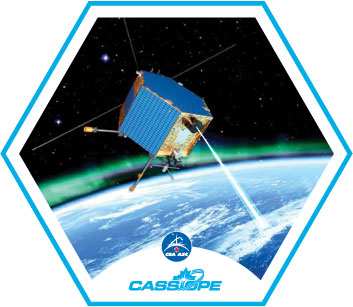
With the launch of the hybrid small satellite CASSIOPE, Canada is making a significant contribution to unraveling the mysteries of space weather. To accomplish this feat, the satellite uses a dedicated scientific payload ePOP (enhanced polar outflow probe), which observes the ionosphere.
In addition, two technological advancements are supported by the mission:
- A new Smallsat spacecraft Bus
- A communications technology demonstrator, Cascade
ePOP
The ePOP probe observes the Earth's ionosphere, where space meets the upper atmosphere; ePOP comprises a suite of eight scientific instruments, including plasma imagers, radio wave receivers, magnetometers and cameras. These are collecting data about the effects of solar storms and, more specifically, their harmful impact on radio communications, satellite navigation and other space and ground-based technologies.
These animations depict the two payloads on Canadian satellite CASSIOPE. The first one, ePOP is a suite of instruments for research on the effects of phenomena such as solar storms in the upper polar atmosphere. The second one, Cascade will demonstrate a high-capacity digital courier system for future commercial applications. (Credit: Canadian Space Agency)
Cascade
The communications technology demonstrator payload, entitled Cascade, serves as the second mission payload. Cascade is providing a 'proof of concept' design for a high volume store-and-forward data communications operational concept.
Like a courier in the sky, Cascade's operational concept is to pick up very large digital data files and deliver them to almost any destination in the world.
The clip begins with the reflection of the Sun on Canadian waters as the camera moves over the northern tip of Baffin Island. Then the satellite flies over Greenland heading towards Scandinavia, and down into Russia over the Kola Peninsula. While near Greenland, we view the limb of the Earth and see the clouds, water, ice, land masses, all lit up by the full moon. We clearly see the airglow; which is the thin layer above the atmosphere. The phenomenon of airglow looks similar to Aurora Borealis except, it is not limited to the Polar Regions and cannot easily be seen from the ground with a naked eye. Finally, at end of the clip, we can see a companion satellite (small dot above the airglow), sharing the same orbit as CASSIOPE. (Credit: Canadian Space Agency)
Small and versatile
CASSIOPE's hexagonal Smallsat bus platform measures only 180 cm long and 125 cm high.
It is more cost effective to construct and launch several small satellites with different goals than combining all the functionality on one big satellite. In addition to reducing the risk, this means that the satellites achieve their scientific or commercial objectives at a more reasonable cost.
The new platform produced for the CASSIOPE mission is also versatile: it is possible to adapt and use it for various missions involving science, technology, Earth observation, geologic exploration and information delivery.
Professor Andrew Yau of the University of Calgary directs the ePOP project and a team comprised of researchers and engineers from seven Canadian universities. The Communications Research Centre, located in Ottawa, as well as the Institute of Space and Astronautical Science of Japan and the U.S. Naval Research Laboratory are also partners in the project.
Moreover, CASSIOPE benefits from a solid partnership between the private and public sectors. Spearheaded by MacDonald, Dettwiler and Associates Ltd. (MDA), industry involvement has included Magellan and ComDEV. Vancouver's MDA serves as the mission prime contractor and is leading mission operations with the University of Calgary for a period of 18 months.

In addition, Cascade will provide CASSIOPE with information storage and large downlink capacity for ePOP data destined for Canadian and international researchers. The daily transmission volume could be up to about 15 gigabytes of data.

Aurora borealis result from solar storms. The ePOP probe will study the impact on communications networks.