
CubeSat Initiative in Canada for STEM (CUBICS)
On this page
Announcement of Opportunity (AO)
Publication date:
Application deadline:
The Canadian Space Agency (CSA) only receives applications when the selection process is open.
Key dates:
- CUBICS : Closed
- Publication date:
- AO closing date:
- CUBICS : Open
- Publication date:
- AO closing date:
Summary of key information for CUBICS
- Expected budget for this Announcement of Opportunity (AO): $2.4 million
- Eligible recipients: Canadian universities and post-secondary institutions
- Type of transfer of payments: Grants
-
Maximum amount per grant (2 funding categories):
- Stream 1: $650,000 (Grants)
- Stream 2: $350,000 (Grants)
- Maximum duration of a project per grant:
- Stream 1: four (4) years
- Stream 2: three (3) years
- Estimated projects start date: –
- Application deadline:
A list of acronyms used in this AO is available in Appendix A.
1 INTRODUCTION
Following the successful Canadian CubeSat Project (CCP) in and the CubeSats Initiative in Canada for STEM (CUBICS) in , the Canadian Space Agency is launching a new Canada-wide initiative. CUBICS will provide postsecondary institutions across Canada with an opportunity to engage their students in a real space science mission by designing, building, testing, and eventually launching and operating a CubeSat in space.
CUBICS will provide hundreds more students with opportunities to acquire hands-on expertise in a wide variety of STEM disciplines and develop invaluable skills to transition into the Canadian workforce to tackle the exciting opportunities that Canada's space sector has to offer.
CUBICS features a new stream designed to challenge more experienced teams with the possibility of building a larger (6U) CubeSat, and to help introduce new schools (including those less experienced in space disciplines) by teaming up for collaborative projects, which may include building a payload to be hosted aboard the mission.
This Announcement of Opportunity (AO) is consistent with the terms and conditions of the Canadian Space Agency (CSA) Class Grant and Contribution Program to Support Research, Awareness and Learning in Space Science and Technology – Research Component (the G&C Program).
Applicants must read the following AO thoroughly before submitting their applications. This AO was prepared to help applicants complete the application process, and outlines key elements, including mandatory criteria for eligibility, details on eligible projects and the selection process. In the event of any discrepancies between this AO and the individual funding agreements governing a project, the latter document(s) will take precedence.
2 AO OBJECTIVES
The main objectives of CUBICS are to:
- Provide professors and post-secondary students across Canada with knowledge, skills, and hands-on science and technology experience on real CubeSat space missions to:
- Develop, maintain and increase their interest and contributions to Canada's space sector; and
- Position students to become highly sought-after candidates or successful entrepreneurs in the Canadian space sector.
- Increase scientific knowledge and/or develop new technologies to increase space science knowledge in priority areas.
- CUBICS will also encourage collaboration between academic institutions to stimulate innovations and dissemination of knowledge, as well as collaboration between academia and industry to facilitate students' transition to the workplace.
3 ELIGIBILITY CRITERIA
On this page 3
3.1 Eligible Recipients
Canadian universities and post-secondary institutions are eligible under this AO.
3.2 Eligible Projects
The CSA invites the eligible institutions to submit a proposal under one of the following two streams (see Section 7.1 for further details):
- Stream 1: 6U CubeSat Project: for projects that will design, build, test, and eventually launch and operate a 6U CubeSat science mission. The unique requirements for 6U applications are explained in detail in Appendix B.1. Funding award is up to $650,000 and the maximum duration of the project is four (4) years, including the operation, data collection, and analysis phase.
- Stream 2: CubeSat Project (up to 3U): for projects that will design, build, test, and eventually launch and operate a CubeSat science mission that may be up to 3U (i.e., 1U or 2U proposals are eligible). Funding award is up to $350,000 and the maximum duration of the project is three (3) years, including the operation, data collection, and analysis phase.
To be eligible, proposals must include the following elements:
- Proposed activities must be related to at least one (1) priority outlined in the Space Strategy for Canada (see Section 3.3);
- Proposals must fall under one of the two funding streams outlined above.
- Proposals must clearly demonstrate that they have sufficient capability in the following areas:
- Obtaining licenses for required radio frequencies; and
- Access to a ground station facility and laboratory facilities.
- Proposals must include detailed information on how the project may be used for the amateur radio community if the CubeSat is designed to use an amateur radio frequency. For more information, please consult the Appendix B, Section B4.
- Proposed missions must be designed to comply with applicable Innovation, Science and Economic Development Canada (ISED) requirements for satellite communications, including obtain and use of authorized frequency bands and compliance with Canadian radiocommunication regulations. Proposed missions must also be capable of meeting ISED's updated satellite licensing conditions issued in , including current requirements for orbital debris mitigation and end of life disposal.
- Proposals that fall under the definition of remote sensing space systems in the Remote Sensing Space Systems Act must clearly describe the plan to support the CubeSat operations during the entire period of the mission, as per Global Affairs Canada requirements.
For Stream 1 applications: It is acceptable for the academic institution to submit more than one Stream 1 applications with different primary payloads teams. It is also acceptable for the primary payload to be included in two Stream 1 applications.
In all situations, each academic institution will receive a maximum of one grant from this AO.
| Stream 1 | Stream 2 | |
|---|---|---|
| Additional Eligibility Criteria | The project must include at least one payload provided by the Co-I from another Canadian post-secondary institution. | The payload may be supplied or purchased by the Principal Investigator (PI), Co-Investigator (Co-I), or another Canadian post-secondary institution. |
| Reasons to apply under either stream | An opportunity to further increase the capacity within the institution and develop CubeSat that can host payloads for advanced scientific and technology development needs | A unique opportunity to participate in a real space mission and acquire valuable foundational experience with financial support and guidance from the CSA (details in Section 6 and Section 7) |
| Foster collaboration among Canadian post-secondary institutions by giving students the opportunity to work on multi partner projects that mirror real world practice, helping them build broad, lasting professional networks in Canada's space sector, | Allow less experienced teams to develop a CubeSat through a supportive and collaborative process |
Projects proposing CubeSats in advanced development stages, rather than the initial phase, are eligible under this AO; however, the proposals should clearly demonstrate how the projects will achieve the objectives of the AO, especially the postsecondary students' skills and knowledge development.
The CSA will strive to accommodate the timelines of the selected projects but due to operational, contractual, and scheduling constraints, the alignment of the technical guidance, mentorship, and launch dates with each project milestone cannot be guaranteed.
Important Notes Regarding Eligible Projects:
- Although we strongly encourage the involvement of students in all aspects of the project, including the leadership roles, the academic institution and the Principal Investigator (PI) submitting the proposal will remain solely and fully responsible for the conduct of the project activities and its outcomes for the entire duration of the project. The PI must also be responsible for regulatory compliance for the entire duration of the mission.
- For this AO, Canadian students include college students, undergraduate and graduate students (master's and doctorate levels) and postdoctoral fellows. The term "Canadian students" refers to all students (including international students) who are registered in a Canadian university or other post-secondary institution.
- Projects submitted under this AO must not include activities currently funded by another CSA funding opportunity. Applicants with ongoing projects funded by the CSA must demonstrate that proposed activities are complementary in nature and do not overlap with those of the previously funded project.
- An application related to a specific project must be submitted by only one eligible applicant (institution), who would be the only signatory of the grant (a proposal submitted by several co-applicants will not be accepted).
For further useful background information on CubeSat projects, please see Appendix B.
All development phases necessary for a project are eligible for funding. Any logical breakdown or combination of these phases can constitute a funded project under this AO. However, breaking down a project into numerous phases submitted as distinct proposals to obtain more than the maximum grant under this AO is not allowed. Furthermore, the completion of a funded phase does not automatically guarantee future funding of the remaining phases.
3.3 Links to CSA Priorities
To be eligible, projects supported under this AO must contribute to at least one (1) CSA priority, as per the Space Strategy for Canada, by advancing scientific knowledge and/or developing new technologies in priority areas.
3.4 Links to the Class G&C Program Objectives
To be eligible, projects supported under this AO must contribute to the achievement of at least one of the following objectives:
- To foster the continuing development of a critical mass of researchers and highly qualified personnel (HQPs) in Canada in areas relevant to the priorities of the CSA;
- To support the development of science and technology relevant to the priorities of the CSA.
4 APPLICATION
On this page 4
The applicant must read the following section carefully and follow all the steps in order to ensure their application is completed and submitted successfully.
4.1 Required Documentation
The applicant is responsible for ensuring that the application includes all required documentation, as follows:
- A completed application form, signed by the duly authorized representative (please see instructions accessing the application form in the Section 4.2).
- The curriculum vitae (CV) of the Principal Investigator (PI), Co-investigators (Co-I) and other members of the team known at the time of the application. Each CV must not exceed 5 pages (6 pages in French) and must follow the format presented in Appendix D.
- A letter of support from each Co-I (if applicable) confirming their intent to participate in the project and the nature of their participation.
-
For projects with industrial partners, other universities or organizations, a letter of support confirming their intent to participate in the project and the nature and the level of their participation.
- Letters from other funding organizations confirming their financial contributions (if applicable).
The following elements may be added to the final PDF document, if necessary, to better understand the proposed research project:
- Diagrams or figures with added details pertaining to the research project and referenced in the application form.
The following document may be required upon request:
- A copy of the document(s) confirming the legal name of the applicant.
It is the applicant's responsibility to ensure that the application complies with all relevant federal, provincial/territorial and municipal laws and regulations.
The applicant must keep one hard copy of all the original documents above. At any time, the CSA may require applicants who successfully passed the evaluation stage described in Section 5 of the AO to send a hard copy of their complete application with the original documents.
Additional governing documents might be requested in a later phase of the evaluation process.
4.2 Submit a completed application electronically
Applicants must follow the steps below to access the application form and submit their application electronically
- Submit an account creation request for this AO using the Electronic Proposal Portal. Please note that Google Chrome is the browser of choice for submissions. The Microsoft Edge browser is also supported.
- In the "Proposal title" field of the Electronic Proposal Portal, please use the following formatting standard: CUBICS 2026_Stream (1 or 2)_Name Of Institution_Last name of PI (e.g. CUBICS 2026_1_InstitutionName_Smith).
- In the "Organization" section, under "Type," please select "Canadian university or postsecondary institution."
- The "Applicant" portion must include information about the Principal Investigator, but they must add the duly authorized representative of the institution as an additional contact, as the duly authorized representative must sign the complete application package. The applicants can add as many additional contacts as they wish, all of whom will have editing access to the same application form.
- Allow up to three business days for the CSA to send an email confirming the account creation as well as instructions (user guide) on how to access the platform. It is strongly recommended that the account creation request be submitted as early as possible.
- Once the account is created, applicants will receive two emails with the links: one for the online application form, and one for the secure portal, where complete application packages must be uploaded.
- Connect to the online Application Form and complete it as per instruction provided; the system permits users to save the application form, close it, and resume completion later.
- After completing the application form, print it as a PDF document before clicking "submit". The duly authorized representative of the institution must sign the PDF application form.
- Combine all required documents into a single PDF document (please see Section 4.1 for details on the accepted format) and upload your complete and signed application package to the secure portal, using the link provided in the initial email. Please refer to the user guide for instructions on how to securely upload documents.
Please note:
- If technical issues related to account creation or to electronic submission cannot be resolved, applicants must inform the CSA as soon as possible at the email address bpsc-gcpo@asc-csa.gc.ca for the issue to be investigated. Applicants are strongly encouraged to upload their complete application well before the submission deadline.
- Applications must be submitted (successfully uploaded) by the applicants no later than Thursday, November 19, 2026, at 4:00 p.m. Eastern Time (ET).
- The onus is on the applicant to ensure that their application is complete and that all documents are uploaded on the Electronic Proposal Portal within the prescribed deadline.
- The CSA is not responsible for any delays under any circumstances and will reject applications that are uploaded after the stipulated deadline.
- Hand-delivered applications and applications sent by email will not be accepted.
- If multiple applications are submitted, only the latest version received will be considered.
The application must be prepared as a single PDF-formatted file containing all the above requested documents with all security features disabled. The proposal and supporting documents should be included in the file as searchable PDF-formatted documents (PDF/A-1a or PDF/A-2a formats preferred). If there are any accessibility issues with the submitted PDF file, all consequences reside with the applicant.
Questions and answers related to this AO will be posted on the CSA website in the FAQ Section of this AO (see Section 9). The CSA will not answer questions received after November 9, 2026, at 4 p.m. Eastern Time (ET).
4.3 Service Standards – Complete Applications
Applicants will be notified in writing of decisions regarding their application. Selected applications will be proactively divulged on the Open Government website. The CSA has set the following service standards for processing times, acknowledgement of receipt, funding decisions and payment procedures.
Acknowledgement of receipt: The CSA's goal is to acknowledge receipt of proposals within two (2) weeks following the reception of the proposal.
Decision: The CSA's goal is to respond to the application within fifteen (15) weeks of the AO's closing date, and to send a grant agreement for signature within four (4) weeks after formal approval of the proposal.
Payment: The CSA's goal is to issue payment within four (4) weeks of the successful fulfillment of the requirements outlined in the grant agreement.
Compliance with these service standards is a shared responsibility. Applicants must submit all required documentation in a timely fashion.
5 EVALUATION
5.1 Eligibility Criteria
Applications will first be submitted for an eligibility assessment to verify whether they comply with the following criteria:
- The applicant is an eligible recipient as defined in Section 3.1;
- The proposed project is an eligible project as defined in Sections 3.2, 3.3 and 3.4;
- The application complies with the funding provisions of the program stated in Section 7.1.
5.2 Evaluation Criteria
Once the eligibility assessment is completed, applications will be evaluated according to the following criteria. The onus is on applicants to address these explicitly in their applications.
- Benefits for Canada and outcomes;
- Feasibility and risks; and
- Resources.
Table 1 below shows the criteria, sub-criteria and associated thresholds, while Table 2 shows a brief description of the graded criteria. A detailed breakdown of all the evaluation criteria is described in Appendix C. To be considered eligible for funding, the total score obtained for these graded criteria must be 70/100 or greater.
| Point Rated Criteria | Maximum points for evaluation | Minimum points to pass | Poor | Average | Good | Excellent |
|---|---|---|---|---|---|---|
| 1. Benefits for Canada and outcomes | 40 | 28 | ||||
| 1.1 Proposed project | 25 | - | 7 | 12 | 18 | 25 |
| 1.2 Training plan | 15 | - | 0 | 5 | 10 | 15 |
| 1.3 Equity, diversity, and inclusion | Pass/ Fail | |||||
| 1.4 Public engagement | Pass/Fail | |||||
| 2. Feasibility and risks | 30 | 21 | ||||
| 2.1 Project plan and schedule | 20 | - | 5 | 10 | 15 | 20 |
| 2.2 Project-related risks and mitigation strategies | 10 | - | 0 | 5 | 7 | 10 |
| 3. Resources | 30 | 21 | ||||
| 3.1 Project team | 20 | - | 5 | 10 | 15 | 20 |
| 3.2 Budget, funding, physical resources, procurement strategy, infrastructure, and collaboration | 10 | - | 0 | 5 | 7 | 10 |
| TOTAL | 100 | 70 | ||||
| Qualifying Criterion | ||
|---|---|---|
| Category (weighting in %) | Sub-Category | Maximum points for evaluation |
| 1. Benefits for Canada and outcomes (40%) |
1.1 Proposed project This criterion is used to evaluate the scientific and/or technical merits of the proposed project, and its probable impact and potential to advance scientific knowledge and/or to enable the development of new technologies in priority areas, as per the Space Strategy for Canada. The proposal should also include an assessment of the maturity of the primary payload, as well as of the quantity and quality of data collected from the mission. |
25 |
|
1.2 Training plan This criterion assesses the quality, relevance, and diversity of the experiences the students will acquire as well as the proposal's potential to prepare students for professional careers or entrepreneurial ventures in the space sector. The level of commitment of the PI and Co-I in training the students should be elaborated. |
15 | |
|
1.3 Equity, diversity, and inclusion (EDI) This criterion evaluates whether the proposal includes a structured EDI plan to foster the recruitment and engagement of members from designated and equity-deserving groups (employment equity groups). |
Pass/Fail | |
|
1.4 Public Engagement This criterion evaluates the nature, relevance, feasibility, and effectiveness of the proposed public engagement activities. |
Pass/Fail | |
| 2. Feasibility and risks (30%) |
2.1 Project plan and schedule This criterion assesses the likelihood that the project team delivers the project's objectives. The assessment will be based on the clarity and completeness of the project plan, the work breakdown structure (WBS), the task descriptions, major milestones, and the proposed schedule. |
20 |
|
2.2 Project-related risks and mitigation strategies This criterion is used to evaluate the applicant's analysis of the risks associated with the project, as well as the proposed mitigation strategies for each risk. |
10 | |
| 3. Resources (30%) |
3.1 Project team This criterion evaluates the competencies – experiences, skills, knowledge, expertise etc. - of the project team (PI, Co-I(s), as well as confirmed students and collaborators, if applicable.) The proposed team structure and task distribution will be assessed towards the delivery of the CubeSat mission. Student recruitment, onboarding and retention strategy will also be evaluated. For STREAM 1, the experience and achievements of key team members in managing a CubeSat mission will also be assessed. The benefits of the collaboration with another academic institution and/or industry will also be assessed. |
20 |
|
3.2 Budget, physical resources, procurement strategy, infrastructure and collaboration This criterion is used to evaluate if the proposed budget (including any co-funding) is adequate to achieve the project's objectives. The timely availability of required physical resources (equipment, instruments, etc.), procurement strategy for CubeSat subsystems and infrastructure access (laboratory, ground station, etc.) will also be evaluated. |
10 | |
5.3 Evaluation Process
Only applications that have passed the eligibility assessment listed in Section 5.1 will be given further consideration.
Once the eligibility criteria are confirmed, evaluators will assess the screened applications according to the criteria listed in Section 5.2 and described in more details in Appendix C. The evaluators will include experts in the fields relevant to the proposals. Evaluators may include representatives of the Government of Canada and of other countries, as well as representatives of other governmental and non-governmental agencies and organizations. If applicable, a multidisciplinary evaluation committee will be formed to evaluate interdisciplinary applications.
An application must receive an overall minimum score of 70%, as well as achieve the minimum thresholds specified in Table 2, in order to be deemed eligible for funding.
Before a final decision is made, the CSA's program manager responsible for this AO may seek input and advice from other organizations, including municipal, provincial, territorial and federal governmental agencies and organizations.
A selection committee made up of CSA experts may carry out a strategic overall selection based on CSA priorities, such as but not limited to:
- Regional geographic distribution.
- Diversity among universities and postsecondary institutions.
- Representation of PIs who are part of one of the underrepresented groups (women, Indigenous Peoples, persons with disabilities and visible minorities).
6 ROLE OF THE CSA
On this page 6
In addition to awarding grants to the selected applicants, the CSA intends to provide technical guidance and mentorship to all teams receiving funding (Stream 1 and Stream 2) and may provide access to certain CSA infrastructure such as laboratories and test facilities. Subject to full compliance with all the CSA selected launch provider requirements, and to the available funding, the CSA may also provide teams from both streams with the opportunity to integrate and launch their CubeSat.
Any collaboration that may be offered to recipients is at the entire discretion of the CSA and will be evaluated on a case-by-case basis by the CSA, based on different criteria, such as the type of project, and CSA experts' and facilities' availability. This section provides an overview of the intended roles of the CSA.
The selected grant recipients under this AO have the right to opt out, in whole or in part, from any collaboration proposed by the CSA, including the launch of the satellite.
Important note:
If a proposal is selected for funding, and the recipient accepts the CSA collaboration as described below, a collaborative agreement must be signed between the recipient and the CSA prior to any guidance and mentorship offered by the CSA, or access to CSA facilities, or for the launch opportunities procured by the CSA.
6.1 Technical guidance and mentorship from the CSA
The CSA may provide guidance to the grant recipients to ensure that the teams gain as much knowledge, skills and expertise as possible through their participation in CUBICS. The objectives of providing such guidance are to maximize the teams' overall learning experience by:
- Optimizing their acquisition of knowledge and experience related to space missions.
- Fostering opportunities for collaboration and networking among participating teams, with industry or not for profit organizations.
- Guiding the team through technical challenges.
- Supporting the teams to ensure that their CubeSat complies with regulations (e.g., radio licenses) and sharing best practices (for example, orbital debris, launch safety).
- Inspiring participants to pursue a career or an entrepreneurial path in the space sector through the acquisition of practical knowledge that will increase their level of employability or the chances to succeed in their space ventures.
Teams under both streams will have the opportunity to submit their technical questions to the CSA's technical experts and to participate in various activities, such as:
- Webinars.
- Videoconferences.
- Design reviews.
- National workshop(s) with a focus on hands-on training (e.g. electronics assembly) at the CSA.
The intention behind the activities listed above is to create collaborative mechanisms to assist all teams in achieving their project goals. The CSA values collaboration between teams as one of the most important vehicles to maximize student knowledge, skills and expertise. Teams will be strongly encouraged to support and assist each other in a non-competitive environment.
In addition to the above activities, the CSA may provide training documents that teams could find useful when designing and building their payload or CubeSat.
Important notes:
Each recipient will lead the execution and overall success of its project, with full ownership of all development activities. While the CSA will provide support and oversight where appropriate, the projects will remain the sole responsibility of the recipients. All final decisions regarding the different phases of the CubeSat project will rest with the recipients.
The CSA intends to offer annual in-person workshops that may be hosted at the CSA's John H. Chapman Space Centre located in Saint-Hubert, Quebec. Each team is strongly encouraged to send a minimum two (2) students to attend each of these workshops. The applicant should clearly provide the funding plan associated with the travel expenses related to the attendance of at least two workshops and to coordinate the logistics with the CSA.
6.2 Access to Launch Opportunities
The recipients under both streams may have the opportunity to launch their CubeSat into space, operate their satellite and conduct their scientific experiment and/or validation of their science-related technology from space. The CSA intends, subject to the availability of funds, to procure launches for eligible CubeSats only. To be eligible for launch, each CubeSat funded under this AO will have to successfully meet certain requirements, including but not limited to the following:
- Meet all the launcher's interface design and safety requirements in a timely manner (requirements will be confirmed subsequently to selected recipients).
- Must comply fully with all applicable regulatory requirements in Canada or internationally.
- Obtain, in a timely manner, all the required licenses to launch and operate the CubeSat; and
- Have access to a ground station facility or facilities and provide proof of proper uplink and downlink functions.
It should also be noted that access to launch opportunities is entirely at the CSA and its designated ride-share service provider's discretion. The CubeSats will be assessed on a case-by-case basis, and they must successfully meet specific requirements to be considered for launch. CSA intends to procure launch for high inclination orbit and most likely they are at sun-synchronous inclination in the 500-620 km altitude range. However, it is important to note that the Right Ascension of the Ascending Node (RAAN) of the orbit is decided by the launch provider. CubeSat teams must not make any assumption that their desired RAAN can be accommodated.
The CSA intends to acquire launch opportunities for eligible CubeSats between three (3) and four (4) years after the issuance of the grant to the recipient. As such, if the grant recipient wants to benefit from the CSA launch opportunity, they must aim to complete their CubeSats (including having obtained the required radio frequency licenses, having implemented or confirmed access to a ground station facility or facilities, and passed all testing required by the launch provider) within three (3) or four (4) years after their project start date. The implementation schedule in the applicants' proposal must reflect this timeline.
The CSA will be the liaison with the contracted launch service provider(s). If they commit to the CSA launch opportunity, no CUBICS team is to liaise directly with the launch service provider(s) contracted by the CSA.
The grant recipients may opt out of the launch opportunity offered by the CSA. No additional funding will be awarded to the teams opting for another launch provider than those offered by the CSA. Opting for another launch provider will not impact the team's access to CSA technical guidance, mentoring and facilities.
The projects that will be deemed ineligible for launch within the timeframe established by the CSA must continue the development of the CubeSat as per the grant agreement.
7 FUNDING
On this page 7
7.1 Available Funding and Duration
Transfer payments will be made through grants agreements. The total funding available under this AO is currently expected to be approximately $2.4 million. The two (2) funding categories are:
- Stream 1: Maximum grant of $650,000 for a 6U CubeSat Project, over a maximum period of up to four (4) years. The maximum amount available per year is $250,000.
- Stream 2: Maximum grant of $350,000 for an up to 3U CubeSat project, over a maximum period of up to three (3) years. The maximum amount available per year is $200,000
For this AO, the CSA intends to fund up to two (2) projects under Stream 1 and up to seven (7) grant projects under Stream 2. However, the overall number of grants awarded in each stream and in total, as well as their value may vary, and are dependent on the availability of funds, the results of the evaluation process and the availability of CSA nonfinancial resources.
Given the objectives of this AO, an eligible recipient (Canadian university or postsecondary institution) may submit multiple applications; however, if two or more applications are submitted with the same designated PI, the CSA reserves the right to select only one of these projects. An eligible recipient may submit only one application for the same CubeSat project.
The CSA reserves the right to reject any proposals or reduce the amount of the grants at its entire discretion.
In no circumstance can the total amount of assistance from governmental sources (federal, provincial, territorial and municipal) to the recipient exceed: 100% of the total project cost.
Applicants must identify all sources of funding in their applications and confirm this information in a funding agreement if the project is selected for funding. Upon completion of a project, the recipient must also disclose all sources of funding.
7.2 Eligible Costs
Eligible costs are costs that are essential to carry out the Project, reasonable and directly related to the Project to achieve the expected results of the Project.
The costs are to be incurred directly by the applicant. Incurred Costs means any expense made to carry out the Project related to an Eligible Cost which is due and payable. CSA will not contribute to costs incurred prior to the coming into force of a Funding Agreement and after the Project Completion Date.
Eligible costs under this AO include:
- Access fees
- Accommodation and meal allowances;
- Acquisition, development and printing of materials;
- Acquisition or rental of equipment;
- Bursaries;
- Consultant services;
- Costs related to obtaining security clearance;
- Data acquisition;
- Data management;
- Laboratory analysis services;
- License and permit fees;
- Materials and supplies (including payload or satellite components and hardware);
- Overhead (administrative) costs (10% of the project cost and not exceeding $20,000);
- PST, HST and GST net of any rebate to which the recipient is entitled and the reimbursement of any taxes for goods and services acquired in a foreign country net of any rebate or reimbursement received in the foreign country;
- Publication and communication services;
- Registration fees;
- Salaries and benefits paid to eligible students and postdoctoral fellows;
- Translation services;
- Travel expenses, including student attendance of CubeSat workshops at CSA.
8 FINANCING AGREEMENT
On this page 8
8.1 Agreement
Upon favorable review of the applications, the CSA will send a Grant agreement to the successful applicant. The Grant agreement will outline the rights, roles, and obligations of each respective party. In the event of any discrepancies between this AO and a Grant agreement between the CSA and the recipient, the latter document will take precedence.
For greater clarity, no liability and no commitment or obligation exist on the part of the CSA to issue a Grant payment to the applicant until a Grant agreement is signed by both parties. Furthermore, any costs or expenses incurred or paid by the recipient prior to the execution of a written Grant agreement by both parties are the sole responsibility of the applicant, and no liability exists on the part of the CSA.
8.2 Payments
For grant agreements, payments will be made in instalments as described in the signed agreement. Grant funding agreements will include a clause stipulating the recipient's obligation to confirm—once a year in the case of multi-year agreements—their eligibility for the G&C Program – Research Component and inform the CSA in writing of any changes to the conditions used in determining their eligibility for this component.
Only eligible costs incurred after the funding agreement is signed and indicated in the agreement will be paid.
8.3 Audit
The recipient of a funding agreement shall keep proper records of all documentation related to the funded project, for the duration of the project and three (3) years after the completion date of the project, in the event of an audit. This documentation shall be available upon request.
8.4 Intellectual Property
All intellectual property developed by the recipient during the project shall vest in the recipient.
The recipient will undertake to protect all intellectual property he will possess, acquire, or develop during the project.
8.5 Organizations in Quebec
8.5.1 Act Respecting the Ministère du Conseil exécutif, CQLR c M-30
An organization in Quebec whose operations are partially or fully funded by the province of Quebec may be subject to the Act Respecting the Ministère du Conseil exécutif (L.R.Q., c. M-30).
Under Sections 3.11 and 3.12 of this Act, certain entities/organizations, as defined in the meaning of the Act, such as municipal bodies, school bodies, or public agencies, must obtain authorization from the Secrétariat du Québec aux relations canadiennes (SQRC), as indicated by the Act, before signing any funding agreement with the Government of Canada, its departments or agencies, or a federal public agency.
Consequently, any entity that is subject to the Act is responsible for obtaining such authorization before signing any funding agreement with the Government of Canada.
Quebec applicants must complete Section 5 of the application form.
8.5.2 Loi sur la langue officielle et commune du Québec
La Loi sur la langue officielle et commune du Québec, le français changes section 55 of the Charter of the French Language and came into force on . Since that date, the conclusion of a G&C Agreement in English in Quebec is subject to the following conditions for the recipient to be bound by the Agreement:
- A French version of the Agreement must be produced including the Schedules and must be given to the recipient before the signing of the English version.
- The recipient must consent to signs the Agreement in English and continue communications in English thereafter.
- Only one Agreement must be signed, either the French or English version.
8.6 Organizations in Alberta
An organization located in Alberta may be subject to the Provincial Priorities Act (Chapter P-35.5) (the Act) and its Provincial Priorities Regulation (Alberta Regulation 21/2025) (the Regulation).
As per section 2 of the Act, provincial entities listed in the Act and Regulations must obtain prior approval from the Government of Alberta in accordance with the process set out in the Act and in the Regulation before entering into an agreement with the Government of Canada.
Therefore, any entity that falls under the application of the Act or the Regulation must obtain such authorization prior to entering into an agreement with the Canadian Space Agency.
Applicants having activities in Alberta must complete Section 5 of the application form.
8.7 Performance Measurement
The CSA will ask the recipients to report on certain elements in their projects, such as the following:
- Increased capacity:
- Project research team (including students and postdoctoral fellows (PDFs) involved). Note that the grant recipient may be asked to provide the names of the research team members, including the students and PDFs.
- Creation of knowledge:
- Advancement of knowledge (including technological breakthroughs, technologies leading to a higher level);
- Production of knowledge (including publications);
- Presentations (including conferences, seminars, workshops and other outreach activities);
- Intellectual property (including patents) generated by the project.
- Collaboration:
- Partnerships;
- Contribution of partners;
Recipients will also be required to inform the CSA in advance of important public announcements (for example, press or news releases of interest to the media) resulting from work related to this AO.
8.8 Open Access Publications
In the event that publications result from the project, the CSA wishes to promote the dissemination of findings that result from the projects it funds as quickly and to the greatest number of people as possible. Improved access to scientific results not only allows scientists to use a broader range of resources and knowledge, but also improves research collaboration and coordination, strengthens citizen engagement and supports the economy.
The CSA promotes the use of open access publication and archiving by recipients in order to facilitate the widest dissemination of findings that result from its funded projects. Thus, recipients are invited to publish their articles in a timely manner by using one of the following methods:
- Accessible online repository (institutional or disciplinary) so that the publication is freely accessible.
- Journal offering open access to articles.
It should be noted that these two methods are not mutually exclusive and that recipients are encouraged to use both.
Finally, the CSA wishes to receive a courtesy copy of the publications (if not freely accessible) or hyperlink (if freely accessible) and its digital object identifier (DOI). These will be used to improve accessibility by including them in the CSA publications directory.
9 FREQUENTLY ASKED QUESTIONS (FAQ)
It is the responsibility of the applicants to obtain clarification of the requirements contained herein, if necessary, before submitting an application.
For any questions related to this AO, applicants shall use the following email address: bpsc-gcpo@asc-csa.gc.ca. Questions and answers related to this AO will be posted on the CSA website in the FAQ section of this AO. The CSA will not answer to questions received after .
-
Question 1: Are colleges and polytechnics eligible to apply under the CUBICS 2026 initiative?
Answer 1: Yes. As specified in Section 3.1 (Eligible Recipients) of the CUBICS Announcement of Opportunity (AO), Canadian universities and post-secondary institutions are eligible under this AO.
Accordingly, Canadian colleges and polytechnic institutions that are legally established, recognized, and authorized by the applicable provincial or territorial authority to operate as post-secondary institutions in Canada are eligible to apply under CUBICS , provided they meet all other applicable requirements and eligibility criteria set out in the AO.
-
Question 2: Are 3U CubeSats with "tuna cans" eligible for the grant? If so, what is the maximum length of the "tuna can" allowed?
Answer 2: Yes, proposals involving a 3U CubeSat equipped with "tuna cans" are eligible under this AO.
However, applicants should be aware that the launch service provider for the CSA launch opportunity has not yet been selected and is not expected to be confirmed before the application deadline. As a result, CSA cannot fully define, before the application deadline, the mechanical, deployment and other systems constraints applicable to the launch.
Consequently, while CubeSats with "tuna cans" are eligible, the CSA cannot currently specify a maximum allowable "tuna can" volume or guarantee compatibility with the future launch configuration. Applicants should therefore recognize that designs incorporating external protrusions may carry a higher risk of being deemed incompatible with the selected launch system once launch provider requirements become available.
-
Question 3: Is there a mass limit for 3U CubeSats?
Answer 3: Yes. For the purposes of this AO, the maximum allowable mass for a 3U CubeSat is 2 kg per unit (2 kg/U). Therefore, a 3U CubeSat may have a maximum mass of 6 kg.
Applicants should ensure that the total launch mass of their CubeSat, including all payloads and integrated subsystems, complies with this limit. Additional mass and interface requirements imposed by the selected launch service provider may also apply once the provider has been identified.
-
Question 4: The CUBICS AO guidelines mandate a five-year deorbit period. Are active propulsion systems strictly mandatory under Innovation, Science and Economic Development Canada (ISED) regulations, or are passive deorbit approaches acceptable if they successfully meet the 5-year limit?
Answer 4: This requirement is defined by the Decision on Changes to Licensing Requirements and Conditions of Licence for Space Debris Mitigation, please refer to Section D5 for details. However, it is not stipulated that an active propulsion system is mandatory. Any deorbiting approach, whether active or passive, may be considered acceptable if it complies with the applicable requirements, including the maximum five-year deorbit period.
-
Question 5: Would access through a shared or paid government network satisfy the CUBICS ground-segment requirement?
Answer 5: CSA strongly recommends that each team has or develops its own ground station.
-
Question 6: The AO encourages teaming up with new schools. How are partnerships with institutions that lack their own satellite-building capabilities evaluated under the Stream 2 scoring criteria?
Answer 6: For the applications under Stream 2, the involvement of another university or post-secondary institution is not required and it will not be evaluated in the eligibility or point rated evaluation criteria. However, the CSA may take such collaborations into account during the final selection process, as outlined in the last paragraph of Section 5.3.
-
Question 7: The AO requires applicants to demonstrate that the proposed activities do not overlap with the on-going funded projects. If a Principal Investigator, who intends to lead a CUBICS project, currently holds another CSA grant that supports activities unrelated to the proposed project, what specific documentation or justification is required in the proposal to formally demonstrate the absence of overlap and meet the requirement.
Answer 7: The CSA expects applicants to disclose any ongoing CSA-funded projects led by the Principal Investigator and to briefly explain how the proposed project differs from, or complements, these projects in terms of scope and resources (see also the application form).
-
Question 8: To ensure a robust project schedule, could you provide guidance on the typical processing timelines for spectrum and regulatory licensing?
Answer 8: As the project plan and its components are part of an evaluation criterion, the CSA is unable to provide guidance, interpretations, or comments that could influence the preparation or assessment of proposals.
-
Question 9: If two universities collaborate on a single CUBICS proposal, may a single faculty member serve as the Principal Investigator (PI) on behalf of both institutions or is each university required to designate its own PI?
Answer 9: As stated in Section 3.2, an eligible project must be submitted by a single eligible applicant (university). Therefore, each proposal represents one project and must identify a single Principal Investigator (PI) who is fully responsible for the entire project, regardless of any collaborations with other institutions.
-
Question 10: If two universities submit separate proposals as independent teams, may the same faculty member serve as the PI for both proposals?
Answer 10: The identification and designation of the Principal Investigator (PI) are entirely at the applicant's (university or other post-secondary institution) discretion and responsibility. The CSA will evaluate each proposal based on the eligibility and evaluation criteria stated in the AO.
-
Question 11: If a project anticipates potentially receiving a certain funding source during the project time (not guaranteed), how should the proponent account for it in our application?
Answer 11: The proposals must clearly identify all sources of funding and demonstrate that the project's full costs are covered. Any shortfalls or unsecured funding must be explicitly described, along with an assessment of the associated risks and mitigation measures to ensure successful completion of the project. Any additional funding received or confirmed during the project period must be disclosed to the CSA. The CSA reserves the right, at its sole discretion, to adjust the remaining grant installments accordingly.
-
Question 12: Can you elaborate on the role of Mission Manager in a satellite mission and what the PI is expected to take on?
Answer 12: The applicant (university) is responsible for establishing the project management structure needed to successfully deliver the project. From CSA's perspective, the Principal Investigator, together with the applicant, remains accountable for achieving the project's objectives and deliverables, regardless of any internal management roles established by the project team. The AO includes, in Annex B (sections B.1, B.2 and B.3) illustrative practices informed by best practices and lessons learned from previous CUBICS initiatives.
-
Question 13: Our team is currently pursuing a launch opportunity without CSA assistance. Does pursuing this opportunity further make our project ineligible for CUBICS funding? What about if we sign a contract with a launch provider?
Answer 13: No. Pursuing a launch opportunity independently of the CSA or signing a contract with a launch provider does not make the project ineligible for CUBICS , provided that the project meets all other CUBICS eligibility requirements.
-
Question 14: If the proposed payload is not focused on climate change, would the project still be eligible under CUBICS ?
Answer 14: Yes. CUBICS does not prescribe specific scientific or technological themes. However, the proposed project must, amongst others, align with at least one of the priorities identified in the Space Strategy for Canada (see Section 3.2). CSA cannot determine or comment on the eligibility of a specific project at this stage of the process.
-
Question 15: Section 6.2 of the AO and Appendix B.6 state that only sun-synchronous orbits will be preferred. Is there any path toward a lower inclination orbit?
Answer 15: The current rideshare opportunity is predominantly in sun-synchronous orbits. Proponents may describe mission requirements that differ from a sun-synchronous orbit; however, they should be aware that there will be fewer launch opportunities.
-
Question 16: Our team plans to develop a payload primarily as a proof of concept for future missions, with limited scientific data return. Would this approach be considered viable under CUBICS ?
Answer 16: CUBICS aims to increase scientific knowledge and/or support the development of new technologies that advance space science in priority areas. Therefore, projects focused primarily on technology demonstration or proof of concept may be considered, provided they clearly contribute to these objectives and align with at least one of the priorities identified in the Space Strategy for Canada. The CSA cannot comment on the eligibility or competitiveness of a specific project at this stage of the process. Proponents are encouraged to clearly describe the expected benefits, outcomes, and relevance of their proposed payload in relation to the objectives of CUBICS .
-
Question 17: Is there a limit on the number of pages that a proposal may contain?
Answer 17: As described in Section 4.1, Required Documentation, proponents must complete only the application form and provide responses to all required questions within the limits established in the application form. However, proponents may include diagrams, figures, and tables, as appropriate, to support and enhance the information presented, provided that these elements are relevant to the proposed project and are clearly referenced in the application form.
-
Question 18: May a university submit more than one application under CUBICS , either within the same funding stream or across different streams? If so, can these applications be led by the same Principal Investigator (PI), or must each application have a different PI?
Answer 18: Under this AO, an eligible applicant may submit more than one application. However, each post-secondary institution is eligible to receive a maximum of one grant. Consequently, a university should not expect to receive funding for multiple applications, whether they are submitted within the same stream or across different streams, and regardless of whether they are led by the same or different PIs.
-
Question 19: Would an individual be eligible to participate in two successful grant proposals simultaneously, serving as the Principal Investigator (PI) on one proposal and as a Co-Investigator (Co-I) on a separate proposal led by another institution's PI?
Answer 19: Yes. An individual may participate in two successful grant proposals simultaneously, whether serving as the Principal Investigator (PI) on one proposal and as a Co-Investigator (Co-I) on another proposal led by a different institution, or serving as a Co-Investigator (Co-I) on both proposals, provided that all other program eligibility requirements are met. However, the proposals must clearly demonstrate that the individual and the applicants have the capacity to fulfill the roles and the responsibilities associated with all funded projects in which they eventually will participate as well as any other professional obligations and commitments they may have.
-
Question 20: Is completion of the table provided under Section 2.1 "Project Plan and Schedule" of the application form sufficient, or is a separate detailed implementation schedule also required as an attachment?
Answer 20: The choice is left to the applicant. The table provided in Section 2.1 must be used to present the project plan and schedule. Applicants who wish to provide additional details may also include a separate detailed implementation schedule as an attachment.
APPENDIX A – List of Acronyms
- AIT
- Assembly, Integration and Testing
- AO
- Announcement of Opportunity
- BOM
- Bill of Materials
- CCP
- Canadian CubeSat Project
- CDR
- Critical Design Review
- Co-I
- Co-Investigator
- CUBICS
- CubeSat Initiative in Canada for STEM
- EMC
- Electromagnetic Compatibility
- FCC
- Federal Communications Commission (USA)
- FRR
- Flight Readiness Review
- G&C
- Grant and Contribution
- GAC
- Global Affairs Canada
- HQP
- Highly Qualified Personnel
- ISED
- Innovation, Science & Economic Development
- ISS
- International Space Station
- KOM
- Kick-Off Meeting
- MCR
- Mission Concept Review
- PDR
- Preliminary Design Review
- PI
- Principal Investigator
- PM
- Project Manager
- RAAN
- Right Ascension Ascending Node
- RF
- Radiofrequency
- STEM
- Science, Technology, Engineering & Mathematics
- TVAC
- Thermal Vacuum Chamber
APPENDIX B – Additional Information on CubeSat Development
On this page 5
The information provided here is based on observations in Canadian CubeSat Project (CCP) and CUBICS . It serves as a general guidance for the applicant to prepare the CUBICS proposals, but it is insufficient for the full proposal. Applicants are responsible for providing detailed information that demonstrates alignment with the eligibility and evaluation criteria mentioned in the AO.
B1. CubeSat Format
This AO will only accept proposal for 1U, 2U or 3U format (Stream 2) or 6U format (Stream 1). The 6U is expected to be in a 2X3U format (Figure 1).
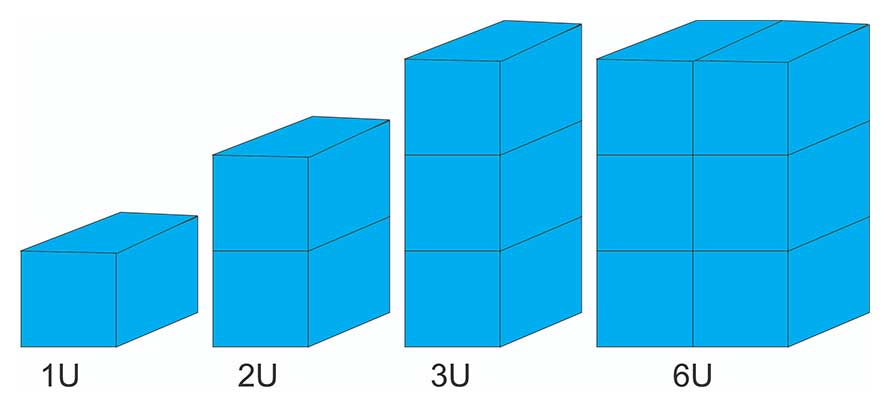
Figure 1 Acceptable CubeSat formats for CUBICS
6U CubeSat offers a significantly larger volume and mass for payload. Many space companies (e.g. Planet, Spire Global, Wyvern) utilise 6U bus for their proprietary payload to produce high quality data products. As such, applicants for Stream 1 must demonstrate competence and past successes in building CubeSat.
B.1. Unique requirements for 6U applications
6U CubeSat has demonstrated to be a powerful low-cost research platform. There are successful examples from university built 6U CubeSat for EO (e.g. University of Versailles Saint-Quentin-en-Yvelines UVSQ-Sat), imaging (e.g. Kyutech KITSUNE), and tech demo (e.g. MIT AMS) missions. CSA is aware there are academic institutions that excel in building scientific or technological payloads and there are also academic institutions that excel in CubeSat bus development. The 6U Stream in this AO aims to create an opportunity to bring at least two academic institutions to work together. The outcome will be an increase in the Canadian academia capability to utilize CubeSat platform for training and research. The applications consist of CubeSat bus team (PI) and the primary payload team (Co-I). The CubeSat bus team shall submit the application and be responsible for the regulatory license requirements and delivery of the completed CubeSat. The following list clarifies the expectations from 6U applications:
- The PI leading the bus team can include a payload; however, it should be designated as the secondary payload. The primary mission objectives should be based on the science or technical data from the primary payload.
- The Co-I should explain how the primary payload aligns with their area of research and what are the scientific or technological data expected from the mission.
- The application should include the primary payload requirements (e.g. power, mass, volume, data, pointing, thermal) and how the proposed CubeSat bus design can meet these requirements.
- The application should elaborate on the training received by the students in the CubeSat bus team and the primary payload team.
- The Co-I should receive adequate financial support from the PI through a service agreement or contract. Redistribution of grant is not permitted under this AO.
- The application should provide financial information to ensure both the PI and Co-I teams have sufficient budgets to complete the mission including the operation phase.
B.2. The role of PI
One of the main objectives of CUBICS is to provide post-secondary students opportunities to gain hands-on experience in design, build, test, launch and operate a CubeSat with a scientific or technological payload.
The PI is equivalent to a Mission Manager (MM) in a satellite mission. This role cannot be delegated to Co-I or students. The PI should demonstrate vested interest in the project from the beginning until the end. The PI is required to monitor the CubeSat and payload development closely and regularly to ensure it will achieve the scientific or technological objectives stated in the CUBICS proposal.
To alleviate the workload of the PI, it is recommended that one or more students with strong leadership skills be designated as the project manager (PM). They will manage the CubeSat team on a daily basis while the PI carries out weekly or bi-weekly check-in with the team to ensure the CubeSat development meets the cost and schedule constraints.
B.3. Team Composition
Throughout CCP and CUBICS , there were several variations of team composition. Here are the observations CSA has gathered, and the PI is encouraged to take them into consideration.
- One structure that did not work well is the heavy reliance on Capstone teams. There are two reasons. First, Capstone students are at the final year of their studies and as such can only invest one year of effort to the project. Second, by the time April arrives, these students do not know who will be replacing them next year to transfer the knowledge and experience. As a result, the next year students tend to restart from the beginning.
- Undergraduate and graduate students have different expectations when they participated in CCP or CUBICS. Undergraduate students look at the project as an opportunity to gain hands-on experience with a space mission whereas graduate students look for an opportunity to tie into their research thesis. It is important to manage the difference in expectations.
- It is important to find a PM with the needed leadership skills. The PM is a person that the PI can entrust with the monitoring of day-to-day activities. Likewise, students look at the PM as a trustworthy leader. A few CCP teams chose to have 2 or 3 PM and the outcome was equally good. It is worth noting that students from any year can be a PM. CCP had instances of teams with a PM in their first year of undergraduate studies. Most PMs started with no experience in leading any activity or project. They essentially learned and managed simultaneously because they were driven by their passion for the project, their willingness to learn and listen, and their openness to work with everyone.
Under the PM, the CUBICS team should be divided into seven (7) sub-teams: Systems, Electrical, RF, Mechanical, Software and On-board Computer (OBC), ADCS (Attitude Determination and Control System) and Payload. Each team should aim for a buddy system where one senior member is always shadowed by at least a junior member. This ensures continuity in case the senior member drops out. It is not necessary to have equal size for all the teams. For instance, depending on the complexity of the payload, the team can have a large variation in size.
Throughout a CubeSat project, it is unavoidable that the team will encounter setbacks. When the team cannot recover from the setback, it is natural that the student motivation starts to descend and personal conflicts begin to ascend. These are the critical moments where the students rely on the leadership of PI and PM to carry the team through the crisis.
B.4. Make versus Buy
In CCP, there were several instances where teams attempted to build subsystems (e.g. transmitter, flight computer, battery pack) and after investing significant effort, the teams abandoned the “make” attempt and chose to procure from vendors. From the perspective of learning, “make” provides the best experience to the students. However, teams must also take into considerations risks associated with building a spacecraft component:
- It is rare, if not impossible, to design and build a spacecraft component with one single iteration.
- The environmental qualification of a newly built component is usually time consuming and effort intensive.
- It usually requires multidisciplinary skills to build a component. The lack of resource in one discipline is sufficient to derail the "make" attempt.
For each subsystem that will be considered for "make," it is recommended that the team carry out a make versus buy trade-off analysis prior to making the final decision. The risk assessment should also include all "make" subsystems and their risk mitigation strategies.
B.5. Licensing
As a minimum, each CubeSat mission requires a radio frequency license issued by ISED (Innovation, Science & Economic Development). Many satellite missions from educational institutions or nonprofit organizations use the Amateur Radio frequency. The principal advantages are low license fee and frequency coordination is usually easy. The principal disadvantages are low bandwidth and downlink transmission cannot be encrypted. Amateur Radio frequency is coordinated by International Amateur Radio Union (IARU). It recommends that the application be accompanied by national Amateur Radio organization which is Radio Amateur Canada (RAC). IARU stipulates that the satellite mission must have:
- Clearly defined amateur component e.g. a transponder, APRS system etc. Ideally, the amateur component would be available on a global basis for 100% of the time, though geographically and time‐restricted applications may be considered if sufficient reasons are provided.
- OR some part of the mission must be relevant to possible future amateur satellite missions e.g. technology or system such as attitude control systems, power systems, communications systems etc. AND the results the study will be made available to the amateur community through open access publications or seminars etc.
- OR some clearly defined STEM activity that clearly involves the amateur service AND with the potential to increase the number of licenced amateur operators, e.g. satellite training courses that are operated by educational institutions, amateur radio clubs and societies, or by qualified amateur operators with a view to increasing knowledge of, and interest in, the amateur service,
- OR some combination of the above components.
Based on CCP experience, point 4 above has the highest chance of obtaining IARU approval.
On the other hand, S-band frequency which is used by all CSA missions and majority of Canadian companies, have a higher license fee and the frequency coordination effort requires a longer lead time because of its high demand. The advantages of S-band frequency are higher bandwidth which means larger quantity of downlink data in each pass, and the downlink transmission can be encrypted to increase security of the data.
B.6. Deorbiting Requirements
In , UN COPUOS adopted the Space Debris Mitigation Guidelines which stipulate that upon completion of the mission, satellites in LEO shall be deorbited within 25 years. Since the adoption of the guidelines, space launch activities have picked up significantly due to the deployment of mega-constellations. In , FCC, regulatory body for radio frequency in the US, decided that the 25 years period be reduced to 5 years. Although FCC is not fully accepted by all COPUOS signatories, CSA requires all CUBICS teams adopt the 5-year deorbiting period as the mission requirement. Since CUBICS will only provide launch opportunities in Sun Synchronous Orbit and the usual range of launch altitude has the upper limit of 590 km, CUBICS teams are expected to demonstrate their CubeSat will deorbit within 5 years at the upper launch altitude of 590 km.
B.7. Ground Station
Many CCP teams encountered unexpected challenges and delays in building their ground stations related to the permission and charges from university facility departments. A couple teams chose to build their ground station off campus or relied on local Amateur Radio station. Some teams completed the ground station installation after the delivery of their CubeSat to the launch provider. These solutions were not optimal as they reduced or eliminated the end-to-end testing prior to launching their CubeSat. For CUBICS , applications without fully functional ground stations need to provide a sound implementation plan that they will have their ground stations ready before CDR. CSA will demand proof of proper uplink and downlink functionalities of the ground stations at FRR.
B.8. End-to-end Testing
One key lesson learned from CCP is the importance of end-to-end testing with the ground station in the loop. After failing to make contacts with their CubeSat, several teams admitted that they carried out over the air testing to confirm the communication links between the CubeSat and the ground station in the laboratory only. To extrapolate the test results from tens of meters to hundreds of kilometers proved to be unwise.
APPENDIX C – Scoring
A numerical score is associated with each criterion. It is strongly recommended that applicants include in their applications information related to each highest score, if applicable.
C.1 Benefits for Canada and outcomes
Maximum: 40
Minimum: 28
C.1.1 Proposed project
This criterion is used to evaluate the scientific and/or technical merits of the proposed project and its probable impact and potential to advance scientific knowledge and/or to enable the development of new technologies in priority areas, as per the Space Strategy for Canada. The proposal should also include an assessment of the quantity and quality of data collected from the mission.
This criterion will be used to answer the following questions:
- Does the project present a probable impact and/or the potential to advance scientific knowledge and/or enable the development of new technologies that would contribute to advance space science knowledge in priority areas as per the Space Strategy for Canada?
- Is there an assessment of the primary payload in the following areas: suitability to deliver the mission objectives, technology readiness level, expected performance in space in terms of quantity and quality of data.
Evaluation Source: Proposal
-
Excellent: (if the proposal demonstrates high confidence of meeting the following 4 elements completely)
- The proposal describes in detail, demonstrating how the project could contribute directly and indirectly to space science and/or the development of technologies that would contribute to advance space science knowledge in priority areas, as per the Space Strategy for Canada.
- The supporting information is complete, accurate and relevant, with all key information and details provided. The proposed project will contribute to science advancement and/or technology development in a priority area.
- The proposed CubeSat mission presents clear elements of originality or effectively describes several distinguishing aspects of the mission.
- The proposal clearly outlines the primary payload, its current state of development, the anticipated steps to advance it, and its expected performance in space.
- The confidence level for the payload to deliver the mission objectives is very high.
(Score: 25)
-
Good: (if the proposal does not demonstrate meeting all 4 elements under Excellent completely and instead one or more of the following elements is more suitable)
- The proposal describes in detail, demonstrating how the project could contribute directly or indirectly to space science and/or to the development of technologies that would contribute to advance space science knowledge in priority areas, as per the Space Strategy for Canada.
- The supporting information is accurate and relevant with most key information provided. The proposed project will likely contribute to science advancement and/or technology development in a priority area.
- The proposed CubeSat mission demonstrates limited originality and describes at least two distinguishing aspects of the mission.
- The proposal describes the primary payload and provides credible information on its current state of development, planned advancement activities, and expected performance in space, with minor gaps or limited detail.
- The confidence level for the payload to deliver the mission objectives is high.
(Score: 18)
-
Average: (if the proposal does not demonstrate meeting all 4 elements under Good completely and instead one or more of the following elements is more suitable)
- The proposal briefly describes how the project could contribute directly or indirectly to space science and/or the development of technologies that would contribute to advance space science knowledge in priority areas, as per the Space Strategy for Canada.
- The supporting information provided is inaccurate or not relevant with key information and details missing. The proposed project may contribute to science advancement and/or technology development but has not demonstrated a clear link to a priority area.
- The proposed CubeSat mission shows limited to no originality and provides a very general description of a distinguishing aspect.
- The proposal identifies the primary payload but provides incomplete, uneven, or general information regarding its development status, planned advancement activities, or expected performance in space.
- The confidence level for the payload to deliver the mission objectives is low.
(Score: 12)
-
Poor: (if the proposal does not demonstrate meeting all 4 elements under Average completely and instead one or more of the following elements is more suitable)
- The proposal does not describe how the project could contribute to the advancement of scientific knowledge and/or to the development of technologies that would contribute to advance space science knowledge in priority areas, as per the Space Strategy for Canada. No specific science or technology is mentioned.
- The information provided does not cover key information and details. The probable impact and potential to advance scientific knowledge and/or to enable the development of new technologies that would contribute to advance space science knowledge in priority areas, as per the Space Strategy for Canada, is expected to be negligible.
- The proposed CubeSat mission shows little to no originality and provides no description of distinguishing aspects.
- The proposal provides insufficient or unclear information regarding the primary payload, with limited description of its development status, advancement approach, or expected performance in space.
- The confidence level for the payload to deliver the mission objectives is very low.
(Score: 7)
C.1.2 Training plan
This criterion assesses the quality, relevance, and diversity of the experience the students will acquire. The level of commitment of the PI and Co-I in training the students should be elaborated.
This criterion will be used to answer the following questions:
- Does the training plan specify the activities in which the students will participate during the project and are they involved in several key aspects, allowing them to acquire useful experience and skills?
- Do the activities assigned to the students suit their academic level?
- Does the plan include information on the method(s) that will be used to supervise the students?
- Is sufficient support provided to the students by the trainers (PI and Co-I)?
- Will the students gain knowledge and experience that is relevant to the development of their professional careers, providing a pathway to higher education in STEM or future employment opportunities in the space sector?
- To what extent has the team established and maintained structured knowledge management practices that support effective student training, onboarding, and continuity of learning throughout the project?
For Stream 1:
- Does the proposal include student exchange opportunities between CubeSat bus and primary payload teams?
Evaluation Source: Proposal
-
Excellent: (if the proposal demonstrates high confidence of meeting the following 5 elements for Stream 1 applications or 4 elements for Stream 2 applications completely)
Streams 1 and 2
- The training plan is well designed and describes in detail the activities in which the students will participate and on the distribution of their tasks. The activities are well planned and clearly suit the academic level of the students involved in the project (undergraduate, Master's, PhD, etc.). The methods for supervising the students are clearly described and well suited to the work to be carried out.
- Significant and detailed information is provided on the knowledge and skills that the students will acquire as well as the potential impact on the careers of the students involved. The students will gain knowledge and experience that may lead to higher education in STEM or future employment opportunities in the space sector, which may include entrepreneurship ventures.
- The contributions and commitments of the PI, the Co-Is, and other trainers is well detailed and demonstrates that the students will be well supported throughout the project.
- A well structured, comprehensive, and regularly updated knowledge database that actively supports student learning and skill development. Clear and effective processes are in place to ensure consistent knowledge sharing, smooth onboarding of new students, and continuity of training across project phases.
Stream 1 only
- The proposal indicates a commitment of 2 or more students will be offered work term in the partner team (e.g. CubeSat bus team member embeds into the primary payload team for one work term or vice versa). The merit of this exchange is well justified.
(Score: 15)
-
Good: (if the proposal does not demonstrate meeting all 5 elements for Stream 1 applications or 4 elements for Stream 2 applications under Excellent completely and instead one or more of the following elements is more suitable)
Streams 1 and 2
- The training plan is well designed and provides detailed information on the activities in which the students will participate and on the distribution of their tasks. The activities suit the academic level of the students involved in the project (undergraduate, Master's, PhD, etc.). The methods for supervising the students are described and suited to the work to be carried out.
- Detailed information is provided on the knowledge and skills that the students may acquire.
- The contributions and commitments of the PI, the Co-Is, and other trainers are briefly mentioned and demonstrate that the students will be supported for key tasks.
- A well organized knowledge database that supports student training, with minor gaps or inconsistencies. Knowledge transfer practices are established and generally effective in helping new students integrate and develop required skills.
Stream 1 only
- The proposal indicates a commitment of 1 student will be offered work term in the partner team (e.g. CubeSat bus team member embeds into the primary payload team or vice versa). The merit of this exchange is briefly explained.
(Score: 10)
-
Average: (if the proposal does not demonstrate meeting all 5 elements for Stream 1 applications or 4 elements for Stream 2 applications under Good completely and instead one or more of the following elements is more suitable)
Streams 1 and 2
- The training plan is partially defined, and details are missing on the activities in which the students will participate, and on the distribution of their tasks. Overall, the activities suit the academic level of the students involved in the project (undergraduate, Master's, PhD, etc.).
- There is little information provided on the method(s) that will be used to supervise the students.
- The PI and the Co-Is or other trainers' contributions are not sufficiently described, making it difficult to assess the level of support provided to students.
- A functional knowledge database that covers key information but contains notable gaps or inconsistencies. Knowledge transfer to students occurs but is largely informal, uneven, or dependent on peer to peer interactions.
Stream 1 only
- The proposal is not committed to offer student exchange (e.g. CubeSat bus team member embeds into the primary payload team or vice versa).
(Score: 5)
-
Poor: (if the proposal does not demonstrate meeting all 5 elements for Stream 1 applications or 4 elements for Stream 2 applications under Average completely and instead one or more of the following elements is more suitable)
Streams 1 and 2
- The training plan is poorly defined and contains few details on the activities in which the students will participate, and on the distribution of tasks.
- There is no information provided on the method(s) that will be used to supervise the students.
- The PI and Co-Is or other trainers' contribution is not described.
- A partially developed or poorly organized knowledge database that provides limited support for student training. Knowledge transfer is inconsistent and relies heavily on individual team members, with minimal structure to support onboarding or skill development.
Stream 1 only
- The proposal does not consider student exchange (e.g. CubeSat bus team member embeds into the primary payload team or vice versa)
(Score: 0)
C.1.3 Equity, diversity and inclusion (EDI)
This criterion evaluates whether the proposal includes a meaningful EDI plan to foster the recruitment and engagement of members from designated and equity-deserving groups (employment equity groups).
This criterion will be used to answer the following questions:
- Does the applicant demonstrate an understanding of EDI considerations and systemic barriers in relation to the proposed work?
- Have concrete measures been or will they be put in place to facilitate the access and the participation of members from designated and equity-deserving groups within the CubeSat team?
Evaluation Source: Proposal
Pass: The proposal shows an understanding of EDI consideration and systemic barriers in the context of the proposed work. Concrete measures have been or will be implemented to facilitate access and participation of members from designated and equity-deserving groups within the CubeSat team and impact will be measured.
Fail: The proposal does not show an understanding of EDI considerations or systemic barriers. No information is provided regarding concrete measures that have been or will be put in place to facilitate access and the participation of members from designated and equity-deserving groups.
C.1.4 Public engagement
This criterion evaluates the nature, relevance, feasibility, and effectiveness of the proposed public engagement activities.
This criterion will be used to answer the following questions:
- Does the public engagement plan include all key aspects with sufficient detail and justification?
- Does the public engagement plan demonstrate that the proposed resources and activities will be sufficient to reach the intended audience?
- Will the public engagement activities allow the project to gain visibility and to reach a large audience within the province or territory?
Evaluation Source: Proposal
Pass: The public engagement plan has relevant information on the proposed activities, the targeted audiences, the variety of promotional tools to be developed and the expected results.
Fail: The proposal does not include a public engagement plan or
The proposal includes a public engagement, but relevant information is not included such as the proposed activities, the target audiences and the variety of promotional tools to be developed.
C.2 Feasibility and risks
Maximum: 30
Minimum: 21
C.2.1 Project plan and schedule
This criterion assesses the likelihood that the project team delivers the project's objectives. The assessment will be based on the clarity and completeness of the project plan, the work breakdown structure (WBS), the task descriptions, major milestones, and the proposed schedule.
This criterion will be used to answer the following questions:
- In light of the proposed project plan included in the proposal, are the objectives realistic?
- Is the project clearly described, with sufficient detail on the work to be performed?
- Is there a high probability that the work will be carried out on schedule and within budget?
- Is the time commitment of the PI and Co-I(s) reasonable given the scope of the project?
- For Stream 1: does it include a working plan explaining how the CubeSat bus and primary payload teams work together?
Evaluation Source: Proposal, Detailed implementation schedule
-
Excellent: (if the proposal demonstrates high fidelity in meeting the following 5 elements for Stream 1 applications or 4 elements for Stream 2 applications completely)
Streams 1 and 2
- The proposal includes a solid and credible project plan that clearly defines all milestones and the criteria required to achieve them and the overall project objectives.
- The Work Breakdown Structure (WBS) is complete and provides detailed information for each work package, including required resources and schedule.
- The schedule includes appropriate flexibility or margins on critical milestones, demonstrating a strong likelihood that the work will be completed on schedule and within budget.
- The time commitment of the PI (and Co I(s), if applicable) is clearly described and appropriate for the scope of the project and the associated responsibilities.
Stream 1 only
- The proposal includes a complete working plan between the CubeSat bus and primary payload teams including frequency of tag-ups between PI and Co-I, student exchange opportunities, information exchange, progress monitoring, dispute resolution, and technical assistance.
(Score: 20)
-
Good: (if the proposal does not meet all 5 elements for Stream 1 applications or 4 elements for Stream 2 applications under Excellent completely and instead one or more of the following elements is more suitable)
Streams 1 and 2
- The proposal presents a credible project plan that defines the main milestones and contributing criteria toward achieving the project objectives. However, there are a few omissions in the criteria.
- The WBS covers the majority of work packages, with generally clear information on resources and schedule.
- The schedule shows some consideration of flexibility or margins, and the work is likely to be completed on schedule and within budget.
- The time commitment of the PI (and Co-I(s), if applicable) is provided and appears generally appropriate for the scope of the project.
Stream 1 only
- The proposal includes a working plan between the CubeSat bus and primary payload teams but at least 1 element from the following list are missing: frequency of tag-ups between PI and Co-I, student exchange opportunities, information exchange, progress monitoring, dispute resolution, and technical assistance.
(Score: 15)
-
Average: (if the proposal does not meet all 5 elements for Stream 1 applications or 4 elements for Stream 2 applications under Good completely and instead one or more of the following elements is more suitable)
Streams 1 and 2
- The proposal includes a project plan that outlines some milestones, but the criteria to meet them or their linkage to project objectives are only partially defined.
- The WBS identifies major work packages but lacks detail regarding resources, schedule, or task breakdown.
- The schedule provides limited flexibility, and there are uncertainties regarding the project's ability to be completed on time or within budget.
- The time commitment of the PI (and Co-I(s), if applicable) is insufficient for the scope of the project.
Stream 1 only
- The proposal includes a working plan between the CubeSat bus and primary payload teams but at least 3 elements from the following list are missing: frequency of tag-ups between PI and Co-I, student exchange opportunities, information exchange, progress monitoring, dispute resolution, and technical assistance.
(Score: 10)
-
Poor: (if the proposal does not meet all 5 elements for Stream 1 applications or 4 elements for Stream 2 applications under Average completely and instead one or more of the following elements is more suitable)
Streams 1 and 2
- The proposal provides an incomplete or unclear project plan, with poorly defined milestones and limited connection to the project objectives.
- The WBS is incomplete or missing significant details on work packages, resources, or schedule.
- The schedule shows little to no flexibility, raising significant concerns about the feasibility of completing the work on time or within budget.
- The time commitment of the PI (and Co-I(s), if applicable) is not included in the proposal.
Stream 1 only
- The proposal does not include a working plan between the CubeSat bus and primary payload teams
(Score: 5)
C.2.2 Project-related risks and mitigation strategies
This criterion is used to evaluate the applicant's analysis of the risks associated with the project, as well as the mitigation strategies for each risk.
The applicant must carry out an in-depth risk analysis. A risk analysis table must be included in the application.
This criterion will be used to answer the following questions:
- Has the applicant identified and described the risks associated with the project in detail, including but not limited to, financial, managerial, environmental, scientific, and technical risks (particularly access to financial, human and physical resources) as well as any aspects that would impact the project schedule?
- Are the proposed mitigation strategies for each risk well thought out and realistic?
- Has the applicant provided a credible assessment of the probability of the risks materializing as well as the impact on the project?
For Stream 1:
- Does it address additional risks associated with the teaming arrangements?
Note that the evaluation of the risk criterion will be based on whether all risks were identified whether the impact and probability assessment is realistic, and whether mitigation strategies are appropriate. The project will not be penalized for having high risks or unconfirmed sources of funding, as long as the risks have been identified and mitigation strategies provided are appropriate.
Evaluation Source: Proposal
-
Excellent: (if the proposal demonstrates high fidelity in meeting the following 4 elements for Stream 1 applications or 3 elements for Stream 2 applications completely)
Streams 1 and 2
- The main risks in finance (e.g. inflation, cost overruns), management (e.g. student turnover, knowledge acquisition and transfer), and technical (e.g. access to a laboratory for AIT or to a ground segment for operations, component shortages) are all identified and well described.
- The mitigation strategies for each risk are well explained and credible.
- A credible and detailed probability/impact assessment is included.
Stream 1 only
- The risk analysis includes risks associated with the teaming arrangement and their mitigation strategies. It is deemed to be high fidelity and complete.
(Score: 10)
-
Good: (if the proposal does not meet all 4 elements for Stream 1 applications and 3 elements for Stream 2 applications under Excellent completely and instead one or more of the following elements is more suitable)
Streams 1 and 2
- The main risks in finance (e.g. inflation, cost overruns), management (e.g. student turnover, knowledge acquisition and transfer), and technical (e.g. access to a laboratory for AIT or to a ground segment for operations, component shortages) are identified and described. However, a small number of risks are not identified or are not well described.
- The mitigation strategies for each risk are explained and credible for most of the risk items. However, there are a small number of mitigation strategies that require further description or lack credibility.
- A probability/impact assessment is provided with some information but lacks detail or is not completely credible.
Stream 1 only
- The risk analysis includes risks associated with the teaming arrangement and their mitigation strategies. It is deemed to be medium fidelity and at least one element is missing.
(Score: 7)
-
Average: (if the proposal does not meet all 4 elements for Stream 1 applications or 3 elements for Stream 2 applications under Good completely and instead one or more of the following elements is more suitable)
Streams 1 and 2
- The application mentions a few of the main risks and several main risks missing.
- The mitigation strategies for each risk are described for most of the risk items. However, many mitigation strategies require further description or lack credibility.
- A probability/impact assessment is presented at a high level and it does not clearly describe the impact on the project.
Stream 1 only
- The risk analysis includes risks associated with the teaming arrangement and their mitigation strategies. It is deemed to be low fidelity and at least two or elements are missing.
(Score: 5)
-
Poor: (if the proposal does not meet all 4 elements Stream 1 applications or 3 elements for Stream 2 applications under Average completely and instead one or more of the following elements is more suitable)
Streams 1 and 2
- The application does not mention any of the main risks associated with the project or it is omitting a significant number of main risks.
- The mitigation strategies for each risk are at a high level. Some strategies also lack credibility.
- No probability/impact assessment is provided.
Stream 1 only
- The risk analysis does not include risks associated with the teaming arrangement.
(Score: 0)
C.3 Resources
Maximum: 30
Minimum: 21
C.3.1 Project team
This criterion evaluates the competencies – experiences, skills, knowledge, expertise etc. - of the project team (PI, Co-I(s), as well as confirmed students and collaborators, if applicable). The proposed team structure and task distribution will be assessed towards the delivery of the CubeSat Mission. Student recruitment, onboarding and retention strategy will also be evaluated. For STREAM 1, the past experience and achievements of key team members and the institution, in managing a CubeSat mission will also be assessed. The CSA reserves the right to take into consideration how the PI managed CSA-funded projects in the past, based on previous project proposals and their results, on reporting accuracy and reliability.
This criterion will be used to answer the following questions for both funding Streams:
- Do the PI and Co-I(s) have experience in leading and completing projects of similar scope in the past in the academia?
- Does the project team have the skills in all disciplines required to build a CubeSat? If not, does the proposal explain how the project team acquires the missing skillset?
- Is the proposed team structure effective in the delivery of the CubeSat mission?
- Is the strategy for the recruitment, onboarding and retention of the student team members explained in detail?
Here the additional questions for Stream 1 applications:
- Do the CubeSat bus team members have demonstrated experience in the development and management of a CubeSat mission?
- Do the primary payload team members have demonstrated experience in building a payload for space or suborbital platforms?
- What are the benefits of this collaboration, e.g. knowledge transfer, future opportunities, capacity building in both teams, etc.?
Evaluation source: Proposal, résumés (Curricula vitae), letters of support from Co-I(s) (if applicable), CSA evaluations of the PI's previous progress and final reports (if applicable)
-
Excellent: (if the proposal demonstrates high fidelity in meeting the following 7 elements for Stream 1 applications or 4 elements for Stream 2 applications completely)
Streams 1 and 2
- The PI and/or Co-I have demonstrated experience in managing and completing two or more projects in the academia with similar complexities.
- The proposal provides a comprehensive analysis of the skillset required for the CubeSat project and identifies clearly the skills the team already possess or lacking. For skill that is lacking, the proposal provides a credible strategy on how it will be secured. The skillset analysis is complete and credible.
- The team organization is clearly explained. The roles and responsibilities of PI, Co-I, Mission Manager, Project Manager, and Subsystem leads are well defined and appropriate for the CubeSat project. The size and structure of each Subsystem team is also explained and justified. All required information is provided.
- The proposal explains the strategies for recruiting, onboarding and retaining student team members. It also discusses strategies that mitigate the impact of student turnover. The proposal also includes credible evidence (e.g. past experience in similar project) that the strategies will be effective.
Stream 1 only
- The key CubeSat bus team members have demonstrated experience in completing two or more CubeSat missions.
- The key primary payload team members have demonstrated experience in completing two or more payloads for orbital, suborbital flights, or field deployment of similar complexity.
- The benefits of the collaboration are very good, e.g. the justification for the collaboration is well explained and credible, there will be significant knowledge transfer from CubeSat bus team to primary payload team, and vice versa, etc.
(Score: 20)
-
Good: (if the proposal does not meet all 7 elements for Stream 1 applications or 4 elements for Stream 2 applications under Excellent completely and instead one or more of the following elements is more suitable)
Streams 1 and 2
- The PI and/or Co-I have demonstrated experience in managing and completing one project in the academia with similar complexities.
- The proposal provides an analysis of the skillset required for the CubeSat project and identifies the skills the team already possess or lacking. For skill that is not available in the team, the proposal discusses on how it will be acquired. The skillset analysis is good.
- The team organization is explained. The roles and responsibilities of PI, Co-I, Mission Manager, Project Manager, and Subsystem leads are defined and reasonable for the CubeSat project. The size and structure of each Subsystem team is also explained. There is some minor information missing (e.g. backup for key member)
- The proposal discusses the general approach for recruiting, onboarding and retaining student team members. It addresses briefly the issue of student turnover. The proposed strategies are reasonable.
Stream 1 only
- The key CubeSat bus team members have demonstrated experience in completing one CubeSat mission.
- The key primary payload team members have demonstrated experience in completing one payload for suborbital or orbital flights or field deployment of similar complexity.
- The benefits of the collaboration are good, e.g. the justification for the collaboration is good, there will be frequent interactions between the teams, etc.
(Score: 15)
-
Average: (if the proposal does not meet all 7 elements for Stream 1 applications and 4 elements for Stream 2 applications under Good completely and instead one or more of the following elements is more suitable)
Streams 1 and 2
- The PI and/or Co-I have demonstrated experience in managing and completing one project in the academia with significant less complexities.
- The proposal provides an analysis of the skillset required for the CubeSat project and identifies the skills the team already possess or lacking. However, there is at least one missing skill not accounted for. For skill that is not available in the team, the proposal does not discuss how it will be acquired. The skillset analysis is incomplete.
- The team organization is presented but little information is included. The roles and responsibilities of PI, Co-I, Mission Manager, Project Manager, and Subsystem leads are discussed but there are some overlap or gaps in responsibilities. There is missing information on the size and structure of each Subsystem team.
- The discussion on recruiting, onboarding and retaining student team members is brief and lacks details. It also does not address the issue of student turnover.
Stream 1 only
- The key CubeSat bus team members have demonstrated experience in the supporting role of a CubeSat mission.
- The key primary payload team members have demonstrated experience in the supporting role of a payload for suborbital or orbital flights or field deployment of similar complexity.
- The benefits of the collaboration are marginal, e.g. the justification of the collaboration is weak, there will be little interactions between the teams, etc.
(Score: 10)
-
Poor: (if the proposal does not meet all 7 elements for Stream 1 applications or 4 elements for Stream 2 applications under Average completely and instead one or more of the following elements is more suitable)
Streams 1 and 2
- The PI and/or Co-I have not demonstrated experience in leading and completing a space project (payload, CubeSat, etc.).
- The proposal provides a summary of the skillset required for the CubeSat project and identifies the skills the team already possesses or lacking. However, there is no discussion on how it will be acquired. The skillset analysis is cursory and incomplete.
- A high-level description of the team organization is presented. The roles and responsibilities of some key members (PI, Co-I, Mission Manager, Project Manager, and Subsystem leads) are discussed and there are significant overlaps or gaps in responsibilities. There is no discussion on the size and structure of each Subsystem team.
- The discussion on student recruitment, onboarding and recruitment is incomplete.
Stream 1 only
- The CubeSat bus team has no prior experience in a CubeSat mission.
- The primary payload team has no prior experience in designing payloads for suborbital, orbital flights or field deployment.
- The benefits of the collaboration for both teams are not explained or are not justified.
(Score: 5)
C.3.2 Budget, funding, physical resources, infrastructure and collaboration
This criterion is used to evaluate if the proposed budget is adequate to achieve the project's objectives. The timely availability of required physical resources (equipment, instruments, etc.), procurement strategy for CubeSat subsystems and infrastructure access (laboratory, ground station, etc.) will also be evaluated. Co-funding and collaboration, if included, will also be evaluated. This criterion will be used to answer the following questions:
- Is the budget (including co-funding if applicable) realistic and sufficient to achieve the project's objectives?
- Will the applicant likely have access to the required physical resources (e.g. test equipment, instruments)?
- Does the proposal include a discussion on the procurement strategy for all CubeSat subsystems?
- Have details been provided regarding the access to the laboratory and/or the ground-based infrastructure that will be used to develop the CubeSat, and to operate the CubeSat if it is put into orbit, including how the access will be granted and guaranteed?
- Has sufficient information been provided regarding how the regulatory licenses will be obtained in order to launch the CubeSat?
This is an additional question for Stream 1 applications:
- Is the budget allocation reasonable for both CubeSat bus and primary payload teams for each side to complete the work?
Note: Considering that the funding is a fixed amount, recipients cannot expect an amendment for an additional sum. The recipient has the ultimate responsibility for any cost overrun.
Evaluation source: Proposal, letter(s) of support from collaborators and industrial partners (if applicable)
-
Excellent: (if the proposal demonstrates high confidence of meeting the following 6 elements completely for Stream 1 applications or 5 elements for Stream 2 applications)
- The budget (including co-funding if applicable) is realistic and sufficient to achieve the project's objectives, including all components of the proposed work, and in particular the necessary funding to support student travel to at least two CSA workshops. Good rationale is provided for all budget items.
- The proposal provides detail on all the physical resources (e.g. test equipment, instruments) required to achieve the project's objectives and demonstrates that the project team will likely have timely access to them.
- The proposal includes a complete procurement strategy of CubeSat subsystems including potential suppliers, estimated cost and delivery timeline.
- The proposal provides details on access to laboratories and ground station for CubeSat operations.
- The proposal includes very good understanding of licenses requirements and confirms resources that will handle all license applications. It also provides a timeline in obtaining the licenses within the project timeframe.
Stream 1 only
- The budget allocation for the CubeSat bus and primary payload teams is fully explained and justified. Both the CubeSat bus and primary payload teams should have sufficient budget to complete the project.
(Score: 10)
-
Good: (if the proposal does not demonstrate meeting all 6 elements for Stream 1 applications or 5 elements for Stream 2 applications under Excellent completely and instead one or more of the following elements is more suitable)
- The budget (including co-funding if applicable) appears to be adequate and reasonable for all components of the proposed work and particularly student travels, including to at least two CSA workshops. A good rationale is provided overall.
- The physical resources (e.g. test equipment, instruments) required to achieve the project's goals and objectives are identified and supported by rationales, and their use is properly planned. However, there are still some uncertainties as to their timely availability.
- The proposal includes a good procurement strategy of CubeSat subsystems including potential suppliers, estimated cost and delivery timeline. However, at least one key subsystem is not discussed or there is insufficient info provided.
- The proposal provides good information on access to laboratories and ground station for CubeSat operations. However, there is no confirmation of full access for either the laboratories or ground station throughout the CubeSat project.
- The proposal includes good understanding of licenses requirements and identifies potential resources that will handle all license applications. It also provides a timeline in obtaining the licenses that will likely be within the project timeframe.
Stream 1 only
- The budget allocated for the CubeSat bus and primary payload teams is explained and justified. It is likely that both the CubeSat bus and primary payload team have the sufficient budget to complete the project
(Score: 7)
-
Average: (if the proposal does not demonstrate meeting all 6 elements for Stream 1 applications or 5 elements for Stream 2 applications under Good completely and instead one or more of the following elements is more suitable)
- Overall, the budget (including co-funding if applicable) appears to be adequate for the proposed work, and minimal rationale is provided, but there are still questions about some cost items. Budget allocations for participation in at least two CSA workshops are missing.
- The physical resources (e.g. test equipment, instruments) required to achieve the project's goals and objectives are identified. However, there is concern on some key items which are either not mentioned or their timely availability not discussed.
- The proposal includes a procurement plan of CubeSat subsystems but there is missing information on some items such as potential suppliers, estimated cost and delivery timeline.
- The proposal provides little information on access to laboratories and ground station for CubeSat operations throughout the CubeSat project.
- The proposal includes general understanding of licenses requirements. It identifies resources that will handle all license applications; however, the proposed timeline in obtaining the licenses may fall outside the project timeframe.
Stream 1 only
- The budget allocated for the CubeSat bus and primary payload teams is briefly explained but lack justification. There is concern of insufficient budget for either the CubeSat bus or primary payload team.
(Score: 5)
-
Poor: (if the proposal does not demonstrate meeting all 6 elements for Stream 1 applications or 5 elements for Stream 2 applications under Average completely and instead one or more of the following elements is more suitable)
- There is a clear mismatch between the planned budget (including co-funding if applicable) and the work associated with the project.
- The main physical resources (e.g. test equipment, instruments) that should be required for the project are absent, and nothing indicates that the applicant has a plan for obtaining them.
- The proposal does not include a procurement strategy of CubeSat subsystems including potential suppliers, estimated cost and delivery timeline.
- The proposal does not provide detail on access to laboratories and ground station for CubeSat operations throughout the duration of the project.
- The proposal includes little understanding of licenses requirements and does not identify potential resources that will handle all license applications. It does not provide a timeline in obtaining the licenses within the project timeframe.
Stream 1 only
- The budget allocation for both the CubeSat bus and primary payload teams is not explained or justified. There is serious concern that both teams will not have the sufficient budget.
(Score: 0)
APPENDIX D – Narrative CV Format
D.1 General Instructions
Each application must include the CV of each of the known at the time of the application team members. The English version of the CV must not exceed five pages (six pages for French). There is no limit per section if the CV does not exceed the total page limit. Please follow the instructions and the structure below.
You must respect the following formatting requirements:
- 12-point, Arial font in black type.
- Different fonts and sizes can only be used in tables, figures and legends but must remain readable.
- Single line spacing.
- Normal/standard character spacing (not condensed).
- Minimum margin of 0.79 (2 cm) around all pages.
- Size all pages to 8 ½"" x 11" (216 mm x 279 mm).
If you are listing publications:
- Use any citation style common in your field.
- Add an asterisk (*) after each of your supervised students and highly qualified personnel (e.g., First Name Last Name* or Last Name, First Name*) if you are their supervisor.
- If the lead author is not listed first (e.g., if authorship is alphabetical), bold the lead author's name.
Students are college and university students (undergraduate); highly qualified personnel are graduate students and members of the workforce that have a minimum of a bachelor's degree.
D.2 Instructions for each portion of the narrative CV
D2.1 Personal Statement
Describe why you are well suited for your proposed role relevant to the application. For example, you may include:
- Collaborations or past performance in the field or related fields.
- Expertise related to the specific topic or related topics.
- Impact of your research, and its benefits to society and science.
- Leadership activities and skills.
- Previous work, progress, or productivity that provides context to the results of your research activities which support your current application.
- Recognitions (e.g., prizes, awards, community letters).
D.2.2 Most Significant Contributions and Experiences
Describe up to 10 important contributions or experiences that relate to your application. Contributions described in the previous section can be used here.
Explain the impact, significance, usefulness, and your role in each contribution or experience. A contribution does not have to be a single publication or report. This can include a collection of related publications.
For example, you may include:
- Articles and other publications (e.g., communications, monographs, memoirs or special papers, review articles, conference/symposia/workshop proceedings, government publications, reports documenting industrial contributions or contributions to professional practice, posters, abstracts, preprints).
- Assessment and review activities (e.g., journal review, conference review, funding assessment).
- Contributions to Indigenous leadership, self-determination, and capacity-building in research.
- Dataset creation, curation, sharing or re-use.
- Equity, diversity, inclusion and accessibility advances in the research ecosystem.
- Knowledge mobilization, including knowledge translation and communication of research results to specialist or non-specialist audiences, including policy-makers and the public (e.g., magazine/newspaper articles, media interviews, blogs, social media, policy briefs, public lectures).
- New companies or organizations created to further the promotion/use of research.
- Partnerships or collaborations within or with Canadian or international research or non-research communities or non-profit / public / private sector organizations (e.g., through research networks, large collaborative projects, community-engaged research/citizen science, non-academic career information, voluntary work).
- Products, technology, processes, services or advice useful to specific organizations (from the private, public or non-profit sectors), communities, or society.
D.2.3 Supervisory and Mentorship Activities
Describe how you have helped mentor or train future generations. This can include the development of highly qualified personnel for careers within and outside of academia.
For example, you may include:
- Creation of safe, equitable and inclusive research environments, practices and norms.
- Development and delivery of training workshops outside of research or course requirements.
- Mentorship (formal or informal) of students and highly qualified personnel, early career researchers, colleagues, collaborators, relevant partners, other professionals, or community members.
- Outreach and engagement with students, youth, or members of the general public, including through in-person or online targeted activities or capacity building.
- Supervision of highly qualified personnel.
- Training in methodologies, knowledge systems, or cultural practices and approaches in the research context (e.g., Indigenous knowledge and science).