
From student CubeSats to major defence research contract
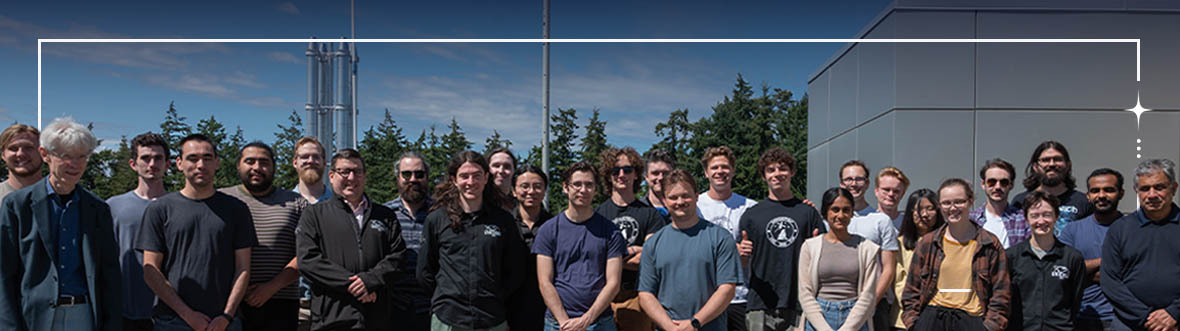
What began as a student satellite project is now helping position the University of Victoria (UVic) and its Centre for Aerospace Research (CfAR) as a key player in Canada's growing space sector.
Developing space talent through CubeSat projects
A key chapter in that journey began with the Canadian Space Agency's (CSA) Canadian CubeSat Project (CCP), launched in 2017 to give post-secondary students the opportunity to design, build and operate real satellites. At UVic, students embraced the challenge through ORCASat, a CubeSat project that gave them hands-on exposure to every stage of a successful space mission.
The skills and knowledge developed through the ORCASat project did not disappear when the mission ended. Many former CCP participants continued to be involved in space engineering activities through employment and graduate studies at UVic, developing novel space technologies and training highly qualified personnel, and supporting innovation across Canada's space industry.
This ongoing involvement has created a cycle of mentorship and knowledge transfer. Former participants continue to support students involved in CubeSats Initiative in Canada for STEM (CUBICS), the CSA's current CubeSat development program for post-secondary students.
"The CSA's CCP and CUBICS programs have provided me with unique opportunities that enabled me to pursue a career in aerospace. Through CCP, I worked on ORCASat as an undergraduate student. Through CUBICS, I pursued my master's degree working on MARMOTSat, and today I contribute as a full-time researcher on CfAR's new space initiatives."
The impact of these student satellite projects extends far beyond technical training. Participants gained experience designing spacecraft, integrating payloads, operating satellites, solving complex engineering challenges and collaborating with partners from academia, industry and government. Those capabilities have helped strengthen CfAR's ability to pursue advanced research projects and collaborations across Canada's space sector.
Building opportunities through student experience
In , CfAR was awarded a $2.82 million contract from Defence Research and Development Canada to develop an 8U CubeSat called PolarLink as part of Canada's Space Low Earth Orbit (SpaceLEO) program. This initiative supports research aimed at creating faster, more reliable communications from space, particularly for Northern and Arctic regions. Planned for launch no earlier than , CfAR's satellite will test new ways to send and receive data using commercial low Earth orbit satellite constellations and optical communications technology.
The SpaceLEO contract represents a tangible example of how investments in student development can help build long-term research and innovation capacity.
Beyond developing satellites, CfAR is building testing facilities, ground station capabilities and partnerships with industry. By increasing access to infrastructure and expertise, CfAR is:
- helping create opportunities for innovation
- supporting Canadian organizations that develop space technologies
- training the highly qualified workforce that Canada's future space missions will require
CfAR hopes to strengthen its role as a hub for space innovation in Western Canada, connecting students, researchers and industry to help advance Canada's space sector and support the Canadian economy.
"The funding and mentorship provided by the CSA through the CCP and CUBICS programs allowed UVic to train its first generation of satellite engineers. Those investments continue to create new opportunities for collaboration, innovation and industry-driven commercialization that extend well beyond the classroom."
A lasting impact
The path from ORCASat to the PolarLink mission demonstrates how investments in student development can generate benefits long after a mission is complete. The experience gained through CSA-supported CubeSat projects helped equip participants with the skills, knowledge and professional networks they now apply to major research initiatives.
Today's student CubeSat projects are not only training the next generation of space professionals, they are also helping build the talent, expertise and partnerships that will support Canada's future in space.