In this section, we invite you to discover our Space Food Facility, the Payload Telescience Operations Centre, the Thermals and Materials Laboratory, and the Electronics Test and Integration Centre.
Space Food Facility
Eating in space: how do they do it?
In this room, astronauts can try out different space-ready food options before going on a mission. Creating space-proof cuisine requires a skillful balance between art and science. There is a standard menu aboard the International Space Station (ISS), but crewmembers can also add variety by requesting some of their favourite foods.
David's space chili
You can make and enjoy Canadian Space Agency (CSA) astronaut David Saint-Jacques' chili at home with this video recipe tutorial.
Ok
David Saint-Jacques' space chili recipe. (Credits: CSA)
In this short video, David Saint-Jacques explains how food supplies are shipped to the ISS and talks about some of the Canadian food items that were on board during his mission.
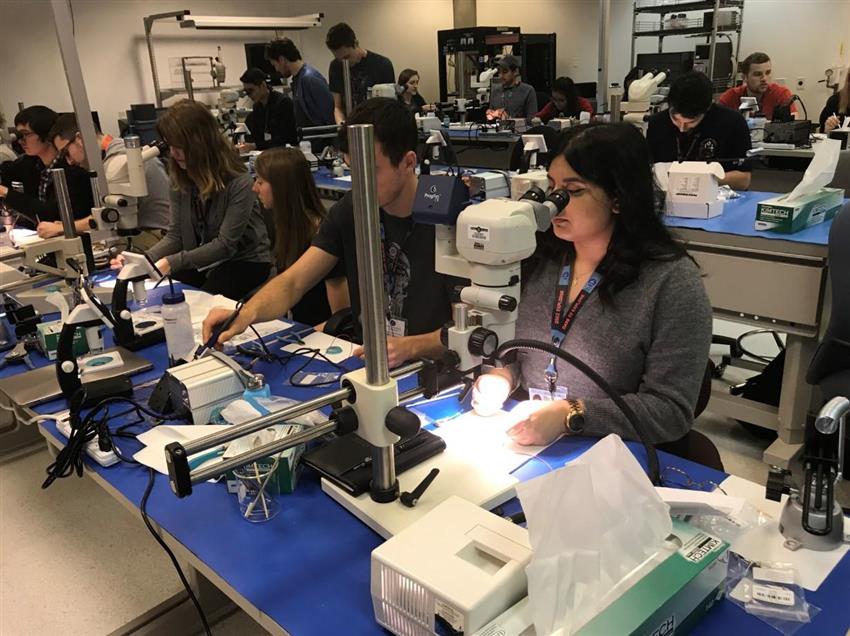
This is where we test all kinds of materials to make sure that once they launch into space, they can take the heat, the cold and everything else that's thrown at them. This lab has also been used to host students training to design and build their own miniature satellites called CubeSats.
In , all of the 15 Canadian CubeSat Project teams met for the first time when they came to the CSA to attend training sessions with our experts and to present their projects to their peers. (Credit: CSA)
Vacuum chamber
Thermal vacuum chambers can simulate the temperature and pressure of a space environment in order to test spacecraft components.
Electronic Tests and Integration Laboratory
As its name would suggest, this laboratory is where spacecrafts' electronic components are tested to make sure they function flawlessly in space.
Dust-free
The lab includes what's known as a “class 10000 clean room,” an enclosed space that maintains exceptionally high air cleanliness levels of a maximum of 10,000 particles per cubic foot (0.028 m2).
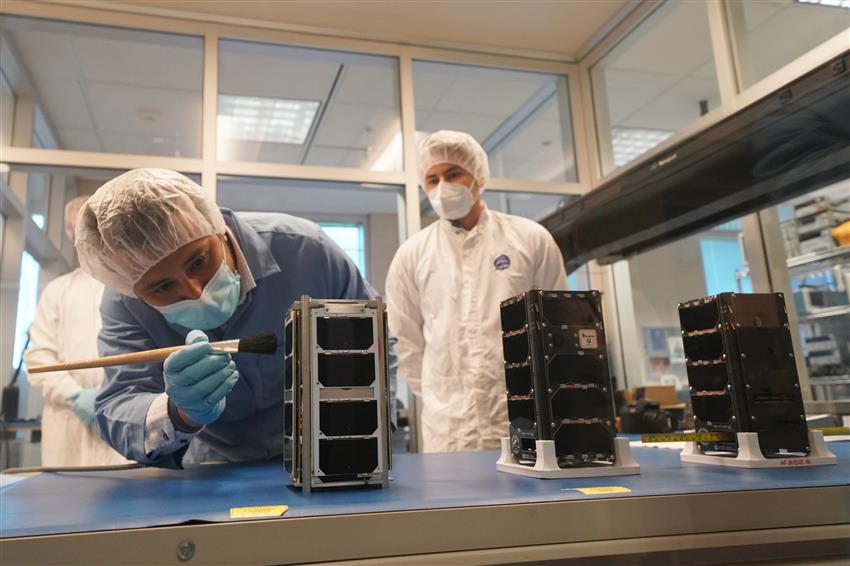
In the clean room, participants in initiatives like the Canadian CubeSat Project make sure their satellites are spotless.
The Canadian CubeSat Project provided teams of students in post-secondary institutions with the unique opportunity to design and build their own CubeSat. (Credit: CSA)
Ready for launch
Find out which Canadian universities participated in the Canadian CubeSat Project in this four-part video series.
Ok
Part 1 features teams from Dalhousie University and the University of Victoria. (Credit: CSA)
Part 2 features teams from McMaster University, the University of Alberta, Yukon University and Aurora Research Institute of Aurora College. (Credit: CSA)
Part 3 features teams from the University of Saskatchewan, the University of Manitoba, Western University, York University and Concordia University. (Credit: CSA)