
Analogue terrain

Rock on!
The analogue terrain, also known as the Mars yard, is a 120 m x 60 m field filled with sand and rocks.
Slightly larger than a football field, this sophisticated sandbox mimics the surface of Mars. It includes tunnels, a drilling shaft, and a host of adaptable geographical features that help test rovers and robotics. It allows the Canadian Space Agency (CSA) and partners to perfect navigation technologies and equipment, and to simulate missions with a hands-on, boots-on-the-ground approach.
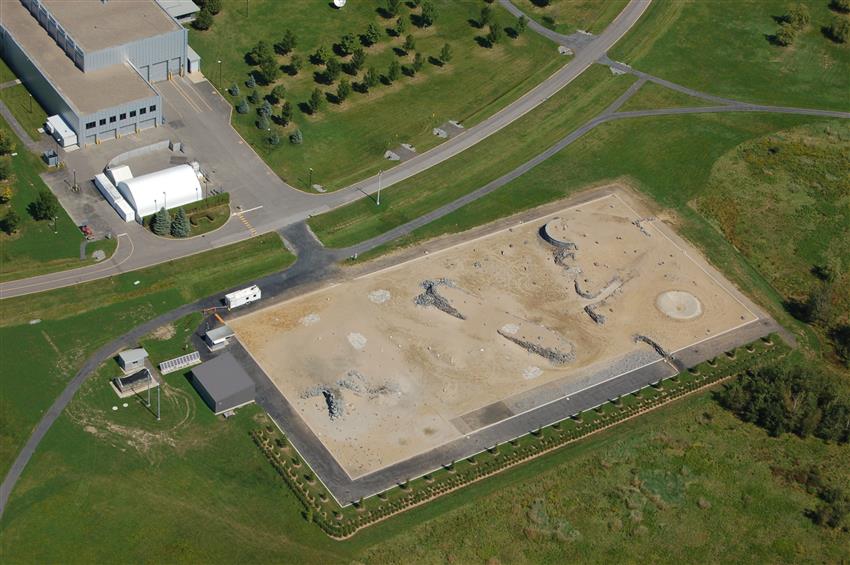
An aerial photo shows the analogue terrain located at the CSA. It is a large sandy field with topographic irregularities. (Credit: CSA)
A team effort
Space exploration endeavours go through the most rigorous processes before taking flight. In order to be fully ready for the next generation of global space missions, the CSA has partnered with over 40 Canadian universities and companies to create a worthy fleet of rover prototypes.
Rover, rover, come on over!
Take a look at the cool lunar, Martian and terrestrial rover prototypes that have made their mark in the Mars yard on our rover fleet webpage.
Great questions, great answers
On , a team of CSA engineers hosted a Reddit "Ask Me Anything" (AMA) to answer questions about the CSA's rovers - see what they had to say!
To the Moon!
The CSA plans to send a Canadian lunar rover to the Moon's South Pole to search for water ice. That's pretty cool, considering temperatures drop to about -200 ˚C in shadowy regions. Learn more about it in this video.
The mission will demonstrate key technologies and accomplish meaningful science. Its objectives are to gather imagery, measurements, and data on the surface of the Moon, as well as to have the rover survive an entire night on the Moon. Lunar nights, which last about 14 Earth days, are extremely cold and dark, posing a significant technological challenge. (Credit: CSA)