
Biography of Robert (Bob) Thirsk

- Date of birth:
- From: New Westminster, British Columbia
- Background: Engineer, physician
- Education: Bachelor of Science in Mechanical Engineering, Master of Science in Mechanical Engineering, Doctorate of Medicine, Master of Business Administration
- Languages: English, French, Russian
- Missions: STS-78, Expedition 20/21
Career highlights
-
Robert Thirsk is selected for the Canadian astronaut corps from more than 4000 applicants in the first astronaut recruitment campaign.
-
He begins astronaut training in February and serves as backup payload specialist to Marc Garneau for Space Shuttle Mission STS-41G in .
-
He serves as crew commander for the seven-day space mission simulation CAPSULS at Defence Research and Development Canada in Toronto.
-
Robert Thirsk flies as a payload specialist aboard Space Shuttle Mission STS-78, the Life and Microgravity Spacelab (LMS) mission. During this 17-day flight aboard Columbia, he and his six crewmates perform 43 international experiments devoted to the study of life and materials sciences.
-
Robert Thirsk is assigned by the Canadian Space Agency (CSA) to NASA's Johnson Space Center in Houston to pursue mission specialist training. This training program involves advanced instruction on both Shuttle and International Space Station (ISS) systems, spacewalking, robotic operations, and the Russian language. Within the NASA Astronaut Office, he serves as a capcom (capsule communicator) for the ISS program.
-
He serves as crew commander for the 11-day NEEMO 7 undersea mission at the National Undersea Research Center in Key Largo, Florida. The crew works with the Centre for Minimal Access Surgery at McMaster University to demonstrate remote surgical techniques for undersea and space applications.
-
–
Thirsk trains at the Yuri Gagarin Cosmonaut Training Center near Moscow and becomes certified as a flight engineer for the Soyuz spacecraft.
-
He serves as backup flight engineer to European Space Agency (ESA) astronaut Roberto Vittori for the Soyuz 10S taxi mission to the ISS in . During this 10-day mission, Thirsk works as Eurocom (European capcom) at ESA's Columbus Control Centre in Germany.
-
He again performs Eurocom duties from Germany in support of ISS Expedition 16 crew activities.
-
Thirsk becomes the first Canadian astronaut to go on a long-duration expedition aboard the ISS. He and two crewmates launch aboard a Russian Soyuz spacecraft from the Baikonur Cosmodrome in Kazakhstan on and spend 188 days in space.
-
–
Thirsk co-leads a research team of International Space University (ISU) alumni investigating the effect of space flight on neuroperception.
-
Thirsk resigns as astronaut and leaves the CSA to join the Canadian Institutes of Health Research in Ottawa as Vice-President of Public, Government and Institute Affairs.
He joins the ISU as an adjunct faculty member, a position he holds to this day.
-
Robert Thirsk retires from the federal government and begins a four-year term as Chancellor of the University of Calgary.
-
–
Thirsk serves as chair of the CSA's Expert Group on the Potential Canadian Healthcare and Biomedical Roles for Deep-Space Human Spaceflight.
-
–
He chairs the Advisory Council on Deep-Space Healthcare and participates in the development of the Health Beyond report.
Photos
-

CSA astronaut Robert Thirsk performing maintenance on the hardware core for the Marangoni Experiment in Space (MEIS), a Japanese-led fluid physics experiment with significant scientific and technological contribution from Canadian Professor Masahiro Kawaji of the University of Toronto. (Credit: NASA)
-

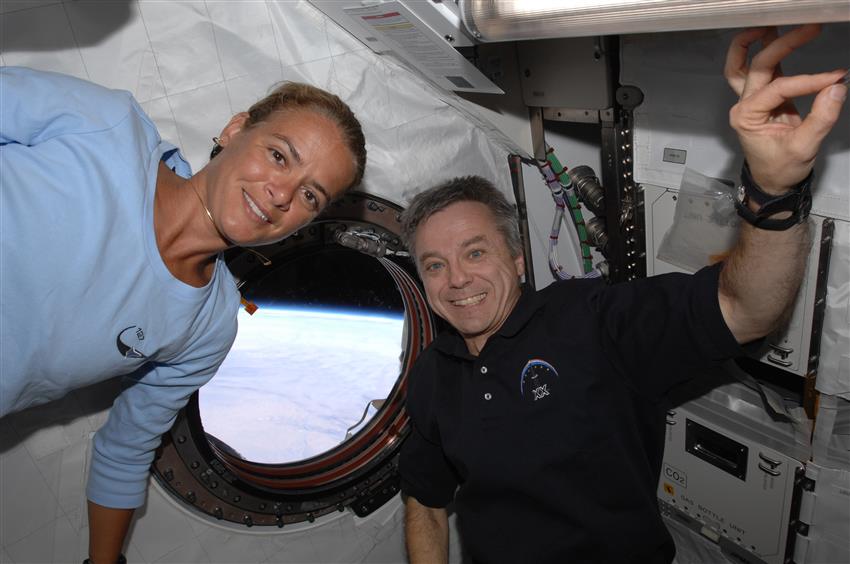
CSA astronauts Julie Payette and Robert Thirsk marked a space milestone on , when they became the first Canadians to meet in space. (Credit: NASA)
-

CSA astronaut Robert Thirsk wearing the Torso Rotation Experiment (TRE) as part of a Canadian study on space motion sickness on the LMS mission in . (Credit: NASA)


Education
He received a Bachelor of Science in Mechanical Engineering from the University of Calgary (), a Master of Science in Mechanical Engineering from the Massachusetts Institute of Technology (MIT) (), a Doctorate of Medicine from McGill University (), and a Master of Business Administration from the MIT Sloan School of Management ().
Honorary degrees
University of Calgary (); University of New Brunswick (); Simon Fraser University (); Toronto Metropolitan University [formerly Ryerson University] (); Vancouver Island University (); Carleton University (); McGill University ().
Special honours
Gold Medal, Association of Professional Engineers, Geologists and Geophysicists of Alberta (); Distinguished Alumni Award, University of Calgary (); NASA Space Flight Medal ( and ); Honorary Member, College of Physicians and Surgeons of British Columbia (); Gold Medal, Professional Engineers of Ontario (); Neil J. Armstrong Award, Aero Space Museum of Calgary (); Alouette Award – The Tomatosphere Team, Canadian Aeronautics and Space Institute (); International Cooperation in Cosmonautics Medal, Russian Federal Space Agency (); Yuri Gagarin Medal, Federation of Cosmonautics of Russia (); NASA Distinguished Public Service Medal (); Paul Harris Fellow, The Rotary Foundation of Rotary International (); Fellow, Canadian Aeronautics and Space Institute (); Outer Space Exploration Medal of Merit, President of the Russian Federation (); Sandford Fleming Medal, Council of the Royal Canadian Institute for the Advancement of Science (); Order of British Columbia (); In honour: Robert Thirsk High School, Calgary (); Queen Elizabeth II Diamond Jubilee Medal (); Officer of the Order of Canada (); Gold Medal and Honorary Fellow, Royal Canadian Geographical Society (); Ronald G. Calhoun Science Ambassador Award, Partners in Research (); In honour: Thirsk Street, University District, Calgary (); Legacy Award, Calgary Board of Education (); Alumnus of Distinction, Lord Beaverbrook High School, Calgary (); Chancellor Emeritus, University of Calgary (); Honorary Fellow, Douglas College (); Honorary Life Member, Australasian Society of Aerospace Medicine (); Life Member, College of Family Physicians of Canada ().