
CAVES underground expedition
Training
The Cooperative Adventure for Valuing and Exercising Human Behaviour and Performance Skills (CAVES) expedition is a simulation of a space mission and an extreme training session, which is held four kilometres underground, in a cave.
This one-week underground adventure was designed by the European Space Agency (ESA) to train astronauts to live and work together as a team. CAVES meets two objectives by giving astronauts an opportunity to:
- tackle challenges associated with long space missions in a hostile environment
- participate in actual scientific studies with research teams, as they would on the International Space Station (ISS)
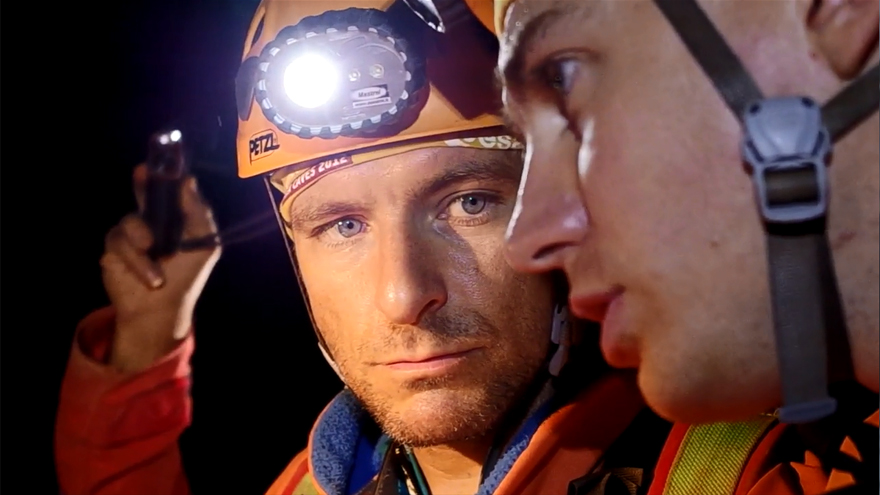
Learn more about CAVES training by watching this video by the ESA on CAVES 2012 (with the participation of Canadian Space Agency astronaut David Saint-Jacques). (Credit: ESA)
A space-like environment in the depths of the Earth
The CAVES expedition prepares astronauts from around the world to:
- work efficiently and safely in a group
- resolve problems as a multicultural team
- carry out complex scientific and technical tasks
- explore unmapped areas
- use procedures related to space exploration

Off for an adventure! The 2013 cavenauts begin their training by going down into the first cave. (Credit: ESA)
Non-standard working conditions
The cohorts of astronauts that participate in the CAVES expeditions experience the challenges, inconveniences and actual dangers of space exploration.
They have to work in extreme conditions, including the following:
- confined spaces
- limited private life
- reduced equipment for hygiene and comfort
- hostile environment (slippery and sharp surfaces, narrow passageways, total darkness, etc.)
- variable temperature and humidity levels
- extremely difficult emergency evacuation
In all, the environment is very similar to that of the ISS!
Our Canadian "cavenauts"
Since , three Canadian astronauts have participated in CAVES expeditions: David Saint-Jacques in , Jeremy Hansen in and Joshua Kutryk in .
Specifically, they spent their days:
- creating 3D maps of the sectors around their base camp in the cave
- making detailed photographic surveys
- analyzing airflow, temperature and humidity
- taking geological, biological and microbiological samples with an aim to better understanding the fauna and environment in the area
- contributing to ongoing research on planetary protection
CAVES 6
Dates: to
Location: Karst region, Slovenia
Canadian crewmember: Joshua Kutryk, Canadian Space Agency astronaut

Canadian astronaut Joshua Kutryk with his fellow "cavenauts" during the CAVES expedition. (Credit: ESA)
Mission objectives
- Search for water, an essential activity for living on another planet
- Study underground waters, which are vulnerable to pollution, in order to understand how to prevent contamination
- Study microplastics
CAVES 3
Dates: to
Location: Sardinia, Italy
Canadian crewmember: Jeremy Hansen, Canadian Space Agency astronaut

Canadian astronaut Jeremy Hansen with his fellow "cavenauts" during the CAVES expedition. (Credit: ESA)
Mission objectives
- Test a device's ability to enable communication through the cave's thick walls
- Analyze wind, water and air characteristics
- Find insects in the cave in order to make biological discoveries
CAVES 2
Dates: to
Location: Sardinia, Italy
Canadian crewmember: David Saint-Jacques, Canadian Space Agency astronaut

Canadian astronaut David Saint-Jacques collecting samples during the CAVES expedition. (Credit: ESA)
Mission objectives
- Conduct mapping and surveying activities
- Make biological and geological observations
- Collect a variety of samples in order to find new forms of life underground