
RADARSAT satellites: Technical comparison
The RADARSAT Constellation is a trio of Earth observation satellites and is the evolution of Canada's RADARSAT Program. Its objective is to ensure C-band data continuity, enhanced operational use of synthetic aperture radar (SAR) data and improved system reliability over the next decade.
Contrary to RADARSAT-2, the RADARSAT Constellation is equipped with an Automated Identification System (AIS) for ships. It can used independently or in conjunction with the radar, allowing improved detection and tracking of vessels of interest.
The comparative tables and infographics below set out the system characteristics and beam modes of the RADARSAT satellites.
System characteristics
| RADARSAT-1 | RADARSAT-2 | RADARSAT Constellation | |
|---|---|---|---|
| Owner | Government of Canada | MDA | Government of Canada |
| Launch | |||
| Status | Inactive | Active | Active |
| High resolution | 8 m × 8 m (stripmap mode) |
1 m × 3 m (spotlight mode) |
1 m × 3 m (spotlight mode) |
| Total mass at launch | 2,750 kg | 2,200 kg | 1,400 kg |
| Mission life | 5 years | 7 years | 7 years (each satellite) |
| SAR antenna dimensions | 15 m × 1.5 m | 15 m × 1.5 m | 6.75 m × 1.38 m |
| Solar arrays (each) | 2.21 m × 1.32 m | 3.73 m × 1.8 m | 2.2 m × 1.7 m main power (one panel vs. two for RADARSAT-1 and RADARSAT-2) 0.5 m × 1.6 m (keep-alive power) |
| Bus | 3.55 m × 2.46 m | 3.7 m × 1.36 m | 3.6 m × 1.1 m |
| Look direction | Right-looking |
|
|
| RADARSAT-1 | RADARSAT-2 | RADARSAT Constellation | |
|---|---|---|---|
| Altitude | 793–821 km | 798 km | 586–615 km |
| Inclination | 98.6 degrees | 98.6 degrees | 97.74 degrees |
| Duration of one orbit | 100.7 min | 100.7 min | 96.4 min |
| Descending node | 6 hours | 6 hours | 6 h +/- 15 minutes |
| Ascending node | 18 hours | 18 hours | 18 h +/- 15 minutes |
| Sun-synchronous | 14.29 orbits per day (14 7/24) | 14.29 orbits per day (14 7/24) | 14.92 orbits per day (14 11/12) |
| RADARSAT-1 | RADARSAT-2 | RADARSAT Constellation | |
|---|---|---|---|
| Active antenna | C-Band | C-Band | C-Band |
| Centre frequency | 5.3 GHz | 5.405 GHz | 5.405 GHz |
| Bandwidth | 30 MHz | 100 MHz | 100 MHz |
| Polarization | HH | HH, VV, HV, VH | HH, VV, HV, VH, Compact Polarimetry |
| Polarization isolation | > 20 dB | > 25 dB | > 30 dB |
| Aperture length | 15 m | 15 m | 6.75 m |
| Aperture width | 1.5 m | 1.37 m | 1.38 m |
| Mass | 679 kg | 750 kg | 400 kg approximate |
| Deployment mechanism | Extendable support structure (ESS) | ESS | Simple strut deployment with a kinematically decoupled internal support structure |
Beam modes
RADARSAT Constellation

| Beam modes | Nominal swath width (km) | Approximate resolution (m) |
|---|---|---|
| Low Resolution 100 m | 500 | 100 × 100 |
| Medium Resolution 50 m | 350 | 50 × 50 |
| Medium Resolution 30 m | 125 | 30 × 30 |
| Medium Resolution 16 m | 30 | 16 × 16 |
| High Resolution 5 m | 30 | 5 × 5 |
| Very High Resolution 3 m | 20 | 3 × 3 @ 35° |
| Low Noise | 350 | 100 × 100 |
| Ship Detection | 350 | Variable |
| Spotlight | 20 [5 km in azimuth] | 1 × 3 @ 35° |
| Quad-Polarization | 20 | 9 × 9 |
RADARSAT-2
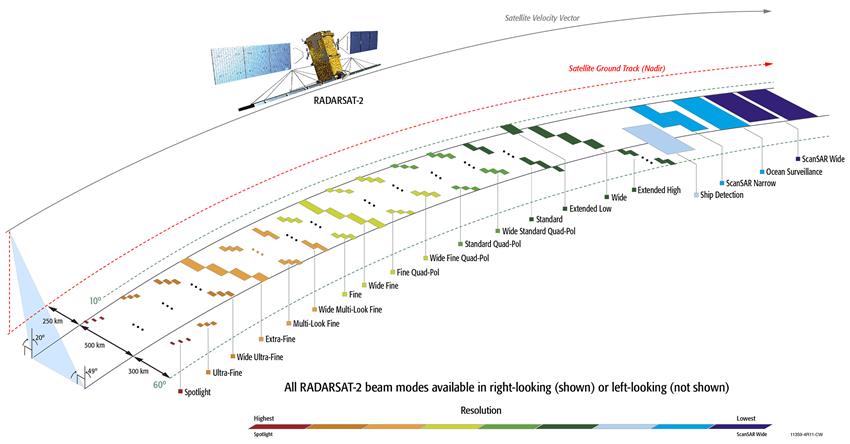
| Beam modes | Nominal swath width (km) | Maximal spatial resolution (m) |
|---|---|---|
| Selective Single or Dual Polarization Transmit H and/or V, receive H and/or V |
||
| Fine | 50 | 8 |
| Wide Fine | 150 | 8 |
| Standard | 100 | 25 |
| Wide | 150 | 25 |
| ScanSAR Narrow | 300 | 50 |
| ScanSAR Wide | 500 | 100 |
| Ocean Surveillance | 530 | Variable |
| Polarimetric Transmit H and V on alternate pulses / receive H and V on any pulse |
||
| Fine Quad-Pol | 25 | 12 |
| Wide Fine Quad-Pol | 50 | 12 |
| Standard Quad-Pol | 25 | 25 |
| Wide Standard Quad-Pol | 50 | 25 |
| Single Polarization HH Transmit H, receive H |
||
| Extended High | 75 | 25 |
| Extended Low | 170 | 60 |
| Selective Single Polarization Transmit H or V, receive H or V |
||
| Spotlight | 18 | 1 |
| Ultra-Fine | 20 | 3 |
| Wide Ultra-Fine | 50 | 3 |
| Extra-Fine | 125 | 5 |
| Multi-Look Fine | 50 | 8 |
| Wide Multi-Look Fine | 90 | 8 |
| Ship Detection | 450 | Variable |
RADARSAT-1
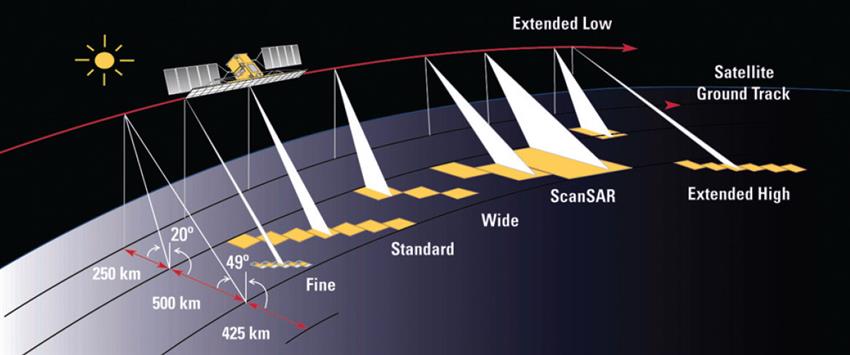
| Beam modes | Nominal swath width (km) |
Nominal resolution (m) |
|---|---|---|
| Fine | 45 | 8 |
| Standard | 100 | 30 |
| Wide | 150 | 30 |
| ScanSAR Narrow | 300 | 50 |
| ScanSAR Wide | 500 | 100 |
| Extended High | 75 | 18-27 |
| Extended Low | 170 | 30 |