
NEOSSat: observing asteroids, space debris and exoplanets

- Launch: February 25, 2013
- Status: Active
Canada's agile space telescope
NEOSSat is the world's first space telescope dedicated to detecting and tracking asteroids, comets, satellites and space debris. The suitcase-sized satellite orbits at an altitude of approximately 800 kilometres above Earth. It circles the globe every 100 minutes, scanning space near the Sun to pinpoint asteroids and comets that may someday pass close to Earth.
NEOSSat is sweeping the skies observing satellites and space debris as part of Canada's commitment to keeping space environment safe. It can also reveal the presence of exoplanets around distant stars using light intensity variation measurements.
NEOSSat applies industry-leading reaction wheels technology for which Canada has become known and has already demonstrated in our very successful Microvariability and Oscillations of Stars (MOST) satellite.
Tracking asteroids and comets
With NEOSSat, Canada is contributing to the international effort to catalogue near-Earth asteroids and comets.
Due to its lofty location, it is not limited by the day-night cycle, unaffected by weather or atmospheric conditions, and can operate 24/7. Therefore, it can look for near-Earth asteroids and comets that are difficult to spot using ground-based telescopes.
Comet C/2020-F3 (NEOWISE) animation processed from NEOSSat images taken on . (Credit: Canadian Space Agency [CSA])
Space debris
NEOSSat monitors orbiting space objects to help understand their behaviour and conduct research on techniques to reduce the risk of collisions. It is the first microsatellite used for this purpose. Unlike ground-based telescopes, NEOSSat is able to:
- accurately track space objects not visible from Canada
- collect data on emerging on-orbit situations
As part of Defence Research and Development Canada's (DRDC) Space Domain Awareness project, NEOSSat's High Earth Orbit Space Surveillance (HEOSS) mission enables scientists to perform a variety of experiments aimed at improving our understanding of both satellites and space debris. The information gathered by NEOSSat bolsters Canada's contribution to international efforts to maintain the safety of Canadian and international space assets.
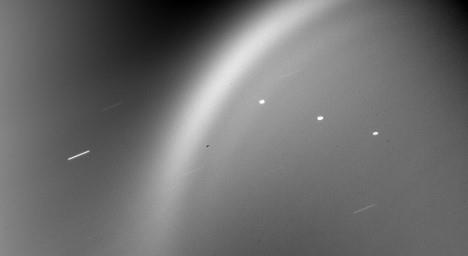
NEOSSat image of RCM satellites on , shortly after launch and before their final orbital phasing. (Credits: DRDC, CSA)
Monitoring planets around other stars
How to find exoplanets
Astronomers use NEOSSat to investigate subtle dimming of stars that reveals the presence of exoplanets as they pass in front of their star. NEOSSat helps confirm the discovery of these exoplanets and determine their orbital period, which complements the science done with larger ground and space telescopes, such as NASA's TESS mission. This advances our understanding of exoplanets that will continue to be studied by observatories such as the James Webb Space Telescope and Ariel, a European Space Agency mission.

An exoplanet is a planet that is outside our solar system. Exoplanets are found orbiting a star other than our Sun. In the same way that our solar system contains eight planets, other stars can have many exoplanets in orbit around them.
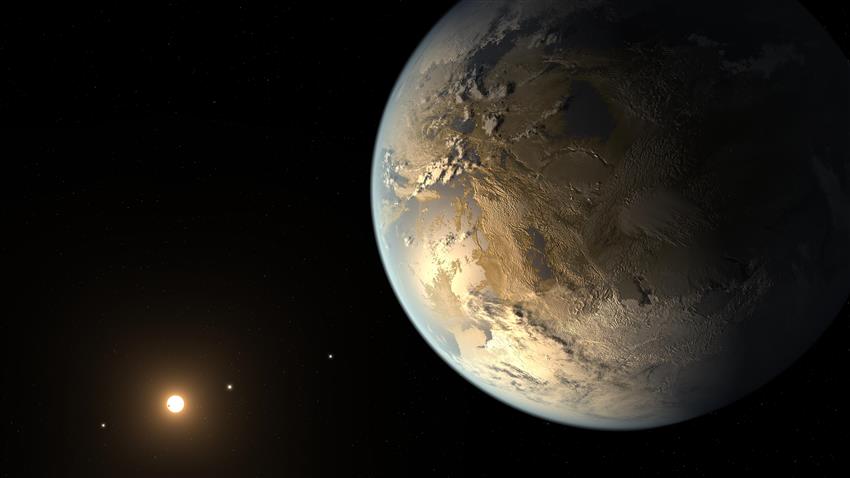
An artist's concept of exoplanet Kepler-186f. (Credit: NASA Ames/SETI Institute/JPL-Caltech)
Ongoing space astronomy research and open data
Astronomers across Canada are using NEOSSat to:
- confirm the existence of exoplanets and better understand them
- provide orbital data on near-Earth asteroids and passing comets
Since , we have provided Canadian astronomers with observation time on NEOSSat.
All astronomy data from NEOSSat is made available in accordance with Canada's Directive on Open Government. Images are downlinked, and transmitted immediately to our Open data and information Portal, and archived by the National Research Council Canada as part of the Canadian Astronomy Data Centre.
| Name of PI | Institution | GO cycle | Project description |
|---|---|---|---|
| Étienne Artigau | Université de Montréal | 1 |
|
| David D. Balam | National Research Council Canada/Dominion Astrophysical Observatory | 1, 2, 3, 4, 5, 6, 7, 8, 9, 10 |
|
| Aaron Boley | University of British Columbia | 2 |
|
| Emily Deibert | University of Toronto | 1 |
|
| Chris Fox | Western University | 1, 2, 3, 4, 5 |
|
| Brett Gladman | University of British Columbia | 1 |
|
| Samantha Lambier | Western University | 5, 6 |
|
| Chris Mann | Université de Montréal | 1, 2, 3, 4, 5, 6, 7, 8, 9, 10 |
|
| Jason Rowe | Bishop's University | 1, 2, 3, 4, 5 |
|
| Karun Thanjavur | University of Victoria | 6, 7 |
|
| Paul Wiegert | Western University | 1, 2, 4 |
|
| Aidan MacDougall | University of Waterloo | 7, 8 |
|
| Michael Lesko | University of Waterloo | 9, 10 |
|
| Stanimir Metchev | Western University | 9 |
|
Collaborators
NEOSSat is jointly funded by the CSA and DRDC. The satellite was built by Microsat Systems Canada Inc., with support from Spectral Applied Research and COM DEV International Ltd. (formerly Routes AstroEngineering). The CSA leads NEOSSat's space astronomy mission, and DRDC is responsible for the HEOSS space surveillance mission.
NEOSSat is used to observe near-Earth asteroids, comets, satellites and space debris, and to reveal the presence of exoplanets. (Credit: CSA)